Statistics Korea May Industrial Activity Trends
[Sejong=Asia Economy reporters Kim Hyunjung and Joo Sangdon] As the novel coronavirus disease (COVID-19) spreads worldwide, exports and manufacturing continue to slump, leaving the overall domestic economy stuck in a prolonged recession phase. Although the government's emergency disaster relief fund and other policy measures have barely kept domestic demand alive, it is difficult to expect this to continue.
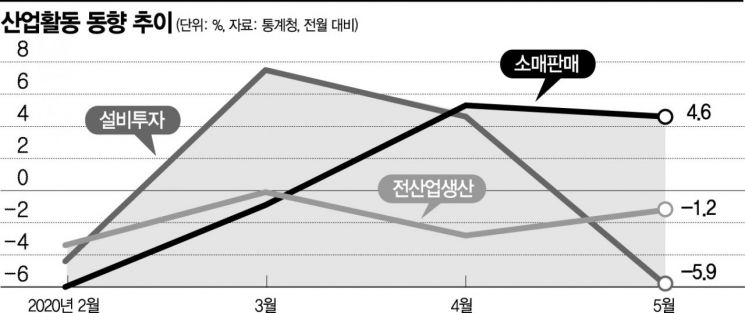
According to the 'May Industrial Activity Trends' released by Statistics Korea on the 30th, industrial production last month decreased for the fifth consecutive month compared to the previous month, and investment also shrank at the largest rate in four months. The manufacturing sector lost momentum due to the impact of the global COVID-19 spread, which hit exports.
◆ Production, facilities, and construction indicators all retreat = Last month, total industrial production fell 1.2% month-on-month, marking the fifth consecutive month of decline. Compared to the same month last year, it decreased by 5.6%. Despite a 2.3% increase in the service sector last month, the significant decline in mining and manufacturing production (-6.7%) had a major impact. Mining and manufacturing production was at the same level as April (-6.7%), which was the largest drop since December 2008 (-10.5%). Although semiconductor (10.8%) and other transportation equipment (3.1%) production increased due to rising demand for servers and PCs, exports conditions worsened, causing sharp declines in automobiles (-21.4%) and machinery equipment (-12.9%).
The average operating rate of manufacturing (63.6%) also dropped 4.6 percentage points from the previous month, reaching its lowest level in 11 years and 4 months since January 2009 (6.8%). The inventory ratio of finished goods (128.6%) rose 8.6 percentage points month-on-month, marking the highest level since August 1998 (133.2%).
Facility investment fell 5.9% from the previous month, turning downward and showing the largest decline in four months since January this year (6.8%). This was due to reduced investment in transportation equipment such as ships (-16.1%) and machinery such as precision instruments (-1.7%). Statistics Korea analyzed that this was due to normal fluctuations rather than the impact of COVID-19. Domestic machinery orders decreased by 12.6% year-on-year, declining in both private sectors such as construction (-12.9%) and public sectors such as electric power (-6.8%). Both civil engineering (-8.5%) and building (-2.4%) construction decreased, causing construction output to fall 4.3% month-on-month. The coincident index of economic indicators, which reflects the overall economic situation, dropped 0.8 points from the previous month to 96.5, marking the lowest level in 21 years and 4 months since January 1999 (96.5), right after the foreign exchange crisis.
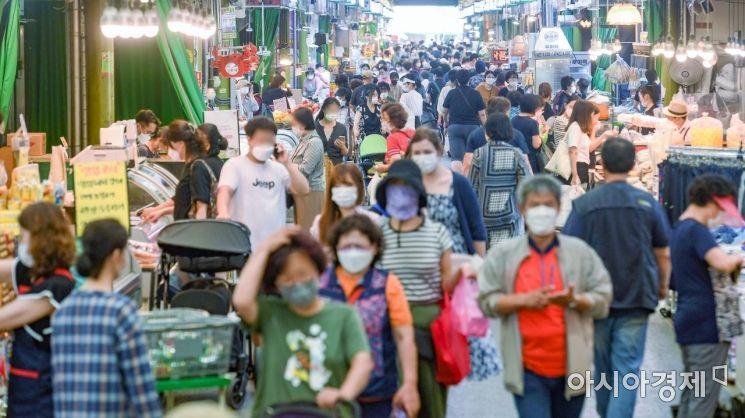 On the 26th, when the discount event "Korea Together Sale," planned to overcome the economic crisis caused by COVID-19 and promote consumption, began, Mangwon Market in Seoul was bustling with citizens. This Together Sale, in which all economic entities including traditional markets, neighborhood supermarkets, department stores, and large marts participate with gift certificate giveaways and discount events, will be held for 17 days until the 12th of next month. Photo by Kim Hyun-min kimhyun81@
◆ 'Disaster relief fund effect' kept consumption alive = On the other hand, domestic demand is recovering, returning to pre-COVID-19 levels. Statistics Korea evaluated that this was due to a combination of the effect of the 14.3 trillion won emergency disaster relief fund, which the government began distributing last month, and the transition to everyday quarantine measures following a decrease in COVID-19 cases.
Retail sales increased 4.6% month-on-month, rising across all sectors including durable goods such as passenger cars (7.6%), semi-durable goods such as clothing (10.9%), and non-durable goods such as vehicle fuel (0.7%), partly due to the impact of individual consumption tax cuts. In particular, sales of durable goods like passenger cars increased 13.9% year-on-year, driving the overall growth trend (1.7%). By retail type, large discount stores (-10.6%) and duty-free shops (-0.5%) declined, but specialty stores (10.5%), passenger car and fuel retailers (7.7%), non-store retailers (4.9%), department stores (4.4%), supermarkets and general merchandise stores (2.2%), and convenience stores (3.7%) increased. The recovery in consumption is also reflected in service sector production, with all industries increasing production in line with demand, including accommodation and food services (14.4%), arts, sports, and leisure (10.0%), associations, repair, and personal services (9.5%), wholesale and retail trade (3.7%), transportation and warehousing (1.5%), and education (1.5%).
A similar trend appears in the 'June 2020 Business Survey Index (BSI) and Economic Sentiment Index (ESI)' released by the Bank of Korea on the same day. The manufacturing sales BSI for June was 53, up 5 points from the previous month. Among sales BSIs, domestic sales (+6 points) rose more than export BSI (+2 points), confirming that domestic sales of export companies improved.
Regarding this, Ahn Hyungjun, Director of Economic Statistics and Trends at Statistics Korea, diagnosed, "Considering the significant increase in sales at specialty stores such as furniture and eyeglasses as well as accommodation and food services, it can be seen that the disaster relief fund had an effect on consumption recovery." However, he added that whether the consumption recovery trend can be maintained in the future is "unknown."
© The Asia Business Daily(www.asiae.co.kr). All rights reserved.
![Clutching a Stolen Dior Bag, Saying "I Hate Being Poor but Real"... The Grotesque Con of a "Human Knockoff" [Slate]](https://cwcontent.asiae.co.kr/asiaresize/183/2026021902243444107_1771435474.jpg)












