May Industrial Trends
Manufacturing Inventory Ratio at 128.6%... Highest in 21 Years and 9 Months
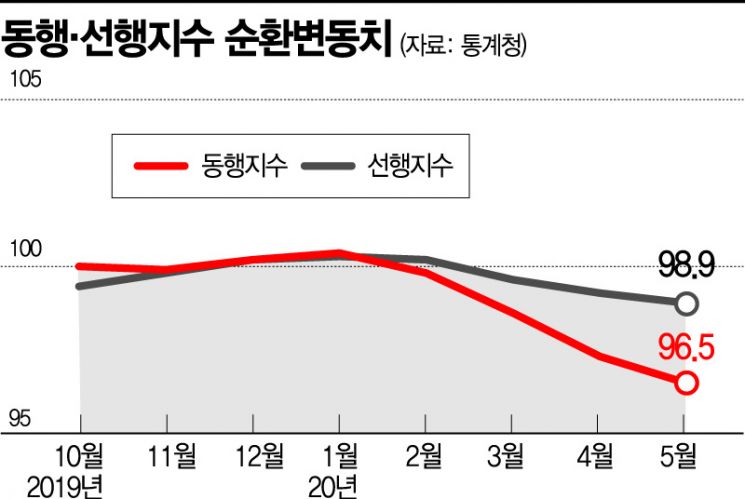
[Sejong=Asia Economy Reporters Joo Sang-don and Kim Hyun-jung] The coincident index cyclical component, which diagnoses the current economic situation, fell to the level seen right after the International Monetary Fund (IMF) foreign exchange crisis (January 1999), marking the worst performance in 21 years and 4 months. The manufacturing inventory ratio, which is the ratio of inventory to shipments, surged to its highest level since August 1998 (133.2).
According to the May industrial activity trends released by Statistics Korea on the 30th, total industrial production (seasonally adjusted, excluding agriculture, forestry, and fisheries) in May decreased by 1.2% compared to the previous month, showing a decline for five consecutive months. Mining and manufacturing production fell by 6.7%. The significant impact was due to a 6.9% decrease in manufacturing production caused by export setbacks amid the spread of the novel coronavirus disease (COVID-19). In particular, automobile production plummeted by 21.4%.
The average operating rate of manufacturing also plunged, dropping to 63.6% in May. This is the lowest level in 11 years and 4 months since January 2009 (62.8%). Although manufacturing production decreased, shipments declined even more, causing the inventory ratio to rise by 8.6 percentage points from the previous month to 128.6%, the highest in 21 years and 9 months. Investment also failed to escape the downward trend. Facility investment decreased by 5.9% compared to the previous month, domestic machinery orders fell by 12.6%, and construction performance dropped by 4.3%. On the other hand, retail sales in May increased by 4.6% month-on-month, boosted by the effect of emergency disaster relief funds.
The coincident index cyclical component fell by 0.8 points from the previous month to 96.5. This is the lowest level since January 1999 and marks a decline for four consecutive months since February this year. The leading index cyclical component, which forecasts future economic phases, also decreased by 0.3 points to 98.9. It too has declined for four consecutive months, recording the lowest level in nine months since August last year (98.9).
An Hyung-jun, Director of Economic Statistics Trends at Statistics Korea, explained, "Since the coincident and leading index cyclical components are used to observe trends, we cannot say that the situation is 'worse than during the IMF crisis.' However, the fact that these numbers are very low means that our economy has deviated significantly from its long-term growth trend, and the magnitude of the decline is a shock comparable to the 2008 financial crisis."
© The Asia Business Daily(www.asiae.co.kr). All rights reserved.

















