The so-called 'prosecutor-media collusion' case, in which the prosecution and the media allegedly colluded to threaten a specific individual for political purposes, is deteriorating into a power struggle between ministries and groups, regardless of its original nature.
The Ministry of Justice, attempting to control the prosecution, and the resisting prosecution have been openly displaying their conflict, and now even within the prosecution, a chaotic power struggle is emerging. The unprecedented overlapping convening of external advisory bodies, orders, and insubordination evoke an image of a 'free-for-all'.
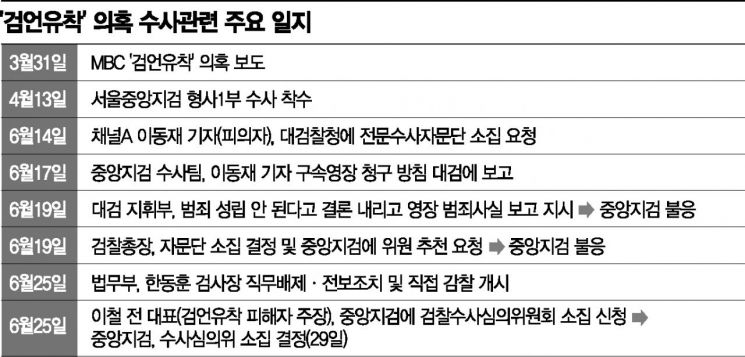
◆After a 'pre-decided' consultation... likely to be used to justify themselves= According to the prosecution on the 30th, the Supreme Prosecutors' Office completed the selection of members for the advisory panel convened by Prosecutor General Yoon Seok-yeol the day before.
According to the guidelines, candidates should also be recommended by the investigation team, but it is reported that the Central District Prosecutors' Office, to which the investigation team belongs, did not comply. With the advisory panel now formed, a meeting is expected to be held by early next month at the latest.
The advisory panel will deliberate on whether to indict Channel A reporter Lee Dong-jae and Prosecutor Han Dong-hoon, suspects in the prosecutor-media collusion case, and whether to request arrest warrants.
Meanwhile, the Central District Prosecutors' Office is also pushing to form a similar external advisory panel. The Central District Prosecutors' Office Citizens' Committee yesterday approved the referral of the prosecution investigation review committee requested by Lee Cheol, former CEO of Value Investment Korea, who was identified as a victim of threats.
This body, which previously reviewed the indictment of Samsung Electronics Vice Chairman Lee Jae-yong, is also expected to convene after the Supreme Prosecutors' Office advisory panel meeting.
While the Central District Prosecutors' Office's Criminal Division 1 (Chief Prosecutor Jeong Jin-ung) has already conducted a significant portion of the investigation into the related allegations, two advisory bodies involving external experts will simultaneously review the 'appropriateness of indictment.'
The problem is that the two advisory bodies are likely to reach different conclusions.
It is well known that the Central District Prosecutors' Office investigation team and the Supreme Prosecutors' Office hold opposing positions. The investigation team judged that reporter Lee and Prosecutor Han threatened former CEO Lee to obtain investigative leads, which constitutes an 'attempted coercion' offense.
Accordingly, they decided to request an arrest warrant for reporter Lee. However, five members of the Supreme Prosecutors' Office's Criminal Division, including the section chief and staff who reviewed the case, reportedly reached a unanimous conclusion that it is difficult to establish a crime.
Therefore, the advisory panel convened by Prosecutor General Yoon is highly likely to reach the same conclusion as the Supreme Prosecutors' Office. On the other hand, the review committee is expected to vote in favor of 'indictment,' believing it is better to let the court decide through trial. Some view this as an attempt by both the Supreme Prosecutors' Office and the Central District Prosecutors' Office investigation team to steer the outcome toward their desired conclusions.
◆Supreme Prosecutors' Office vs. Ministry of Justice and Central District Prosecutors' Office confrontation= Another reason this case draws attention is that Prosecutor Han, a close aide to Prosecutor General Yoon, is involved.
For this reason, some in the ruling party have from the early stages framed the incident as exposing the prosecution's systemic corruption and pressured Prosecutor General Yoon to resign under the accusation that he is obstructing the investigation to protect his aide.
In particular, doubts about the purity of the tip-off arose when it was revealed that the whistleblower, Mr. Ji, who represented former CEO Lee, had contact with ruling party figures such as Representative Choi Kang-wook of the Open Democratic Party and former Ministry of Justice Human Rights Bureau Chief Hwang Hee-seok, and that MBC reporters accompanied him to meet reporter Lee. Currently, Mr. Ji has been accused of obstructing reporter Lee's work.
Concerns have also been raised within the prosecution that Central District Prosecutor Lee Seong-yoon, perceived as pro-government, is recklessly pushing forward this investigation, which could damage Prosecutor General Yoon.
This view gained strength as the Central District Prosecutors' Office reportedly did not respond to the Supreme Prosecutors' Office's request to recommend advisory panel candidates and disobeyed orders to send the criminal facts for the arrest warrant.
Under the 'principle of unity of prosecutors' and the hierarchical order of command and obedience, such 'insubordination' was almost unimaginable within the prosecution.
Amid this, on the 25th, Minister of Justice Choo Mi-ae carried out a demotion transfer of Prosecutor Han and ordered a direct inspection by the Ministry of Justice.
Although there was controversy over the effectiveness of the inspection given the ongoing investigation, it is clear that this move has empowered Prosecutor Lee of the Central District Prosecutors' Office, who is currently in conflict with Prosecutor General Yoon. Conversely, it can also be interpreted that Prosecutor Lee is aligning with Minister Choo in the clash between her and Prosecutor General Yoon.
© The Asia Business Daily(www.asiae.co.kr). All rights reserved.

















