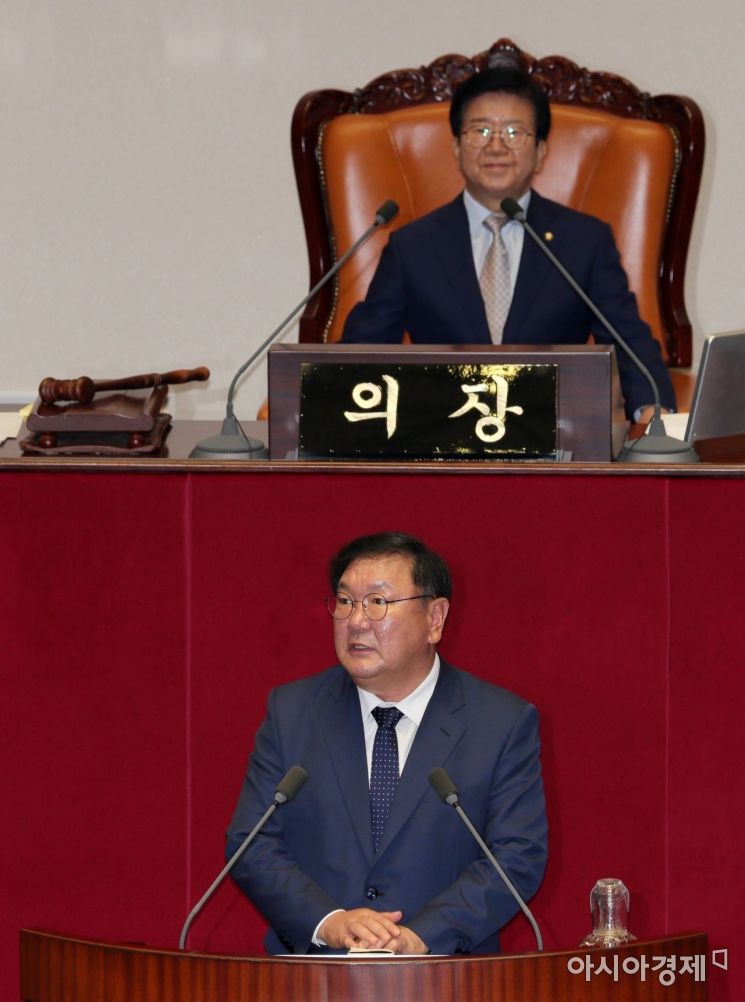
 Kim Tae-nyeon, floor leader of the Democratic Party of Korea, who was elected as the chairman of the National Assembly Steering Committee, is giving a greeting at the plenary session of the National Assembly on the 29th. Photo by Yoon Dong-joo doso7@
[Asia Economy Reporter Park Cheol-eung] The Democratic Party of Korea, having unilaterally completed the National Assembly's organizational structure, has announced another strong move to launch the High-ranking Officials' Crime Investigation Office (HCIO). The key issue is whether to completely remove the opposition party's veto power over the HCIO chief recommendation, as stipulated in the HCIO Act. The Democratic Party's stance is to push forward if the United Future Party continues to refuse to acknowledge the HCIO Act, labeling it as a 'rush passage.'
Baek Hye-ryun, the ruling party's secretary of the Legislation and Judiciary Committee, appeared on KBS Radio's "Kim Kyung-rae's Strongest Current Affairs" on the 30th and said, "The United Future Party is trying to change the opposition party's recommended members to be appointed by the ruling party in the rules I proposed for the operation of the HCIO Chief Recommendation Committee, but that is absolutely impossible." She added, "The mother law, the HCIO Act, grants the opposition party veto power, and it is common sense that rules cannot override the law. Without the cooperation of the United Future Party, the normal launch of the HCIO will become difficult."
She continued, "Ultimately, if the United Future Party truly does not cooperate, there will be no choice but to amend the law." The previous day, Democratic Party leader Lee Hae-chan stated at the Supreme Council meeting, "The United Future Party must fulfill its obligations as prescribed by law. If the United Future Party obstructs the launch of the HCIO, the Democratic Party will prepare extraordinary measures, including amendments to the HCIO Act."
The proposed rules by Representative Baek include provisions allowing the Speaker of the National Assembly to request the negotiation groups to recommend HCIO chief recommendation committee members within a set deadline, and if no recommendation is made by the deadline, the Speaker can designate a negotiation group to request recommendations. The United Future Party interprets this as allowing the Democratic Party to fill the two opposition seats if the United Future Party refuses to recommend members. However, as Baek pointed out, the HCIO Act requires the opposition party to recommend two of the seven HCIO chief recommendation committee members and mandates obtaining the consent of six members. Without the United Future Party's participation, there is no way under the current law.
United Future Party floor leader Joo Ho-young said to reporters the previous day, "I don't know if there is a way to launch it unilaterally," reflecting this background. On the same day, Floor Leader Joo also said, "They created the HCIO through a fast-track process that did not meet the requirements, and now, because there are so many flaws and unexpected outcomes, they are threatening to change even this law."
The United Future Party does not acknowledge the passage of the HCIO Act at the end of last year as anything other than a 'rush passage' and has filed a constitutional complaint seeking a ruling on its unconstitutionality. Moreover, with the breakdown of negotiations on the National Assembly's organization and the United Future Party's declaration of a boycott, the launch of the HCIO by the legal deadline of the 15th of next month has become unlikely. Leader Lee Hae-chan's "extraordinary measures" appear to be a declaration of determination to break through this reality. Options under consideration include removing the opposition party's right to recommend HCIO chief candidates or granting this authority to another opposition party instead of the United Future Party. Of course, if this is forced, the distance with the United Future Party will widen further, and cooperation will be out of the question. Even within the Democratic Party, positions and specific plans seem not yet fully formed.
Representative Baek said, "Discussions have not yet become concrete," and mentioned, "There are several legally examinable options." There were also remarks suggesting that the HCIO Act might not be amended, showing an unsettled stance. Kim Young-jin, the Democratic Party's deputy floor leader, appeared on MBC Radio's "Kim Jong-bae's Focus" the same day and said, "The Democratic Party currently has no plans to amend the HCIO Act," adding, "I have never seen a case where a law was amended without being implemented even once after being enacted. If problems arise while implementing the HCIO Act, amendments can be discussed, but talking about amendments during the ongoing process is inappropriate. It is necessary for the ruling and opposition parties to put their heads together and find a solution."
© The Asia Business Daily(www.asiae.co.kr). All rights reserved.

















