[Asia Economy Reporter Buaeri] It has been three months since the van-hailing service 'Tada Basic' stopped operating. Among the approximately 10,000 Tada drivers, one out of every four has moved to platform taxis such as Kakao Mobility. Most of these re-employed drivers prefer platform taxis over regular taxis because they have no prior experience with "haehoe yeongeop" (cruising for passengers). This is notable as the driver infrastructure is expanding around platform taxis since Tada ceased operations on April 11.
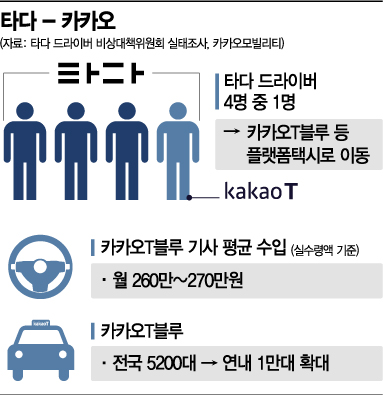
◆One in four Tada drivers moved to Kakao, etc. = According to the Tada Drivers Emergency Committee on the 30th, a recent "Former Tada Driver Status Survey" conducted among members showed that 26.8% of respondents are currently working for platform taxis such as Kakao Mobility’s franchise taxi 'Kakao T Blue.' Most cited the ability to expect a fixed income and less burden from haehoe yeongeop (the act of cruising the streets to find passengers) as reasons for re-employment. Ninety-eight people participated in this survey. A committee official stated, "Although some have not yet been re-employed, many are preparing for taxi license exams to move into platform taxis." This indicates that some Tada drivers are entering the platform taxi industry following the end of Tada’s service.
Jo Jihoon (48, pseudonym), who worked as a Tada driver for one year, recently started working as a Kakao T Blue driver. After quitting Tada, he obtained a taxi license to work as a Kakao T Blue driver. Jo said, "Tada drivers without taxi experience feel burdened by cash deposits and haehoe yeongeop. Kakao T Blue’s call receiving system is similar to Tada’s, so the entry barrier felt lower."
◆Preference for platform taxis without haehoe yeongeop burden = Kakao T Blue is relatively free from competition to attract passengers. Unlike regular taxis that compete to receive calls, Kakao T Blue automatically assigns passengers from the company. Since passengers are steadily assigned, a fixed income is generated after driving for a certain amount of time. Jo reported, "I earn about 2.6 to 2.7 million KRW per month."
Recently, as Kakao Mobility expanded Kakao T Blue operations, employment opportunities have increased. Kakao Mobility plans to increase the number of Kakao T Blue vehicles nationwide from the current 5,200 to 10,000 this year. As more taxi corporations sign franchise contracts with Kakao Mobility, recruitment of taxi drivers is actively underway. Another platform taxi, Macaron Taxi, currently has 3,600 vehicles in Seoul and 4,000 in other regions, totaling 7,600 vehicles. They plan to increase the fleet to 20,000 vehicles within this year.
According to the committee, former Tada drivers have recently entered the disabled call taxi sector. Disabled call taxis are operated by local governments with budgets to assist mobility-impaired passengers. In Seoul, drivers are selected through written and interview exams conducted by the Seoul Facilities Corporation. Disabled call taxis also operate on a system similar to Tada, moving according to assigned calls, and offer the advantage of a fixed salary.
Meanwhile, the Tada Emergency Committee is preparing a second civil lawsuit against VCNC, the operator of Tada, and SoCar, Tada’s parent company, regarding recognition of worker status. Earlier, in April, the committee filed criminal complaints against former SoCar CEO Lee Jae-woong and current CEO Park Jae-wook for violations of the Dispatch Act and Labor Standards Act, and proceeded with the first civil lawsuit.
© The Asia Business Daily(www.asiae.co.kr). All rights reserved.

















