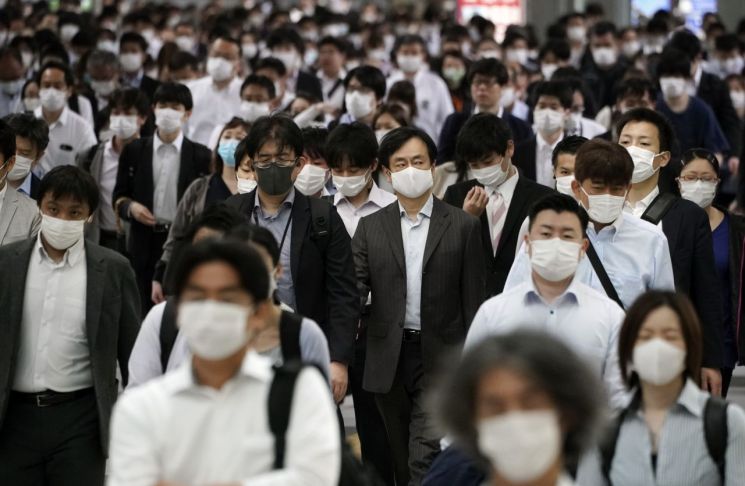
[Asia Economy Reporter Jeong Hyunjin] A survey revealed that Japanese people tend to hold individuals more responsible for being infected with the novel coronavirus (COVID-19) compared to people from other countries, viewing it as a 'personal issue.'
According to the Yomiuri Shimbun on the 29th, a research team led by Professor Miura Asako of Osaka University (Psychology) conducted an online survey from March to April targeting 400 to 500 people each in five countries: Japan, the United States, the United Kingdom, Italy, and China, asking about responsibility for COVID-19 infection.
In this survey, when asked "Do you think COVID-19 infection is a result of one's own fault?" 11.5% of Japanese respondents answered "strongly agree," "somewhat agree," or "agree." This means about one in ten Japanese people view COVID-19 infection as the individual's fault.
Looking at responses from other countries, the percentage of those who answered "yes" was 1% in the United States, 1.49% in the United Kingdom, 2.51% in Italy, and 4.83% in China. For the same question, those who answered "do not think so at all" were 29.5% in Japan, while the other four countries recorded rates in the 60-70% range.
Professor Miura stated, "In Japan, not limited to COVID-19, there is a strong tendency to excessively blame people who are clearly 'victims.'" He cited as an example the culture of reproaching women who are victims of random crimes by saying "it is bad to be out at night." He pointed out that this mindset among Japanese people may have led to the belief that COVID-19 infection is also the individual's responsibility.
Meanwhile, in Tokyo, Japan, the number of daily confirmed COVID-19 cases has reached a record high for two consecutive days since the emergency declaration was lifted last month. In Tokyo alone, 60 new cases were reported, surpassing the previous day's figure of 57 on the 27th. As a result, the total number of confirmed COVID-19 cases in Japan stands at 19,234, with 985 deaths.
Regarding this, Chief Cabinet Secretary Suga Yoshihide explained, "Although continuous new infections are being confirmed mainly in Tokyo, this also includes results from actively conducting tests regardless of the presence or absence of symptoms." He added that it is not yet a situation to immediately declare a state of emergency again, saying, "We will monitor the local infection situation while striving to prevent the spread and balance social and economic activities."
© The Asia Business Daily(www.asiae.co.kr). All rights reserved.

















