3rd Revised Estimate Approval and National Assembly Policy Speech... Continued Small-Scale COVID-19 Cluster Infections
Economic Impact of COVID-19... Severe Job Market Situation
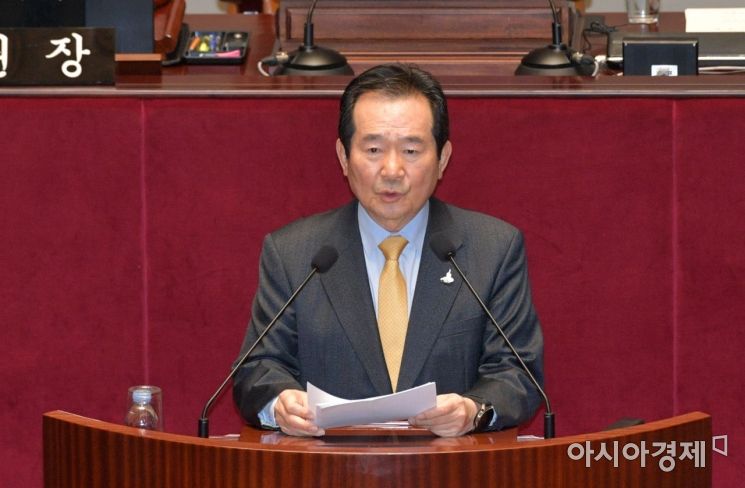 Prime Minister Chung Sye-kyun, who attended the National Assembly Budget and Accounts Committee plenary session on the 28th to review the second supplementary budget bill for the emergency disaster relief fund payment, is giving a proposal explanation. Photo by Yoon Dong-ju doso7@
[Asia Economy Reporter Lim Cheol-young] Prime Minister Chung Sye-kyun urged the passage of the second supplementary budget (supplementary budget) worth 35.3 trillion won to overcome the economic recession caused by the novel coronavirus infection (COVID-19). This is the third supplementary budget this year and the first in the 21st National Assembly.
On the 29th, Prime Minister Chung attended the plenary session held at 2 p.m. in the National Assembly plenary hall and emphasized the need for prompt passage of the supplementary budget, stating that recent small-scale group infections of COVID-19 continue in the metropolitan area and infection cases have appeared in other regions such as the Chungcheong area, causing considerable economic impact.
The government prepared a supplementary budget worth a total of 35.3 trillion won as a fiscal policy to support post-COVID measures such as the Korean New Deal and submitted it on the 4th. The supplementary budget consists of government expenditures of 23.9 trillion won and 11.4 trillion won to cover the shortfall in revenue.
Prime Minister Chung said, "Thanks to the successful K-quarantine so far, we have endured difficulties without a complete lockdown, but quarantine measures alone cannot restore the disrupted daily lives of the people," adding, "The service industry is shrinking and consumption is decreasing, increasing difficulties for small business owners, and this crisis is spreading to manufacturing."
Due to the global economic recession caused by COVID-19, exports in April and May sharply declined by more than 20% for two consecutive months. Prime Minister Chung explained, "Although many institutions including the IMF have given relatively positive evaluations of our economy, which has implemented exemplary quarantine policies, it is also forecasted to experience negative growth for the first time since the foreign exchange crisis," adding, "Export companies' performance is deteriorating, and related industries such as aviation and automobiles are facing liquidity crises."
He also revealed that the job situation is serious. He said, "As the economic contraction spreads to production, the employment situation has become more difficult," adding, "Especially, the decline is clearly seen in vulnerable jobs such as temporary and daily workers, and the safety net for existing socially vulnerable groups is showing its limits."
Therefore, he emphasized that fiscal resources must be actively injected. The government has prepared measures worth 27.7 billion won so far to overcome COVID-19 damage and stabilize the livelihood economy. He also added that our society is reorganizing from a non-face-to-face society to an on-tact society, and proactive transformation is necessary.
Prime Minister Chung said, "For fiscal measures to be effective, fiscal support must be timely," adding, "Moreover, preparations for the future regarding economic and social structural changes after COVID-19 must begin immediately."
He also expressed his will to promote the 'Korean New Deal,' which has digital New Deal and green New Deal as two pillars on the foundation of strengthening the employment safety net, as a future national development strategy to transition to a leading economy.
Prime Minister Chung explained, "We will turn this unprecedented crisis into an opportunity to leap forward as a global leading country in economic and social structural changes caused by COVID-19," adding, "We have promoted intensive expenditure restructuring to maximize the government's fiscal capacity, thoroughly reviewed projects of all ministries, identified projects difficult to execute due to COVID-19, and readjusted priorities by project."
Regarding concerns about the rising national debt ratio, he pointed out that countries such as the United States, Japan, and Germany are actively injecting fiscal resources despite having higher debt ratios than Korea.
Prime Minister Chung emphasized, "By injecting sufficient fiscal resources timely so that fiscal policy acts as a primer, we can establish a virtuous cycle of 'crisis overcoming - growth driving - fiscal recovery,'" adding, "Through this, the Korean economy currently in crisis must achieve a V-shaped rebound."
Meanwhile, he also requested the prompt passage of amendments such as the Government Organization Act for the promotion of the Korea Disease Control and Prevention Agency to a bureau, the National Assembly Act for the launch of the Corruption Investigation Office for High-ranking Officials in July, and the Personnel Hearing Act, in addition to the third supplementary budget proposal.
© The Asia Business Daily(www.asiae.co.kr). All rights reserved.

















