Statistics Korea, Population Movement in the Seoul Metropolitan Area over the Past 20 Years and Future Population Projections
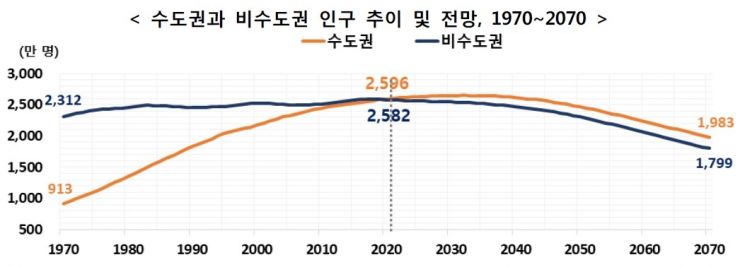
[Sejong=Asia Economy Reporter Joo Sang-don] This year, for the first time in history, the population of the Seoul Metropolitan Area, including Seoul, Gyeonggi, and Incheon, is expected to surpass the non-metropolitan population. Due to reasons such as employment, education, and housing, there is a net inflow to the metropolitan area, and for the same reasons, the movement of single-person households to the metropolitan area is increasing.
On the 29th, Statistics Korea announced these details in the report titled "Population Movement in the Seoul Metropolitan Area over the Past 20 Years and Future Population Projections."
According to the report, the metropolitan population will exceed the non-metropolitan population for the first time this year. Based on the 2017 Future Population Special Projection, the metropolitan population in 2020 is projected to be 25.96 million, while the non-metropolitan population will be 25.82 million, making the metropolitan population 140,000 more.
The metropolitan population increased by 184.4% (16.83 million) over the past 50 years, from 9.13 million in 1970 to 25.96 million in 2020, and is expected to peak at 26.5 million in 2032 before declining. By 2070, it is projected to be 19.83 million, a decrease of 23.6% (6.13 million) compared to 2020 over the next 50 years.
The non-metropolitan population increased by 11.7% (2.71 million) over the past 50 years, from 23.12 million in 1970 to a peak of 25.93 million in 2018, then decreased slightly to 25.82 million in 2020. By 2070, it is expected to decline to 17.99 million, a decrease of 30.3% (7.83 million) compared to 2020 over the next 50 years.
Over the past 20 years, movement to the metropolitan area has shown net inflow due to reasons such as employment, education, and housing, while net outflow occurred due to family and natural environment reasons. For employment reasons, the net inflow has been decreasing since 2011, with net outflow in 2014 and 2015, but it switched back to net inflow from 2016, maintaining an increasing trend. Single-person movement to the metropolitan area has also consistently shown net inflow due to employment, education, and housing reasons, and net outflow due to family and natural environment reasons.
Single-person movement to the metropolitan area continues to show net inflow, with the largest net inflow among people in their 20s.
Since 2001, single-person movement to the metropolitan area has recorded net inflow. The scale peaked in 2002 and decreased until 2015, then shifted to an increasing trend from 2016. Teenagers and people in their 20s have consistently shown net inflow in single-person movement, while for groups of two or more, net outflow was observed from 2011 until switching to net inflow in 2018. Conversely, for those aged 40 and above, both single-person and group movements have shown continuous net outflow since 2008.
© The Asia Business Daily(www.asiae.co.kr). All rights reserved.

















