"If It's the Same Regulation, I'd Rather Live in Seoul than Gyeonggi-do"
As Gyeonggi-do Tightens Regulations, Residents Feel Seoul's Regulations Are Relatively Looser
Analysis Suggests Jeonse Demand Has Shifted to Purchase Demand Amid Jeonse Shortage
#Kim, living in a 41㎡ Jugong apartment in Sanggye-dong, Nowon-gu, Seoul, decided to move. This was because his commute became longer after his workplace moved to Yeouido. Since the Seoul small-to-medium-sized apartment prices have been rising following the December 16, 2020 measures, he put his house on the market in March for 380 million KRW. Although the price was 30 to 40 million KRW higher than the market price, and inquiries were scarce for a while, recently there have been many inquiries. Kim eventually made a preliminary contract to sell the house for 400 million KRW, which is 20 million KRW higher than his original asking price.
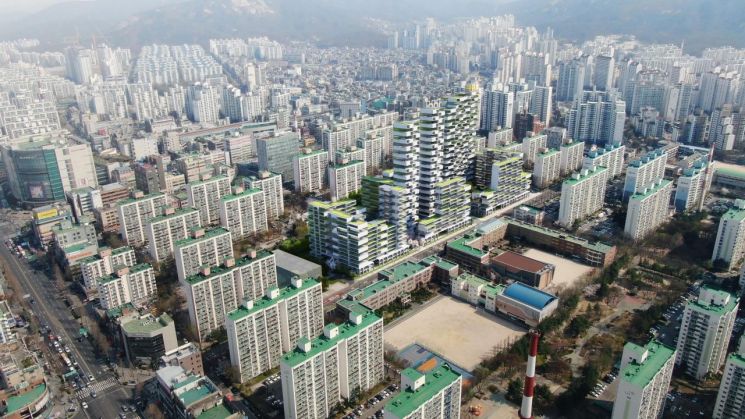
Since the June 17 real estate measures, housing prices in the 'Geumgwan-gu (Geumcheon, Gwanak, Guro) and Nodogang (Nowon, Dobong, Gangbuk)' areas, where low-to-mid-priced apartments are concentrated in Seoul, have been rising sharply. As many areas in the Seoul metropolitan area such as Suwon, Gunpo, and Incheon were designated as speculative overheated districts, an 'inverse balloon effect' has occurred, with investment demand shifting to higher-tier areas. There is also analysis that many buyers who failed to find rental housing in Seoul have turned to purchasing in these areas.
According to the real estate industry on the 28th, record-high prices continue in the Geumgwan-gu and Nodogang areas of Seoul. These are all areas where apartments priced below 900 million KRW are concentrated. In Gwanak-gu, on the 18th, Yesung Grand Felice in Namhyeon-dong, with an exclusive area of 83㎡, was traded at 873 million KRW, setting a new record. The Gwanak Park Prugio in Bongcheon-dong, 84㎡, also broke its record by being traded at 845 million KRW on the 17th. A real estate agent in Bongcheon-dong said, "Although the actual transaction has not yet been registered, it was traded at 850 million KRW a few days ago," adding, "Prices are being called up to 930 million KRW."
In Guro-gu, on the 19th, Taeyoung Town in Guro-dong, 59㎡, was sold at the highest price ever of 848 million KRW. This is nearly a 70 million KRW increase in just two months from 780 million KRW in April. Currently, many small units priced below 900 million KRW in this complex have been sold out. Additionally, in Nowon-gu, on the 20th, Suraksan Belliche in Sanggye-dong, 114㎡, was traded at a record high. The Jugong 5th complex in Junggye-dong, which was traded at 889 million KRW in March, now has asking prices up to 930 million KRW.
The rising trend in housing prices is also reflected in official government survey indicators. According to the weekly apartment trend report by the Korea Real Estate Board, in the fourth week of June, the price increase rates for Geumcheon (0.04→0.07), Gwanak (0.05→0.06), Nowon (0.05→0.08), and Gangbuk (0.06→0.07) all increased compared to the previous week. Guro (0.11→0.11) and Dobong (0.05→0.05) maintained the same rate as the previous week but are also rising sharply.
The June 17 measures reignited the housing prices in Geumgwan-gu and Nodogang, which had been taking a breather with price declines or stagnation since last month. When areas such as Suwon, Anyang, Guri, Gunpo, Yongin Suji and Giheung, and Incheon Yeonsu, Namdong, and Seo-gu, which had seen a rapid inflow of idle funds due to the December 16 measures' balloon effect, were designated as speculative overheated districts, demand shifted to this area with good location but under the same regulations. This is a kind of inverse balloon effect.
Jang Jaehyun, head of Real Today, explained, "Since most of the metropolitan area has been designated as regulated areas, some people decided to go to Seoul instead." Yoon Jihae, a researcher at Real Estate 114, also said, "The strengthening of regulations in Gyeonggi-do and Incheon creates an illusion of weakened regulations in Seoul," adding, "Among these, demand has turned to low-to-mid-priced apartments with relatively weaker loan regulations, causing housing prices in Geumgwan-gu and Nodogang to continue rising."
There is also analysis that real demanders who failed to find rental housing in Seoul have shifted to purchasing in these areas. Kim Hakryul, director of Smart Tube Real Estate Research Institute, said, "For rental housing to be available, either new apartments must be supplied or existing properties must be rented out, but both are blocked," adding, "People who could not find rental housing in Mayongseong (Mapo, Yongsan, Seongdong) have turned to buying in Geumgwan-gu and Nodogang, where price differences are minimal."
© The Asia Business Daily(www.asiae.co.kr). All rights reserved.
![Clutching a Stolen Dior Bag, Saying "I Hate Being Poor but Real"... The Grotesque Con of a "Human Knockoff" [Slate]](https://cwcontent.asiae.co.kr/asiaresize/183/2026021902243444107_1771435474.jpg)
















