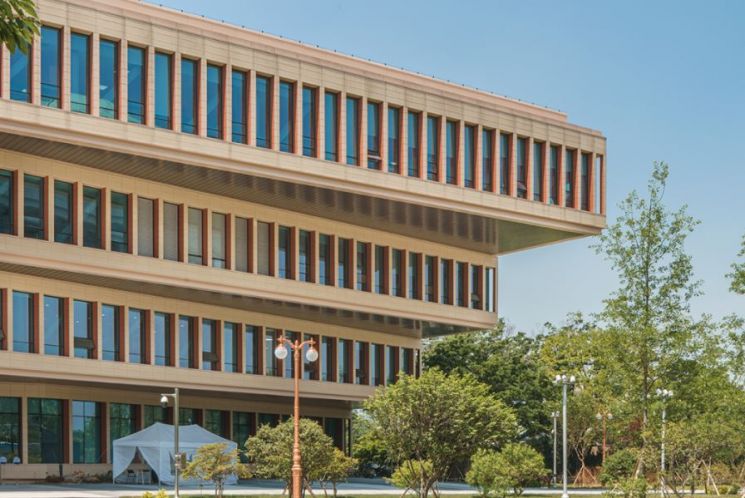
[Asia Economy Reporter Hwang Yoon-joo] The National Assembly Communication Center, which held its completion ceremony on December 23 last year, has recently become known to the public through several high-profile press conferences. From the time the design competition was announced in 2015 and throughout the construction period, the project was referred to by the somewhat unfamiliar name "National Assembly Smart Work Center and Press Center."
After government ministries relocated to Sejong City, there was a need for a space where administrative staff could wait or work at the National Assembly building (Smart Work Center), and with the continuous increase in journalists and media outlets, there was a shortage of press rooms (Press Center), prompting the initiation of this project as a solution.
The building, which emphasizes "communication" from its very name, was guided during the design competition by the principles of having "symbolism as a smart work facility and media facility" while also being "flexible and adaptable to respond to rapidly changing social conditions." The architects chose a simple rectangular form out of respect for the formal monumentality of the current National Assembly complex.
This low and wide building, with four above-ground floors and a total floor area of 24,732 m², was given two clear programs from the start: office space and press rooms. Since it does not require special facilities, its layout is straightforward. The 2nd floor houses the Press Center, the 3rd floor the Smart Work Center. The basement level 1 is a parking lot, the 1st floor contains restaurants and shops, and the 4th floor is office space.
If the boxes had simply been stacked as they were, the building might have felt cramped, but each floor is slightly rotated and stacked. It resembles a wide matchbox shape twisted and piled up. Naturally formed outdoor spaces have terraces, making access easy and pleasant.
One of the contributors to the architectural design of the National Assembly Communication Center is POSCO. POSCO construction materials such as InnoBuilt AU Beam were used. The AU Beam’s slim structure is a major advantage, as it is not thicker than typical concrete beams or steel beams, allowing for higher indoor ceiling heights. In long-span designs where fewer columns and walls are preferred, concerns about bending and sagging are resolved by the stiffness provided by the AU Beam. Additionally, unlike the conventional method requiring on-site installation of stud bolts at the slab and steel beam interface, the AU Beam uses a cover-type steel anchor for connection, making construction much easier.
Also notable in the construction of the National Assembly Communication Center is POSCO’s D-Deck method, one of the latest technologies (a long-span deck plate method using double ribbed corrugated steel sheets and inverted triangular lattice girders). This method, designated as a new construction technology in January this year, uses formwork decks with two ribs and inverted triangular girders composed of two upper steel wires and one lower steel wire. The girder rests in the groove between the ribs of the corrugated steel sheet, and the load is supported by this girder along with additional reinforcing steel bars.
POSCO explained, "The simple construction method of placing the lattice girder on the rib groove without welding simplifies the work and enables long-span construction." They added, "Previously, the area next to the Welfare Center was crowded and dangerous due to many cars on the ground, but by demolishing the old building and constructing this Communication Center, a spacious and pleasant underground parking lot was secured."
[Reference: POSCO Essay ? The National Assembly’s New Building, a Flat Box Twisted and Stacked, National Assembly Communication Center]
© The Asia Business Daily(www.asiae.co.kr). All rights reserved.
![Clutching a Stolen Dior Bag, Saying "I Hate Being Poor but Real"... The Grotesque Con of a "Human Knockoff" [Slate]](https://cwcontent.asiae.co.kr/asiaresize/183/2026021902243444107_1771435474.jpg)
















