At the Edge: Visiting Pyeongtaek Factory
Employees Say "We Will Do Everything We Can"
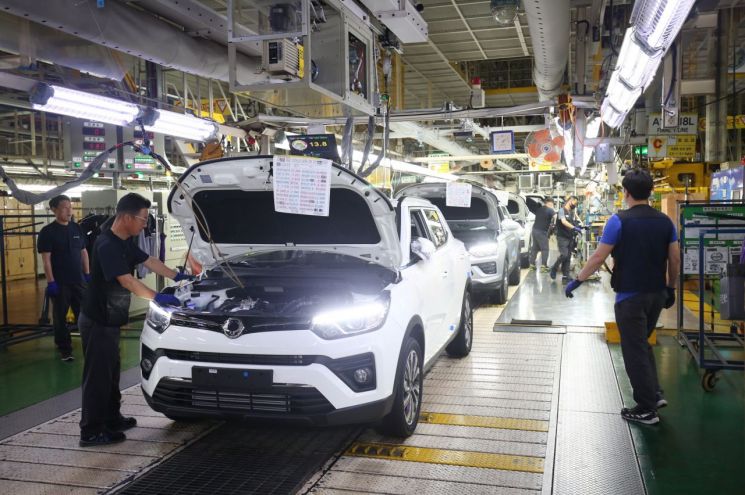 Ssangyong Motor employees are performing assembly work on the vehicle body production line at the Ssangyong Motor Pyeongtaek plant on the 25th.
[Asia Economy Pyeongtaek=Reporter Seong Gi-ho] "During the 2009 'Ssangyong Motor crisis,' there was still hope. But now, phrases like 'Will it be okay?' and 'What should we do?' are exchanged among employees as if they were greetings."
At Ssangyong Motor's Pyeongtaek plant visited on the 25th, employees were quietly doing their best in a calm atmosphere. However, when approached and asked about the company’s situation, they poured out words full of desperation. Although it was payday that all employees eagerly awaited, the weight of survival seemed to press down even heavier on their shoulders.
The Pyeongtaek plant employs 3,922 workers, accounting for 80% of the approximately 5,000 Ssangyong Motor employees. All vehicles produced by Ssangyong Motor are manufactured on the three lines here. However, due to the discontinuation of Turismo and Chairman models, Line 2 has stopped operating. Lines 1 and 3 are producing Korando, Tivoli, and Rexton, respectively.
The employees met on site unanimously emphasized, repeating, "Please help us," and "We have sufficient capability."
The total annual production capacity of the Pyeongtaek plant is about 250,000 units based on equipment. However, considering operational personnel, the actual production volume is 170,000 units, and even this year’s business plan was set at only 131,000 units due to the impact of the novel coronavirus disease (COVID-19). This is about 78% of the actual production volume. Lee Jin-woo, head of the Production Innovation Team, stated, "We are inevitably adjusting volume due to export disruptions caused by COVID-19," and emphasized, "If exports recover, we have a structure that can increase volume again at any time."
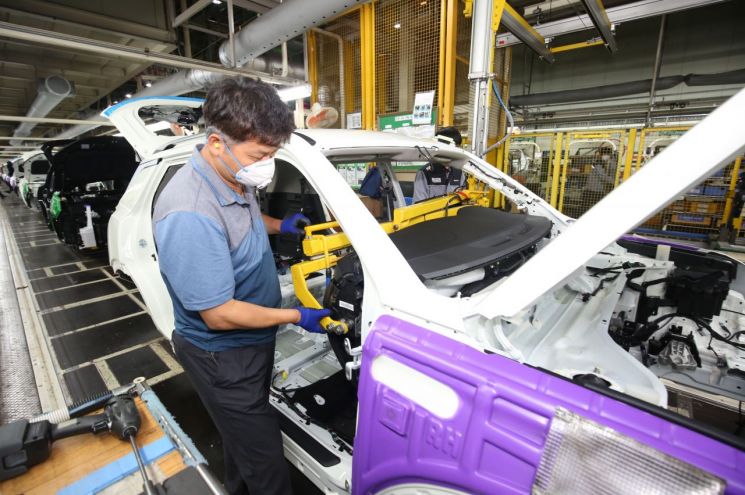 A SsangYong Motor employee is performing assembly work on the body production line at the SsangYong Motor Pyeongtaek plant on the 25th.
The story that Ssangyong Motor’s competitiveness is sufficient was also heard on the production line. Song Young-seung, head of Assembly Team 1 at Ssangyong Motor, emphasized, "One line is currently producing 24 vehicles per hour, but it is possible to produce up to 35 vehicles," and raised his voice, saying, "We have enough production capacity. We desperately need help to overcome this difficult situation."
The labor-management atmosphere was also significantly different from expectations. Kim Sang-chun, chairman of the Ssangyong Motor Workers and Factory Council and representative of on-site supervisors, explained that the day before, he met with President Ye Byeong-tae along with employees and delivered a resolution for management normalization along with the on-site employees’ willingness to actively cooperate.
Kim, who has worked for 33 years and is approaching retirement this year, said, "There is a fear that if we fall this time, we won’t be able to get up again. The unified thought among employees is to do their best in their original positions and do everything they can," and appealed, "Ssangyong Motor is a company with dynamism and patience. Please help us just once."
Among Pyeongtaek plant employees, the number of those working a 'two-job' at nearby logistics centers to overcome hardships caused by welfare reductions, rotational leave, and the abolition of weekend overtime is increasing.
A Ssangyong Motor official stated, "The government subsidies are not intended to be used as operating funds for the company," and emphasized, "At least 300 to 400 billion won in research costs are required for new car development. Support funds are essential for long-term survival."
© The Asia Business Daily(www.asiae.co.kr). All rights reserved.


















