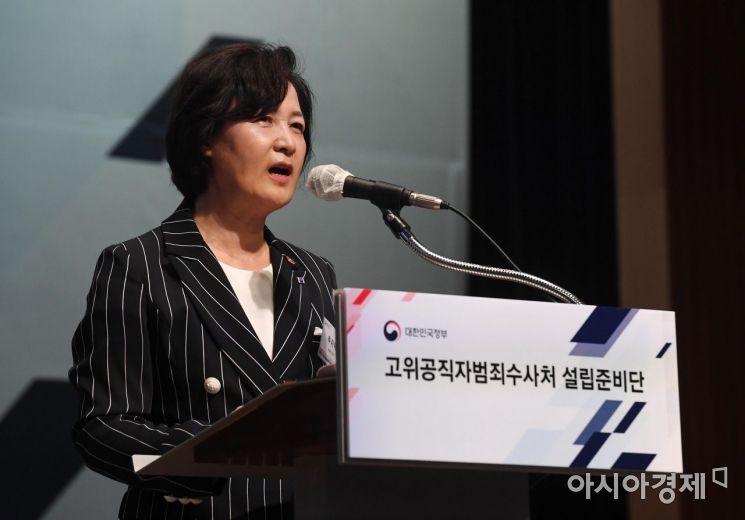
 Justice Minister Choo Mi-ae is delivering a congratulatory speech at the Public Hearing on the Corruption Investigation Office for High-ranking Officials (CIO) held at the Korea Chamber of Commerce and Industry in Jung-gu, Seoul, on the 25th. This hearing, themed "Establishment Direction of the CIO for Launching as an Advanced Investigation Agency," was organized to gather opinions from experts and the public so that the CIO can be launched as an organization that meets the expectations and standards of the people ahead of the enforcement of the CIO Act on the 15th of next month. Photo by Kim Hyun-min kimhyun81@
[Asia Economy Reporter Choi Seok-jin] A public hearing was held to discuss the desirable establishment direction of the High-ranking Officials' Crime Investigation Office (HCIO), scheduled to launch in July.
Minister of Justice Choo Mi-ae, in her congratulatory remarks, urged, "Please ensure that the HCIO becomes a model (典範, exemplary standard) that complies with criminal justice procedures."
On the 25th at 2 p.m., the HCIO Establishment Preparation Team hosted a public hearing titled "Establishment Direction of the HCIO for Launching as an Advanced Investigation Agency" at the International Conference Hall of the Korea Chamber of Commerce and Industry in Jung-gu, Seoul.
The hearing proceeded with an opening address by Nam Ki-myung, head of the HCIO Establishment Preparation Team, congratulatory remarks by Minister Choo and Lee Chan-hee, president of the Korean Bar Association, followed by expert presentations and discussions.
In his opening remarks, Nam said, "At today's hearing, I hope you will provide valuable opinions and engage in passionate discussions so that the HCIO does not follow existing investigative agencies but introduces a differentiated investigative system to become a dignified and restrained advanced investigative agency model."
Nam also requested active cooperation from the National Assembly for the prompt appointment of the inaugural HCIO chief.
He stated, "The HCIO Act will be enforced from July 15, six months after its promulgation, but the HCIO can only be launched once its head is appointed. For this, amendments to the 'National Assembly Act' and 'Personnel Hearing Act' for recommending the HCIO chief candidate, as well as the enactment of the National Assembly rule 'Regulations on the Operation of the HCIO Chief Candidate Recommendation Committee,' must precede. I ask for your keen interest and the National Assembly's active cooperation."
Minister Choo, instead of a prepared speech, gave an impromptu address. She particularly revisited the investigation-prosecution separation plan, which she had mentioned in February, stating, "We will consider institutional improvements to separate the subjects of investigation and prosecution within the prosecution."
First, Minister Choo pointed out, "Reflecting on the prosecution's investigations, I could not help but question whether there was a righteous exercise of prosecutorial power that destroys evil and reveals justice (破邪顯正)."
She continued, "When I said it would be better to separate investigation and prosecution, there was an uproar. Attempts were made to frame it as if we were trying to incapacitate a righteous prosecution and favor the regime."
Minister Choo said, "The Criminal Procedure Act was created in 1954, 67 years ago. At that time, the law publication committee stated, 'Investigation should be handled by the police, prosecution by legal experts (prosecutors), and the court judges whether a crime exists, thereby revealing substantive truth and establishing justice through checks and balances, which is the conclusion of observing advanced judicial systems.' They also said, 'Although it would be proper for police and prosecutors to divide investigation and prosecution, since we cannot proceed immediately, the issue of separating investigation and prosecution will be left for the future, and prosecutors will be entrusted with both investigation and prosecution.' I recall this statement."
Finally, Minister Choo urged, "I ask that the HCIO become a model (典範, exemplary standard) that complies with criminal justice procedures in all criminal justice processes."
Next, President Lee of the Korean Bar Association said, "If the prosecution had been independent from power and boldly wielded the sword of justice against the living power, the HCIO would not have emerged today." He pointed out, "The HCIO, introduced under the banner of reforming a prosecution that failed to be independent from power, is an organization that could be embroiled in political whirlpools as much as, or perhaps more than, the prosecution."
He added, "The essential condition for the HCIO's success is securing independence from power and political neutrality. Until the HCIO Chief Candidate Recommendation Committee convenes, we will do our utmost to select a candidate with firm belief in political independence, excellent investigative ability, and a sense of justice from among our members."
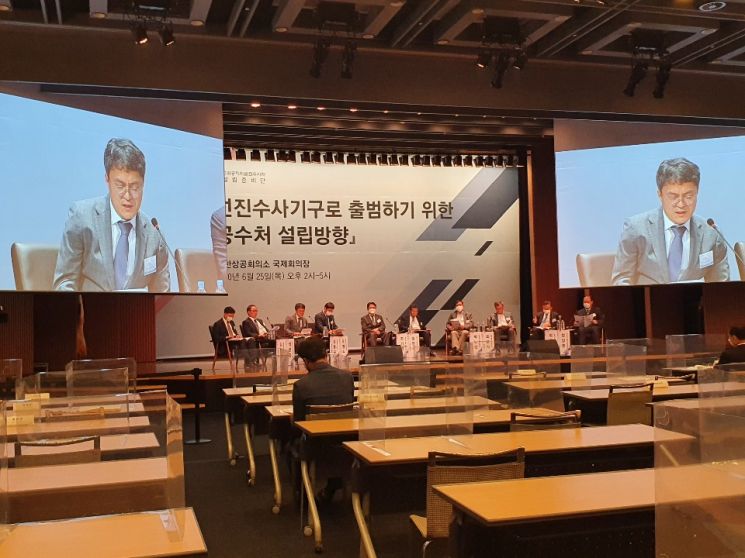 On the afternoon of the 25th, a designated discussion took place at the public hearing on "Directions for Establishing the Corruption Investigation Office to Launch as an Advanced Investigation Agency," held at the International Conference Hall of the Korea Chamber of Commerce and Industry in Jung-gu, Seoul. Photo by Choi Seok-jin
In the presentations, Kim Young-jung, senior researcher at the Korea Institute of Criminology and Justice, spoke on "A Study on the Investigation System of Foreign Anti-corruption Special Investigation Agencies," Han Sang-hoon, professor at Yonsei University Law School, on "Establishing a Restrained Investigation Structure through Checks and Balances," and Jeong Han-jung, dean of Hankuk University of Foreign Studies Law School, on "Establishing Due Process and a Human Rights-friendly Investigation System for the Advancement of Criminal Procedures."
In the subsequent designated discussion, Im Byung-soo, advisory chairman of the HCIO Establishment Preparation Team, served as the moderator. Discussants included Cho Ki-young, professor at Jeonbuk National University Law School; Park No-seop, professor at Hallym University Global School; Oh Byung-doo, professor at Hongik University Law School; Choi Woon-sik, lawyer at Daeryuk Aju Law Firm and former prosecutor; Oh Yong-gyu, lawyer at Dongin Law Firm and former judge; and Jeong Young-hoon, lead attorney at Haeyul Law Office and former member of the Legal and Prosecutorial Reform Committee.
© The Asia Business Daily(www.asiae.co.kr). All rights reserved.
![Clutching a Stolen Dior Bag, Saying "I Hate Being Poor but Real"... The Grotesque Con of a "Human Knockoff" [Slate]](https://cwcontent.asiae.co.kr/asiaresize/183/2026021902243444107_1771435474.jpg)

















