Jeonnam Culture and Tourism Foundation Conducts Academic Excavation Survey
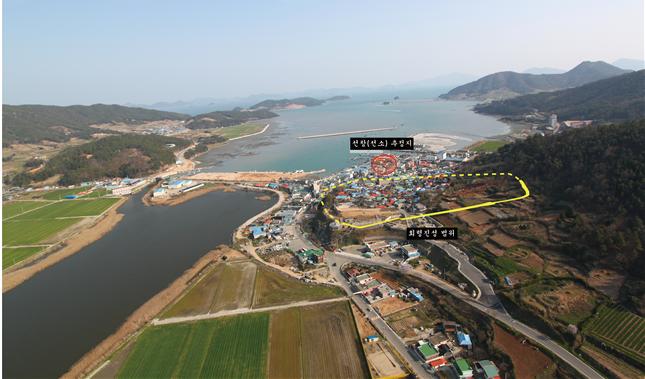
[Asia Economy Honam Reporting Headquarters Reporter Yoon Jamin] The structure of Jangheung Hoeryeongjin Fortress, the site of Admiral Yi Sun-sin's 12-ship legend, has been revealed.
The Jeonnam Culture and Tourism Foundation announced on the 25th that, together with Jangheung County, it conducted an academic excavation survey for four months starting in February to identify the structure of Jangheung Hoeryeongjin Fortress (Jeollanam-do Cultural Property Material No. 144).
Through this excavation, it was archaeologically proven that Jangheung Hoeryeongjin Fortress was built in April 1490 (the 21st year of King Seongjong) with a height of 13 cheok and a circumference of 1990 cheok, constructed by mixing earth and stones, with the east wall built on a cliff, as recorded in historical documents.
It was confirmed that the east wall of Hoeryeongjin Fortress, previously thought to be completely damaged, was constructed using a natural terrain of cliffs and steep slopes, with an outer wall made of stones and the inside filled with earth (naetak-style construction).
Additionally, four pits (susul) and one main pillar hole (jugongyeol), presumed to be related facilities, were excavated, confirming traces of the east wall that existed only in records.
Furthermore, the “Hoeryeongpojin Map” (1872) depicts the south, north, and east gates, and inside the fortress are the Dongheon, Gaksa, Janggocheong, Saryeongcheong, and Gungigo, while outside the fortress are the Seonso and military anchorage, traces of which were also confirmed.
Dongheon refers to the government office, Gaksa to the official residence, Janggocheong to the senior officer’s office, Saryeongcheong to the junior officer’s office, and Gungigo to the armory.
The foundation promoted the excavation of Jangheung Hoeryeongjin Fortress as part of Jeonnam Province’s core project, the “Yi Sun-sin National Defense and Tourism Belt Development Project,” and plans to systematically investigate Yi Sun-sin-related history, relics, and cultural tourist sites in areas such as Yeosu, Haenam, Jindo, and Wando for restoration and maintenance materials.
Joo Sunseon, the foundation’s CEO, said, “Based on the results of this excavation, we will strive to develop Jangheung Hoeryeongjin Fortress into Jeonnam’s representative historical theme tourism attraction through systematic academic research and verification, linked with the ‘Yi Sun-sin National Defense and Tourism Belt Development Project.’”
Meanwhile, Hoeryeongjin Fortress and the nearby Hoeryeong Port were locations of shipyards and docks during the Joseon Dynasty. After the defeat of Won Gyun at the Battle of Chilcheonryang in 1597 during the Japanese invasions of Korea (Imjin War), Gyeongsang Right Naval Commander Bae Seol fled here with 12 damaged ships, and this place (present-day Deoksan Village) was where those ships were repaired.
After completing his period of serving as a common soldier, Admiral Yi Sun-sin returned as the Commander of the Three Provinces Naval Command and, with about 300 residents, repaired the nearly wrecked ships at Hoeryeongjin Fortress. With these 12 ships, he achieved the most dramatic victory of the Battle of Myeongnyang by defeating 133 Japanese ships, making this a historic site.
© The Asia Business Daily(www.asiae.co.kr). All rights reserved.
![Clutching a Stolen Dior Bag, Saying "I Hate Being Poor but Real"... The Grotesque Con of a "Human Knockoff" [Slate]](https://cwcontent.asiae.co.kr/asiaresize/183/2026021902243444107_1771435474.jpg)
















