Russian Space Startup 'Start Rocket' Develops
European Space Agency Estimates About 129 Million Pieces of Space Debris in Earth's Orbit
"We Could Be Trapped in a Space Debris Prison... The Scientific Community Must Respond Together"
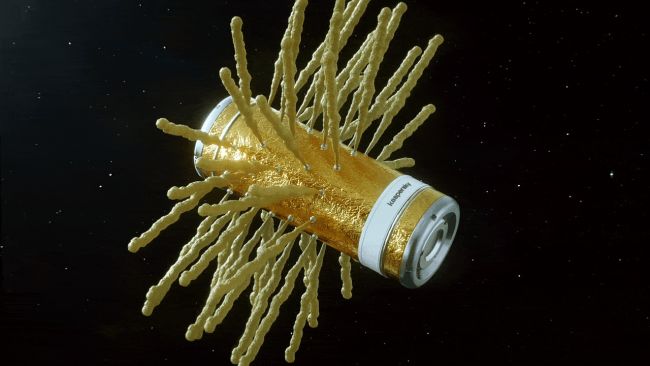 Polymer foam satellite by Russian space startup 'StartRocket.' Designed to capture space debris by launching sticky foam. / Photo by StartRocket
[Asia Economy Intern Reporter Lim Juhyung] An artificial satellite capable of emitting sticky foam is set to be deployed for space debris removal missions.
On the 24th (local time), according to the U.S. space magazine Space, the Russian space startup StartRocket is inventing a small, barrel-shaped autonomous artificial satellite weighing 50 kg that can catch space debris.
The foam emitted by this artificial satellite is a sticky substance called "polymer foam." The satellite moves to areas where space debris is concentrated, fires the polymer foam to capture the debris, and then sends it down into the atmosphere. Subsequently, the debris is drawn by Earth's gravity below the atmosphere and naturally incinerated by heat.
Vlad Sitnikov, founder of StartRocket, explained the operating principle of the polymer foam in an interview with the media as "similar to a spider web."
Regarding the reason for inventing this artificial satellite, he responded, "If we do not take such measures, we will eventually be trapped in a prison made of space debris."
Dr. Aleksandr Shenko, an advisor to StartRocket, also stated, "The space debris problem is becoming more serious. It poses significant risks to space exploration and technology development," adding, "It is important for the scientific community to work together to find solutions. In particular, the polymer foam satellite is an affordable and scalable solution."
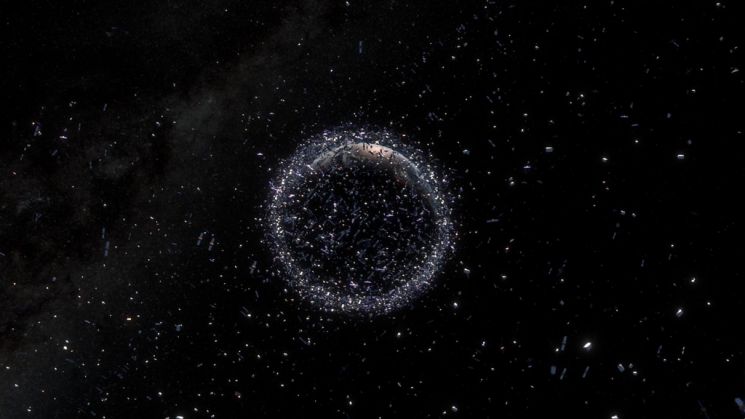
The European Space Agency estimates that about 129 million pieces of space debris are floating in actual outer space. Among these, over 34,000 pieces are larger than 10 cm in size.
This debris orbits Earth at a speed of 28,200 km/h, and if it collides with rockets or artificial satellites, it can cause serious damage.
The problem lies in the expectation that as space development becomes more active in the future, the amount of space debris will also rapidly increase.
Since the launch of the world's first artificial satellite, Sputnik 1, in 1957, over 12,000 artificial satellites have been launched worldwide. In particular, the U.S. launch vehicle and space development company SpaceX plans to launch more than 30,000 communication satellites in the future.
As space debris is seen as a threat to future space development, efforts by academia and companies to reduce it are also accelerating.
Last year, British researchers unveiled a small satellite called "OSCAR" that captures space debris by deploying a net and towing it below the atmosphere.
Researchers from the European aerospace company Airbus also demonstrated a mission in space where a satellite fires a harpoon to pierce and capture space debris, actively removing actual space debris.
© The Asia Business Daily(www.asiae.co.kr). All rights reserved.
!["The Woman Who Threw Herself into the Water Clutching a Stolen Dior Bag"...A Grotesque Success Story That Shakes the Korean Psyche [Slate]](https://cwcontent.asiae.co.kr/asiaresize/183/2026021902243444107_1771435474.jpg)

















