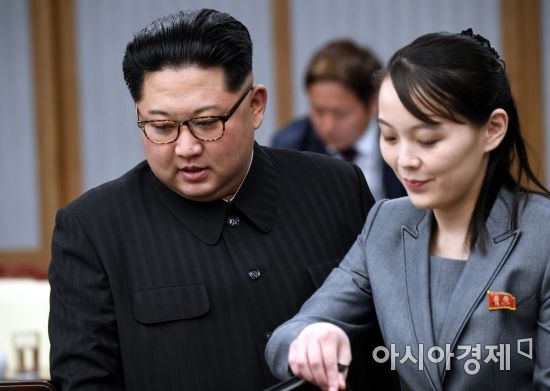
 North Korean State Affairs Commission Chairman Kim Jong-un and First Deputy Director of the Workers' Party Kim Yo-jong are seated at the inter-Korean summit held on the second floor conference room of the Peace House in Panmunjom on the morning of April 27, 2018.
 The North Korean version of the 'good cop-bad cop' strategy is drawing renewed attention as Kim Jong Un, Chairman of the State Affairs Commission of North Korea, appears to be putting the brakes on the hardline drive toward South Korea led by his sister, Kim Yo Jong, First Deputy Director of the Workers' Party of Korea.
This negotiation tactic, which divides the roles of the good cop and the bad cop, has also been used by the United States in dealing with North Korea. While Mike Pompeo, former U.S. Secretary of State, and John Bolton, former National Security Advisor to the White House, took on the role of the bad cop with hardline and pressuring remarks, then-President Donald Trump positioned himself as the good cop with conciliatory statements.
The North Korean version of the good cop-bad cop strategy was concretized on the 24th when Kim Jong Un issued a sudden order to suspend military actions against South Korea. On that day, North Korea’s state media, the Korean Central News Agency, reported that Kim Jong Un presided over a preliminary meeting of the 7th Central Military Commission of the Workers' Party on the 23rd and suspended plans for military actions against South Korea.
This effectively put a temporary halt to the anti-South offensive led recently by Kim Yo Jong. North Korea had announced on the 9th that it would thoroughly convert its South Korea-related affairs into hostile affairs and had warned of military actions against South Korea.
In a statement on the 13th, Kim Yo Jong hinted at the demolition of the Kaesong Inter-Korean Joint Liaison Office and said, "The authority to carry out the next hostile action will be handed over to the General Staff of our army."
Then, on the 17th, the General Staff of the Korean People's Army announced in a spokesperson’s statement the deployment of military units to the Mount Kumgang tourist area and the Kaesong Industrial Complex, the redeployment of troops to guard posts (GPs) in the Demilitarized Zone (DMZ) from which they had withdrawn, the resumption of military exercises in the West Sea, and military support for the distribution of anti-South leaflets.
On the same day, marking the 20th anniversary of the June 15th Inter-Korean Joint Declaration, Kim Yo Jong harshly criticized South Korean President Moon Jae In’s remarks emphasizing inter-Korean exchanges and cooperation, calling them "shameless and brazen words that sound like indigestion after drinking plain water."
Kim Yo Jong’s remarks showed a tendency to be swiftly realized to the extent that they were considered exceptional. Just three days after her statement on the 13th claiming, "Soon, you will witness the miserable sight of the useless North-South Joint Liaison Office collapsing without a trace," this was put into action.
Moreover, related departments and agencies such as the Party’s United Front Department and the General Staff took steps to mention the implementation instructions of Kim Yo Jong’s statement, and even North Korean cadres’ resolutions to execute Kim Yo Jong’s statement were published in the Rodong Sinmun, further solidifying her status within North Korean society.
Since Kim Yo Jong personally vowed continuous retaliation, follow-up measures were expected to follow soon. This is why Kim Jong Un’s order on the 24th to 'suspend' these actions is considered sudden.
This role division between Kim Jong Un and Kim Yo Jong began to emerge earlier this year. Kim Yo Jong issued the first statement on March 3 in response to the South Korean government’s expression of regret over North Korea’s projectile launches, but the next day, March 4, Kim Jong Un personally sent a letter to President Moon Jae In regarding the COVID-19 situation.
Through the good cop-bad cop strategy, North Korea is evaluated to have achieved the strategic outcome of leaving Kim Jong Un as the 'last bastion' while indirectly elevating Kim Yo Jong’s status.
Some view this not so much as a North Korean good cop-bad cop strategy but rather as an attempt to shift the situation out of practical necessity.
In response to North Korea, South Korea and the U.S. are considering resuming joint military exercises, and two U.S. aircraft carriers have been forward-deployed to the operational area of the 7th Fleet, which includes the Korean Peninsula, increasing pressure on North Korea simultaneously.
Jung Sung-jang, Director of the North Korea Research Center at the Sejong Institute, explained, "If North Korea’s ultra-hardline policy leads to expanded South Korea-U.S. joint military exercises and frequent deployment of U.S. strategic assets to the Korean Peninsula, North Korea will become very fatigued. The burden of the joint military exercises and concerns about the possible spread of COVID-19 within the military could be reasons behind North Korea’s retreat."
© The Asia Business Daily(www.asiae.co.kr). All rights reserved.
















