Seoul City Passes Private Investment Feasibility Study... Design and Construction to Begin in 2023
Expectations to Improve Urban Accessibility and Promote Balanced Development in Northwest and Southwest Areas
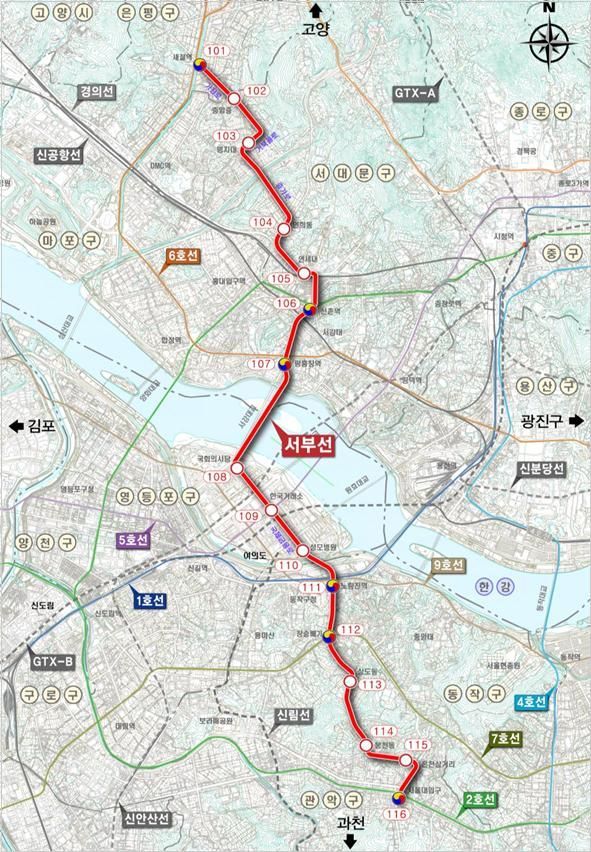
[Asia Economy Reporter Jo In-kyung] The project to connect the northwestern and southwestern areas of Seoul?regions known for excessive detours and complex travel routes, making them representative transportation underserved areas in Seoul?via urban rail is set to be launched in earnest.
Seoul City announced on the 22nd that the 'Seobu Line Light Rail Transit' private investment project has passed the private investment feasibility review conducted by the Korea Development Institute Public Investment Management Center (KDI PIMAC).
The Seobu Line Light Rail Transit will be constructed as a branch line connecting Saejeol Station (Line 6) in Eunpyeong-gu to Seoul National University Station (Line 2) in Gwanak-gu, with a total length of 16.15 km and 16 stations, allowing transfers to five existing trunk urban rail lines.
Since its first inclusion in the 'Mid-term Transportation Maintenance Plan' announced in 2000, it has been consistently included in the '1st Urban Rail Network Construction Plan' established in 2008 and 2015, and is currently reflected in the '2nd Urban Rail Network Construction Plan' under approval by the Ministry of Land, Infrastructure and Transport, making it a key project to eliminate blind spots in public transportation.
The city expects that once the Seobu Line Light Rail Transit is completed, travel time between the northwestern and southwestern areas of Seoul will be significantly reduced. It will connect high-demand areas such as Sinchon and Yeouido, which are university, commercial, and business districts, in one route, and allow transfers to subway Lines 1, 2, 6, 7, and 9, reducing travel time on major sections by up to 16 minutes, greatly shortening commuting times for citizens.
Currently, the travel time from Saejeol Station to the final stop, Seoul National University Station, takes about 36 minutes with one transfer on the subway's shortest route. After the Seobu Line is completed, this will be reduced by 14 minutes to approximately 22 minutes. Additionally, travel times from the terminal Seoul National University Station to Noryangjin and Jangseungbaegi are expected to be shortened by up to 16 minutes?from about 23 minutes to 7 minutes and from about 22 minutes to 6 minutes, respectively?demonstrating a significant reduction in travel time.
With the passing of this private investment feasibility review, the city plans to proceed with the project in earnest, conducting related administrative procedures such as private investment deliberations, and will issue a third-party proposal announcement in the second half of this year to select the implementing and operating companies. The detailed design is scheduled to be completed by 2023, with construction starting in 2023 and the line opening targeted for 2028.
Park Won-soon, Mayor of Seoul, stated, "I am confident that the Seobu Line Light Rail Transit will serve as a catalyst to resolve chronic traffic congestion, improve urban accessibility, and accelerate balanced regional development." He added, "We will do our best to ensure that this project enhances the convenience of life for local residents who have waited for 20 years and serves as an opportunity to revitalize the region."
© The Asia Business Daily(www.asiae.co.kr). All rights reserved.

















