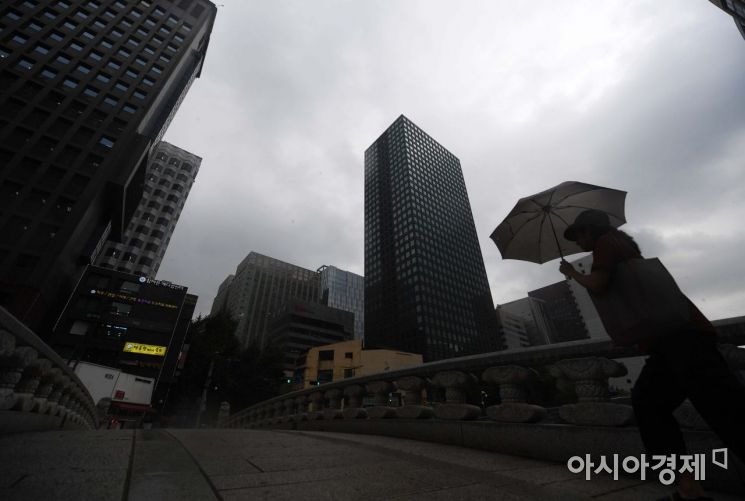
 On the 3rd, when rain hastening autumn fell across the country, a citizen with an umbrella was passing Mojeon Bridge over Cheonggyecheon Stream in Seoul. The Korea Meteorological Administration forecasted that the central region would receive 50 to 100mm of heavy rain by tomorrow, with some areas expecting over 150mm. Photo by Moon Honam munonam@
[Asia Economy Reporter Junho Hwang] Domestic researchers have announced a study result indicating an increased likelihood of extreme summer precipitation occurring in East Asia, including South Korea. Extreme precipitation is an extreme climate phenomenon caused by global warming, accompanied by short-term concentrated heavy rainfall during the monsoon and prolonged droughts. There are calls for preparation against massive economic losses and ecological changes caused by damage to crops and human lives.
The research team led by Professor Jinho Yoon of the Department of Earth Environment Engineering at Gwangju Institute of Science and Technology recently published these findings in the international journal Environmental Research Letters, announced on the 22nd.
Increased Likelihood of Extreme Precipitation Occurrence
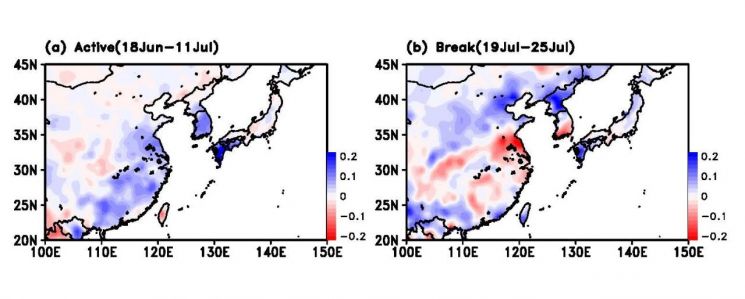 This graph shows the trend of precipitation changes from 1979 to 2017 during the East Asian rainy season (June 18 - July 11) and the subsequent dry period (July 19 - July 25). During the rainy season, precipitation in the East Asian region (Korea, the Yangtze River area in China, and southwestern Japan) increases, while during the dry period, precipitation in the East Asian region tends to decrease. This suggests that more rainfall occurs during the traditional rainy season, followed by a drier dry period, which may lead to more intense and frequent extreme precipitation events such as heavy rains and droughts.
The research team judged that as the life cycle of the East Asian Summer Monsoon (EASM), which dominates summer weather, becomes increasingly distinct, the possibility of consecutive droughts following floods and heatwaves (extreme high-temperature phenomena) has increased, prompting related research.
For example, in Japan, from June 27, 2018, over a period of 10 days, more than 1000mm of rain fell, causing floods and landslides in the southeastern region. Before the massive damage caused by the concentrated heavy rain could be recovered, a severe hot and dry climate lasted for a month. As a result, more than 1000 people died, causing enormous damage.
The research team studied climate changes in East Asia, including South Korea and Japan, using 30 years of past climate observation data and the latest climate model (CMIP 6). Through this, they analyzed that the risk of extreme precipitation events, characterized by heavy rainfall over a short period followed by prolonged hot and dry conditions, is increasing.
Global Warming's Impact on Extreme Precipitation

The research team cited global warming as the reason for the increased likelihood of extreme climate events. As the Earth's temperature rises, the atmosphere can hold more water vapor, while at the same time, the surface loses moisture to the atmosphere, becoming drier. The team explained that this environment leads to a simultaneous increase in the possibility of both heavy rainfall and prolonged droughts.
In particular, the East Asian summer monsoon affects a wide area over several months. The possibility of consecutive extreme climate events, like those in Japan, can occur anywhere.
Professor Jinho Yoon said, "It is very important to understand that global warming has strengthened the life cycle of the East Asian summer monsoon, thereby increasing the risk of consecutive extreme weather anomalies at both extremes."
© The Asia Business Daily(www.asiae.co.kr). All rights reserved.



















