[Asia Economy Reporter Seulgina Jo] “The data industry is a field with great growth potential in the future and has a high possibility of creating various jobs by combining with other industries."
President Moon Jae-in visited data and artificial intelligence (AI) companies as his first on-site move for the 'Korean New Deal,' raising interest in the data industry, which forms the foundation of the digital economy. The government expects the data industry to expand and new jobs to be created with the implementation of the Data 3 Act in August.
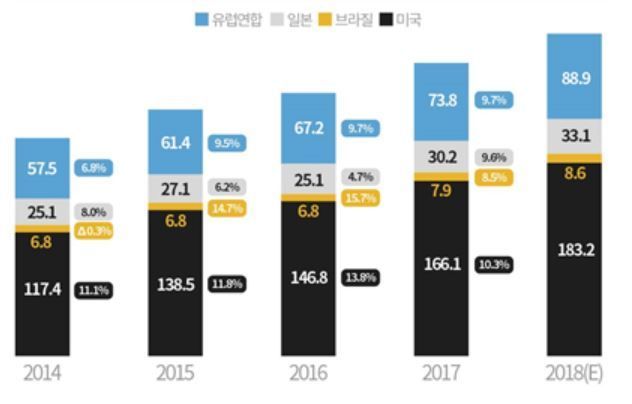
According to the recent issue brief "Q&A on Jobs (Asking about jobs and answering about jobs)" released by the Presidential Committee on Jobs on the 21st, in the United States, which has large-scale global data companies, the employment ratio of data professionals to total employment reaches 9.3%. Based on 2018, the data markets in the United States and the European Union (EU) grew by 10.3% and 9.6%, respectively.
The Jobs Committee noted that the domestic data industry also shows higher growth and employment increase rates compared to other industries. With the Data 3 Act passed earlier this year and about to be implemented, which expands the foundation for data openness and distribution, it is explained that new job creation can be expected in the future.
The domestic data market size was around 15.5 trillion KRW in 2018, showing 8.5% growth. The proportion of data-related job personnel to total employed persons was 0.33% in 2019. The Jobs Committee emphasized, "Considering Korea's digital technology capabilities and the growth trend of the data industry, more employment creation in the data industry can be expected in the future."
The Jobs Committee particularly introduced the ‘AI learning data labeler’ as an example of data processing jobs. AI learning data refers to data processed into a form that allows AI algorithms to learn autonomously. An AI data labeler is a specialist who processes data into a form that AI can learn from, intervening in the intermediate process alongside computers during data construction to ensure data quality.
The Jobs Committee explained, "As ICT technology internalization deepens across various social sectors such as public, medical, education, finance, distribution, transportation, and manufacturing, the role of human labelers who understand and analyze the characteristics of data generated in each sector is increasing," adding, "In the stages of designing and inspecting AI data construction directions and steps, the role of highly skilled experienced personnel with existing knowledge in each field is essential."
In the case of Alibaba, China's largest e-commerce company, over 200,000 AI data experts are responsible for labeling work, and it is estimated that related employees inside and outside China will reach about 5 million by 2022. Especially, early AI labeling was not highly difficult, contributing to youth employment.
The Ministry of Science and ICT recently decided to invest 292.5 billion KRW in the AI learning data construction project this year through the third supplementary budget.
Vice Chairman Kim Yong-gi stated, “Personnel in non-ICT fields may not be familiar with the data industry or data processing jobs,” and added, “Since the data industry has a high potential to create various jobs by combining with other industries, I hope many citizens will take an interest in data jobs and create new work experiences.”
© The Asia Business Daily(www.asiae.co.kr). All rights reserved.

















