Announcement of 'Digital Ecosystem Development Plan' as Key to OTT Activation
Complete Abolition of 33% Rule, Rapid M&A
Competitiveness in Network (5G), Devices (Samsung), and Content (Hallyu) Platforms
Fostering Media Market to 10 Trillion Won by 2022
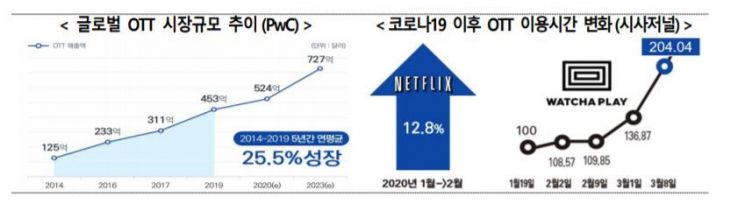
[Asia Economy Reporter Koo Chae-eun] The government plans to enhance the market competitiveness of native online video services (OTT) to foster a "Korean version of Netflix." Leveraging the world's best 5G network and devices, along with the competitiveness of Hallyu content, the government aims to support the overseas export of platform companies and grow the domestic media market to 10 trillion won by 2022 (6.9 trillion won as of 2018).
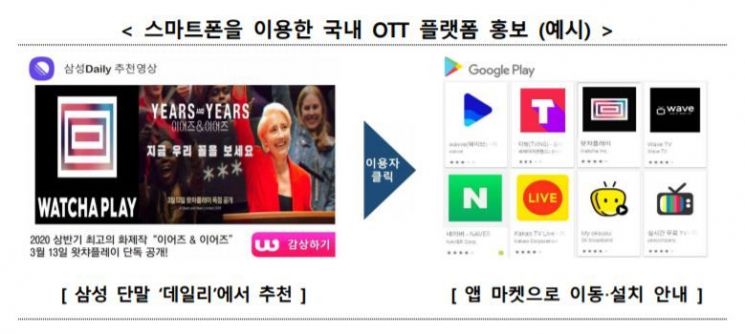
To this end, the government will support investment and overseas exports across the OTT market. For example, native OTT apps like Watcha Play will be featured on the daily recommendation screen of Samsung Electronics smartphones, which hold the world's number one market share, to facilitate overseas exports. The government will also expand the virtual reality (AR) content market utilizing 5G. Outdated regulations on native platforms will be abolished, and differentiation and scaling through M&A will be fully supported.
Competitiveness in Network (5G), Devices (Samsung), and Content (Hallyu) Platforms
On the 22nd, the government announced the cross-government "Digital Media Ecosystem Development Plan" containing these details. Lee Tae-hee, Director of Network Policy at the Ministry of Science and ICT, stated, "OTT usage such as Netflix and YouTube is rapidly increasing," but added, "(However) domestic industries face difficulties due to siloed regulations and unfair competition conditions with global media." Lee emphasized, "Therefore, we will ease regulations and expand investments so that Korea can leverage its world-class network, devices, and Hallyu content competitiveness to gain global competitiveness."
First, the government will fully support the overseas expansion of domestic OTT companies like Watcha Play and Wavve. They plan to collaborate with device manufacturers such as Samsung Electronics to expose domestic media platforms on Korean smartphones exported overseas. The plan is to have native OTTs like Watcha Play recommended on Samsung Electronics' 'Daily' device, which holds the world's number one market share. Lee Tae-hee said, "We will support the promotion of domestic OTT platforms using smartphones through consultations with operators."
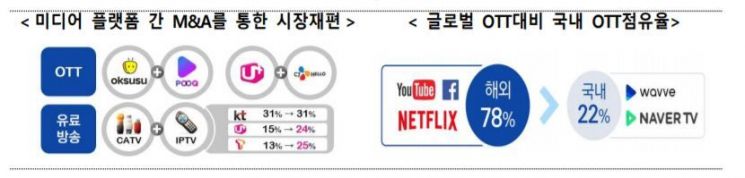
Excessive regulations in the media market will be trimmed. The market share cap limiting individual SO and IPTV to one-third will be completely abolished. Paid broadcasting subscription plans will change from an approval system to a notification system. For video content distributed online through OTT providers, a self-rating system will be introduced, allowing autonomous classification without going through the Video Rating Board. Additionally, when conducting M&A in the broadcasting and telecommunications sector, a consultative body among the Ministry of Science and ICT, the Fair Trade Commission, and the Korea Communications Commission will be formed and operated. This aims to prevent delays in M&A reviews that currently pass through three ministries and to simplify procedures.
Expanded Support for Media Creators Including Solo YouTubers
Support for media creators such as solo YouTubers will also be expanded. A "One-person Media Cluster" will be established to provide full-cycle support including content planning, production, commercialization, and overseas expansion. A cultural content fund exceeding 1 trillion won will be created, and the current production cost tax credit applied to film and broadcasting content will be extended to online video content distributed via OTT. Additionally, support for technology-converged immersive content such as short-form and AR will be increased.
The scope of export content support will be expanded from broadcasting programs to include films, animations, and video content. Furthermore, projects linking content production sites with universities and graduate schools will be discovered and supported. Through these policies, the government aims by 2022 to achieve ▲ a domestic media market size of 10 trillion won, ▲ content export revenue of 13.42 billion USD, and ▲ support for at least five global platform companies. The broad strategy includes ▲ abolishing and easing regulations while supporting differentiation and scaling, ▲ supporting content production and investment, ▲ establishing a foundation for overseas expansion, and ▲ creating fair competition conditions among domestic and foreign operators.
© The Asia Business Daily(www.asiae.co.kr). All rights reserved.



















