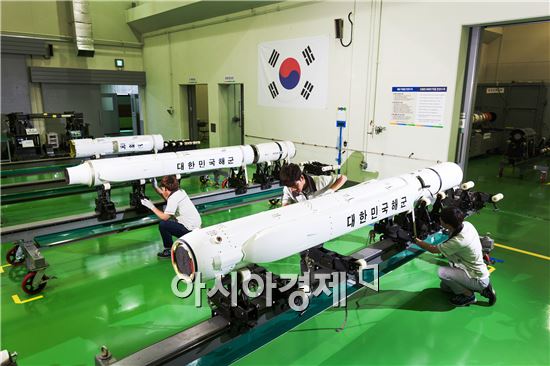
 Production site of a domestic defense industry company
[Kim Seong-jun, Director of Defense Industry Promotion Bureau, Defense Acquisition Program Administration] In 2003, the U.S. Department of Defense invested $200 million to initiate development for securing artificial intelligence technology. Apple acquired this technology and created Siri for the iPhone, taking the lead in the voice personal assistant sector.
In 2013, the Defense Acquisition Program Administration invested a total of 1.3 trillion KRW to promote the development of Surion, the first domestic utility helicopter. Through the development of Surion, it was analyzed that an industrial ripple effect of 15.3 trillion KRW and a technological ripple effect of 19.8 trillion KRW would be generated, resulting in significant economic benefits.
The defense industry is an industry that drives high value-added in industrial sectors through high-risk and high-cost technology development investments that are difficult for the private sector to undertake, and it can create numerous "sustainable quality jobs."
In February 2018, our government announced the "National Balanced Development Vision and Strategy," based on the value of innovation, to enable regions to take the lead in balanced development. The main point is to shift from the previous method led by the central government to a system where local governments plan policies and projects and the central government supports them.
In line with the government's innovation growth and balanced development policy, the Defense Acquisition Program Administration selected the Gyeongnam and Changwon regions as defense industry innovation clusters last April.
The Defense Industry Innovation Cluster project encourages excellent companies to actively participate in the defense industry and brings together regional innovation actors such as local governments, system companies, small and medium enterprises, universities, and the military to establish a regional and industry-specific cooperative ecosystem.
The central government establishes the foundation by building test facilities and component development laboratories, while local governments operate defense industry development governance that includes regional companies, universities, research institutes, and the military. This supports defense industry growth suitable for the regional industrial base by promoting proactive development of defense components, expanding localization, strengthening win-win cooperation between large and small-medium enterprises, and creating jobs.
For the Defense Industry Innovation Cluster project to successfully take root and for defense companies to grow into deeply rooted trees in the region, active interest and support from local governments are essential. Establishing a legal foundation by enacting related ordinances and close collaboration centered on local governments among regional companies, universities, research institutions, and the central government are required. Additionally, regulatory relaxation and budget support are necessary to enable linked development with national key industries.
The Defense Acquisition Program Administration will intensively support the Defense Industry Innovation Cluster to serve as a catalyst for national balanced development and plans to continuously expand it starting with one region, Gyeongnam and Changwon, in 2020. It is hoped that the defense industry will lead technological innovation in the era of the Fourth Industrial Revolution and become a revitalizing force for the stagnant regional economy.
© The Asia Business Daily(www.asiae.co.kr). All rights reserved.