Routine Measures... No Changes Compared to Last Year
Warning Analysis on North Korea's Position Shift
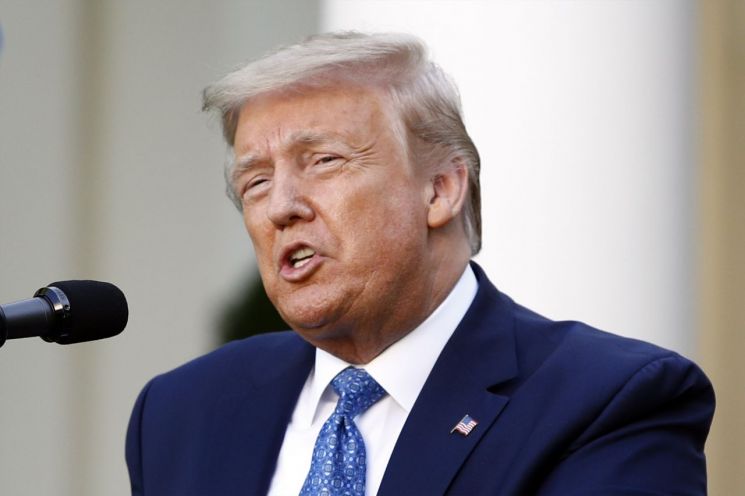
[Asia Economy New York=Correspondent Baek Jong-min] On the 17th (local time), U.S. President Donald Trump extended the existing economic sanctions against North Korea for another year, redefining North Korea as an "unusual and extraordinary threat." Instead of directly mentioning North Korea, President Trump appeared to focus on managing the situation by extending existing measures.
In a notification sent to Congress and published in the Federal Register on the same day, President Trump announced the extension of the effectiveness of six executive orders related to sanctions against North Korea, including Executive Order 13466 (June 26, 2008), which was issued during the George W. Bush administration.
Following Executive Order 13466, the orders subject to extension include Executive Order 13551 (August 30, 2010), Executive Order 13570 (April 18, 2011), Executive Order 13687 (January 2, 2015), Executive Order 13722 (March 15, 2016), which were expanded during the Barack Obama administration, and Executive Order 13810 (September 20, 2017), issued after President Trump took office. These North Korea-related executive orders require notification to Congress and publication in the Federal Register every year.
In the notification to Congress, President Trump stated, "The actions and policies of the North Korean regime continue to pose an unusual and extraordinary threat to the national security, foreign policy, and economy of the United States," and explained the necessity of maintaining the "national emergency" declared in the North Korea-related executive orders.
This extension is a routine measure, and the wording was the same as in previous years. The phrase "unusual and extraordinary threat" was also used during the Obama administration.
However, since the decision was made at a time when North Korea was taking steps to revert inter-Korean relations to the state before the June 15, 2000 Joint Declaration?such as blowing up the inter-Korean joint liaison office building and suggesting the deployment of troops in the Demilitarized Zone?there is an interpretation that this reaffirmed the stance that there will be no easing of sanctions without progress in denuclearization and also served as a warning to North Korea.
Meanwhile, President Trump again made no mention of North Korea's actions on this day.
© The Asia Business Daily(www.asiae.co.kr). All rights reserved.
![From Hostess to Organ Seller to High Society... The Grotesque Scam of a "Human Counterfeit" Shaking the Korean Psyche [Slate]](https://cwcontent.asiae.co.kr/asiaresize/183/2026021902243444107_1771435474.jpg)
















