Increase in Lane Departure and Emergency Braking Systems Leads to Lower Accident Rates
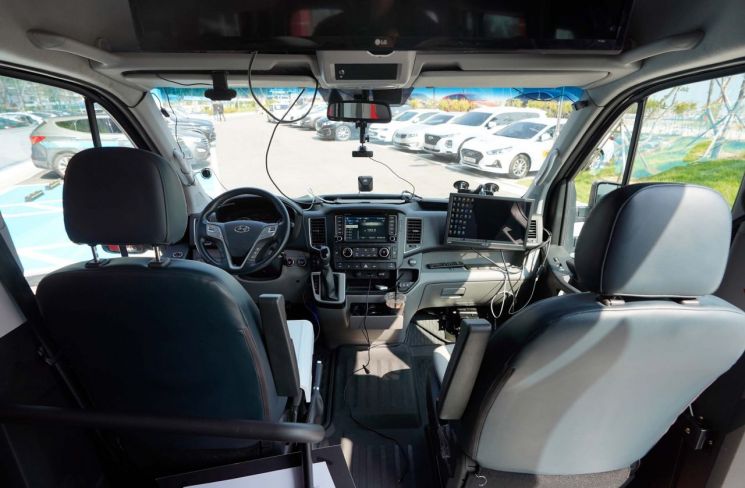
[Asia Economy Reporter Oh Hyung-gil] Son Hyun-soo (34), an office worker who visited a car dealership to purchase a new car, opted to install lane departure prevention devices and forward collision warning systems based on the salesperson's recommendation. Although it cost over 1 million won in additional expenses, he considered it not a loss if it could prevent traffic accidents. The fact that installing safety devices could reduce car insurance premiums also influenced his decision.
As autonomous driving technology advances, the number of drivers equipping their vehicles with advanced safety devices is rapidly increasing. These have become 'essential options' that help prevent potential accidents in advance. However, while the traffic accident rate has decreased, repair costs have risen due to expensive parts.
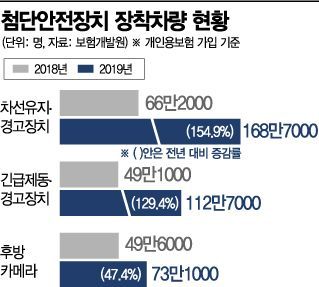
According to the Insurance Development Institute on the 17th, last year, vehicles equipped with Lane Departure Warning System (LDWS) and Lane Keeping Assist System (LKAS) reached approximately 1.687 million units, a sharp increase of 154.9% compared to the previous year. During the same period, vehicles equipped with Forward Collision Warning (FCW) and Autonomous Emergency Braking (AEB) systems also increased by 129.4% to 1.127 million units compared to the previous year.
LDWS is a driving convenience system that alerts the driver with warning sounds when the vehicle departs from its lane without the turn signal being activated, helping to promote safe driving. LKAS assists by steering the wheel to maintain the lane when the vehicle drifts, preventing accidents caused by drowsy or inexperienced driving.
FCW warns of collision risks in advance when the vehicle approaches another vehicle ahead, and AEB automatically reduces speed or stops the vehicle without the driver pressing the brake pedal in case of collision risk.
Vehicles equipped with rearview cameras, which assist in parking or reversing, also recorded about 731,000 units, a 47.4% increase compared to the same period last year.
Safety devices, also known as Advanced Driver Assistance Systems (ADAS), are expanding their market presence as they are now applied not only to luxury cars but also to compact cars. Due to their effectiveness in reducing accident risks, insurance companies have introduced special discounts of up to 8% on premiums for vehicles equipped with advanced safety devices.
The number of accidents has also decreased with the installation of safety devices. According to the Insurance Development Institute's investigation of accident cases relative to the number of personal automobile insurance subscribers last year, the accident rate dropped by 1.0 percentage point from 18.8% in 2018 to 17.8% last year. This reflects a reduction in minor damages and low-speed collisions due to advanced safety devices.
However, there has been a counter-effect of increased repair costs due to the high price of advanced safety devices. Examining last year's automobile property insurance loss amounts, the proportion of small claims under 500,000 won decreased by 3.1% to 24.8% compared to the previous year, while claims between 500,000 and 1.5 million won increased by 1.0%, those between 1.5 million and 4 million won rose by 1.7%, and claims exceeding 4 million won also increased by 0.5%.
An official from the property insurance industry explained, "While the increase in repair costs cannot be solely attributed to advanced safety devices, the parts themselves are expensive, so replacement and repair costs rise in the event of an accident," adding, "However, most drivers tend to install these devices if it means reducing accidents, even if it involves additional costs."
© The Asia Business Daily(www.asiae.co.kr). All rights reserved.
![Clutching a Stolen Dior Bag, Saying "I Hate Being Poor but Real"... The Grotesque Con of a "Human Knockoff" [Slate]](https://cwcontent.asiae.co.kr/asiaresize/183/2026021902243444107_1771435474.jpg)

















