Asia Economy & Seoul City Joint Project [Work-Life Balance 2.0 Era]
'Work-Life Balance Strong Small Business' _ Cloud Service Company 'Didim365'
Employees Getting Married and Having Children During Company Growth
Decided to Revise System with Seoul City Consulting
"Dad, are you going on a business trip today?"
For Lee Jeong-ho, head of the corporate research institute at Didim365, who has been working from home for six years, going to the office is referred to as a business trip by his family. His two daughters find it unusual that their dad goes to the office 2 to 3 days a week out of the 5 working days. Lee said, "My younger child is amazed that her friends' dads go to the office every day. If I had commuted 2 to 3 hours daily, I wouldn't have been able to pay as much attention to my kids, so I am satisfied to be able to stay by their side."
[Asia Economy Reporter Lee Hyun-joo] Lee, who lives in Yongin, Gyeonggi Province, started working from home on specific days since 2015 and has continued ever since. To focus solely on work, he changes clothes before starting work and enters a separate room prepared for work at 9 a.m. He works until 6 p.m., but has breakfast, lunch, and dinner with his family. Didim365, where Lee works, is a cloud service company located in Geumcheon-gu, Seoul. It is a small and medium-sized enterprise with about 70 employees.
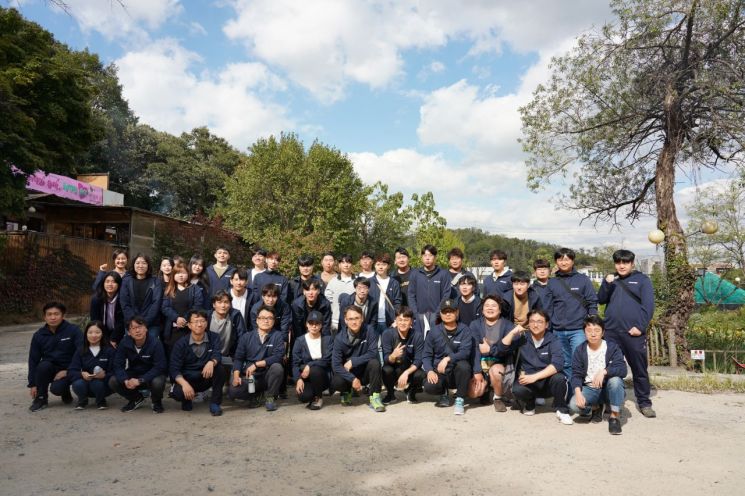 All employees of Didim365 are taking a commemorative photo after trekking Gwangmyeong Gureumsan. (Provided by Didim365)
The company was not affected by the spread of the novel coronavirus (COVID-19). Although the company had prepared scenarios for a 'shut down' (temporary work suspension), it did not change its work style. For Lee, the only change was that his work-from-home days increased from 2-3 times a week to a fixed 3 times a week. Other than that, there was little change. Inside the company, Lee had been practicing remote work for over five years, so video conferences and phone reports were familiar. Besides Lee, one other department head also works from home.
At the beginning of implementing remote work, Lee systematized attendance and created a program that automated vacation, expense, and fieldwork approvals to create a workable environment. He said, "Sometimes I regret not being able to bond with new employees because I don't work five days a week, but unnecessary meetings have been reduced, and reports are accurately organized in documents, so I can carefully manage things that might otherwise be overlooked."
Formalizing Adjusted Commute Times and Establishing a 'Happiness Support Office' for Employee Complaints
Longer Tenure and Increased Sales Performance
When the company was founded in 2005, a work-life balance system was not yet in place. As the company grew over about ten years, unmarried employees got married and had children, creating a need for change. Under the existing system, some employees faced situations where they had to quit the company. This pressure was especially severe for women, who had to either fully entrust childcare to others or quit their jobs to raise their children themselves.
The company did not want to lose talent. They had to decide whether to continue as is. During a period of deep internal reflection, they received consulting from the Seoul Work-Life Balance Support Center and revamped their system. Through flexible work arrangements, employees could work from home or adjust their commute times by one-hour increments, allowing them to come and go without feeling pressured. Reasons for flexible work included childcare, studies, and time differences with overseas clients.
Kim Yoo-jung, head of the management support office, who started as a part-timer and rose to a managerial position, firmly states that she would not be where she is today without the flexible work system. Kim explained, "I had no one to take care of my child, so I quit my previous job and took a break before starting part-time work. I worked 2 to 3 hours a day and gradually increased by one hour." When her child entered elementary school, she considered quitting but was able to send her child to school and then go to work, leaving at 4 p.m. to pick up her child thanks to the flexible work system. Kim emphasized, "There is no disadvantage for reduced working hours, and department staff support it. It has already become part of the company culture, and most employees think, 'If I get married, I can do this too,' so the average tenure is relatively long at 4 to 5 years."
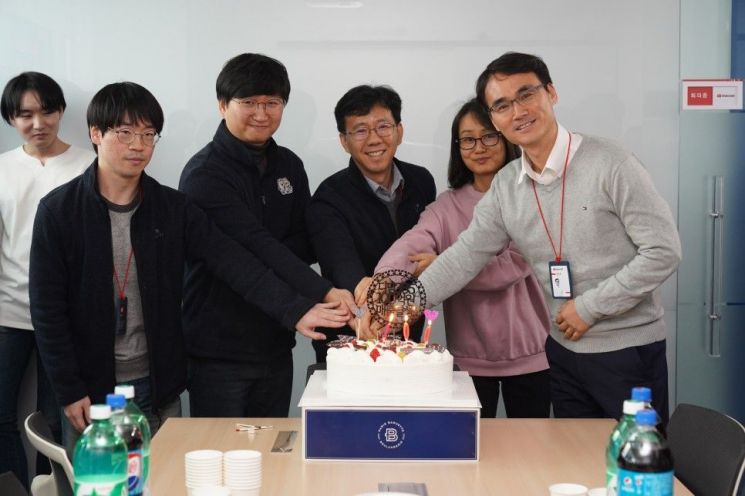 At the ceremony celebrating the achievement of 10 billion KRW in sales, long-term employees and Jang Min-ho, CEO of Didim365 (right), are cutting the cake. (Provided by Didim365)
Choi Chang-hwan, team leader of the system integration operations center, who had a child in January this year, uses a flexible work system that delays his start time by one hour. Choi said, "I was the first to get married and take maternity leave at the company, and the CEO and operations center director told me, 'Thank you for starting this. Thanks to you, the perception that the operations center is just a work-only organization is changing, and systems for work-family balance can be established,' which gave me great strength." He added, "Since our department operates 24 hours, there is some hesitation about taking leave, but regardless of seniority, the atmosphere is that those who really need to take leave can do so first."
Didim365 has a special department called the 'Happiness Support Office' that handles employee complaints. While in most companies such tasks are handled within HR or management support offices, this separate department was established to ensure employees have no discomfort. It is said to have high satisfaction among new employees who find it awkward to ask questions. To accommodate employees who prefer self-development over company dinners, the company converted those costs into welfare points worth about 800,000 KRW, which can be used in various ways.
At the end of last year, an incentive of about 2.6 million KRW was given to all employees to celebrate achieving 10 billion KRW in sales. CEO Jang Min-ho said, "I have worked at regular companies and venture firms, and even when companies performed well, I wondered if such work could sustain a sustainable life. I founded this company wanting to create a company where people come first and sustainable work is possible, so I have worked hard to establish a work-life balance system." Jang added, "I feel sorry that we couldn't provide benefits to employees sooner. Going forward, I want to support people inside and outside the company who dream of starting their own businesses."

© The Asia Business Daily(www.asiae.co.kr). All rights reserved.
![Clutching a Stolen Dior Bag, Saying "I Hate Being Poor but Real"... The Grotesque Con of a "Human Knockoff" [Slate]](https://cwcontent.asiae.co.kr/asiaresize/183/2026021902243444107_1771435474.jpg)


















