[Asia Economy Reporter Junho Hwang] A supercomputer has found the key to the commercialization of next-generation solar cells being developed for use in extreme environments such as space, deserts, and oceans. The problem with these solar cells was that their structure would change under high pressure or impact, rendering them unable to function as solar cells. However, with the supercomputer revealing the principles behind the structural changes, commercialization has become much closer.
Dr. Jeonghoon Lee's research team at the Computational Science Research Center of the Korea Institute of Science and Technology (KIST), in collaboration with Professor Jeffrey B. Neaton's team from the Department of Physics at the University of California, Berkeley, announced on the 17th that they have theoretically identified the causes of performance degradation in 'hybrid (organic-metal halide) perovskite solar cells' due to structural changes and metallization phenomena occurring under external pressure and impact.
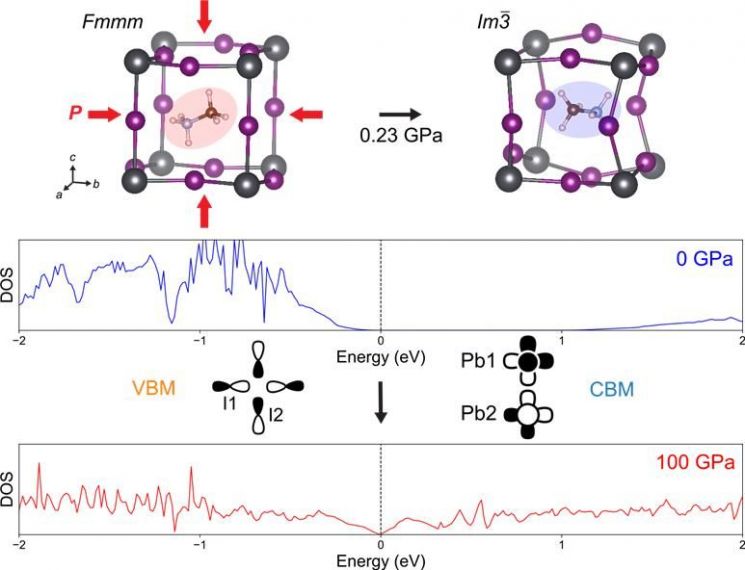
Solar cells are used in everyday life but are also widely used in extreme environments such as the atmosphere, space, deserts, and oceans. In particular, hybrid perovskite solar cells are gaining attention as replacements for conventional silicon solar cells due to their high efficiency and low production costs. However, these cells face commercialization challenges because when subjected to high external pressure or impact, they undergo a 'phase transition' from a tetragonal to a cubic structure and a 'metallization phenomenon' where electricity flows abnormally within the device, preventing normal function.

The research team elucidated the principles behind these issues using quantum mechanical theories powered by supercomputers. They accurately predicted the pressure at which the phase transition occurs and discovered that organic molecules under high pressure are induced to adopt a cubic structure rather than the original tetragonal structure for greater stability. Furthermore, they found that under high pressure, lead atoms?one of the elements in hybrid perovskites?interact to cause metallization, changing the material from an insulator to a conductor.
Dr. Lee of KIST stated, "This achievement provides a new theoretical guideline for the future development and optimization of high-performance hybrid perovskite solar cells," adding, "It is expected to contribute to establishing hybrid perovskite solar cells as the next-generation solar cells that can replace silicon solar cells." Based on this research, Dr. Lee is conducting studies to develop materials that replace organic metals and lead to prevent structural changes.
This research was published in ACS Energy Letters, an international journal in the field of energy materials.
© The Asia Business Daily(www.asiae.co.kr). All rights reserved.
![Clutching a Stolen Dior Bag, Saying "I Hate Being Poor but Real"... The Grotesque Con of a "Human Knockoff" [Slate]](https://cwcontent.asiae.co.kr/asiaresize/183/2026021902243444107_1771435474.jpg)

















