Controversy Rekindled Over Konkuk University Budget Cuts
Universities with Poor Financial Conditions Flustered
High Education Act Amendment and Budget Reconsideration
Likely to Be Decided in the National Assembly
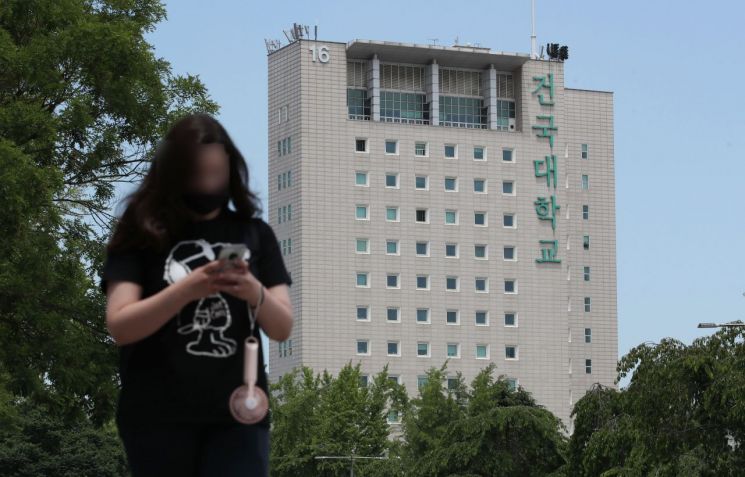
[Asia Economy Reporter Lee Hyun-joo] The demand for university tuition refunds triggered by the aftermath of the novel coronavirus infection (COVID-19) has reignited following Konkuk University's announcement of a tuition reduction. While most universities, excluding Konkuk University, have expressed reluctance citing lack of capacity, the issue is increasingly likely to be ultimately decided by the National Assembly.
According to Konkuk University on the 16th, the school plans to hold a meeting on the 18th to finalize the tuition refund issue. The refund will take the form of deducting a certain amount from the tuition for the second semester out of the tuition paid for the first semester. The reduction rate or amount will be decided through discussions with the student side. A Konkuk University official said, "It is expected to be slightly higher than the previously discussed special scholarship (around 200,000 won)." The school plans to secure funds for the reduction from the remaining budget and by abolishing merit-based scholarships.
On the other hand, four-year universities in Seoul are in a difficult financial situation due to years of tuition freezes, and they appear somewhat taken aback by Konkuk University's sudden reduction announcement. The method of converting university innovation project funds into special scholarships has also been blocked, and the Ministry of Education's requested "COVID-19 University Emergency Support Fund" of 190 billion won was not reflected in the third supplementary budget, making the situation even more difficult. A government official said, "If tuition is supported by government funds, it creates discrimination against young people who are not attending university," adding, "Tax support is fundamentally not allowed, and universities must come up with their own solutions."
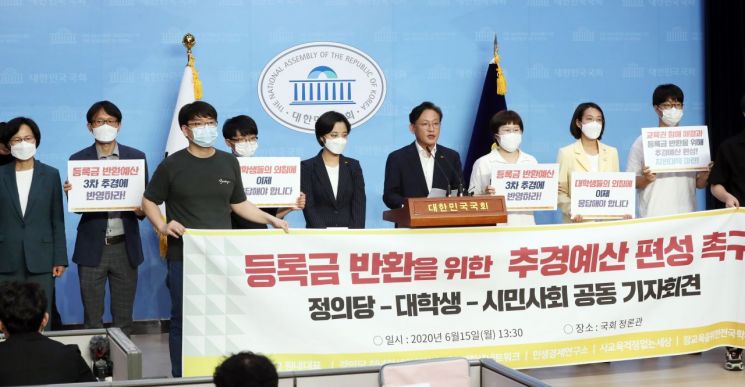
Attention is focused on whether this tuition reduction demand will lead to amendments to the Higher Education Act. The United Future Party proposed the 21st National Assembly's first bill, the "COVID-19 Crisis Escape Package Act," which includes a bill to add a clause on "infectious disease tuition refund support" to the Higher Education Act. It states that if normal educational activities are difficult due to a first-class infectious disease, the state or school may take necessary measures such as tuition refunds for enrolled students.
The Ministry of Education's budget, which was cut by the National Assembly's Budget and Accounts Special Committee before the supplementary budget passed, may be reconsidered. Park Won-seok, Policy Committee Chair of the Justice Party, emphasized, "The supplementary budget ignores the tuition refund demand agreed upon by 75% of the public," and said, "We will strive to ensure that the solution to this issue is included in the supplementary budget." A Democratic Party official said, "Although it is not yet decided as a party stance, a considerable consensus has been formed, and we are thinking positively."
Meanwhile, as universities face criticism over the low quality of remote education, they are expected to devise self-help measures. Jo In-sik, Legislative Research Officer at the National Assembly Legislative Research Office, mentioned in the issue analysis "Issues and Improvement Tasks Related to University Remote Classes," "Universities need to form learning communities that share teaching and learning methods and best practices related to remote classes, and the government needs to establish related infrastructure to support this."
© The Asia Business Daily(www.asiae.co.kr). All rights reserved.


















