Numerous Laws Ignoring Industry Reality
Possibility of Enacting 20s Failed Bills
Controversies Over Integrated Supervision Act and Interest Rate Limit Act
Concerns Over Negative Effects of One-Sided Push
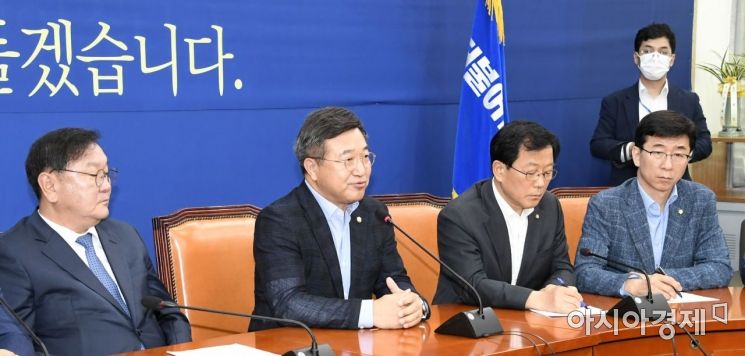 Yoon Ho-jung, Chairman of the National Assembly Judiciary Committee, is delivering a greeting at the joint meeting of standing committee chairpersons and floor leaders held at the National Assembly on the 16th. Photo by Yoon Dong-ju doso7@
[Asia Economy Reporter Kangwook Cho] The ruling party, the Democratic Party of Korea, has ultimately taken the chairmanship of the Legislation and Judiciary Committee, which was the biggest issue among the standing committees of the 21st National Assembly, causing the financial sector to tremble. This is because financial reform bills that failed to pass the Legislation and Judiciary Committee in the 20th National Assembly now have a very high possibility of being legislated, relying on the ruling party's overwhelming majority of 177 seats.
Financial companies, facing a crisis due to ultra-low interest rates and low growth triggered by the COVID-19 pandemic, are expressing strong concerns that the bills ignore the changed business environment compared to when the legislation was initially pursued. In the market, there are also critical voices that the National Assembly is not supporting financial companies that are fully committed to financial support amid COVID-19, but rather focusing solely on increasing restrictive regulations. ▶Related article page 3
According to the financial sector on the 16th, financial authorities and the ruling party are successively introducing financial-related bills that failed to pass the National Assembly due to opposition from the opposition party in the 20th National Assembly.
A representative example is the recently announced 'Financial Group Integrated Supervision Act.' This bill, which the Moon Jae-in administration set as one of its top 100 national tasks since 2017, aims to establish an internal control system for six major complex financial groups?Samsung, Hyundai Motor, Hanwha, Mirae Asset, Kyobo, and DB?to prevent the entire group from becoming insolvent due to the insolvency of one affiliate, based on the principle of separating finance and industry. Although some regulations such as limits on acquiring shares of non-financial companies and orders to dispose of shares have been excluded, the bill is criticized as effectively tightening control over large conglomerates by scrutinizing governance and internal transactions. Despite market concerns, the bill is expected to pass the plenary session of the National Assembly smoothly.
The 'Partial Amendment to the Interest Restriction Act,' proposed by Democratic Party lawmaker Kim Cheol-min on the 1st, which lowers the statutory maximum interest rate from 24% to 20% per annum and prohibits the total interest from exceeding the principal, is also controversial. Contrary to the intention of reducing the burden on low-credit and low-income households, there are concerns that lowering the maximum interest rate could drive these people into illegal private loans. This bill was also proposed by Democratic Party lawmaker Song Gap-seok in the 20th National Assembly; at that time, the bill passed the Political Affairs Committee but failed to pass the Legislation and Judiciary Committee due to opposition from the opposition party over such adverse effects. However, this time, with the ruling party holding the chairmanship of the Legislation and Judiciary Committee, legislation is highly likely.
The financial industry feels as if misfortunes are piling up. Amid the increased burden of capital expansion due to COVID-19 risks, such as the Risk-Based Capital (RBC) ratio, implementation of the New Solvency Regime (K-ICKS), and Liability Adequacy Test (LAT), they are now facing additional tightening regulations.
Experts express concern that while the government calls for financial innovation and global competitiveness, it simultaneously ignores the changed economic environment and merely rides on the political situation of the 'ruling party's overwhelming majority.' They point out that pushing through legislation unilaterally without careful review could cause serious side effects in the future.
Professor Kim Sang-bong of the Department of Economics at Hansung University said, "It is inappropriate to hastily push forward legislation out of inertia, and when proposing bills, one must broadly consider the underlying aspects of the system and its consequences." He added, "For example, if the Interest Restriction Act is amended to lower the maximum interest rate to 20%, there could be side effects such as more than one million people being driven into illegal private loans."
© The Asia Business Daily(www.asiae.co.kr). All rights reserved.

















