800MHz Band Allocated for 5G Use
Total 30MHz Bandwidth Likely to Be Put Up for 'Frequency Auction'
800MHz Has Good Diffraction Rate, Rated as 'Prime'
Expected to Emerge as a 'Key Player' in Expanding 5G Coverage
[Asia Economy Reporter Koo Chae-eun] As the 800 MHz frequency band returned due to the termination of 2G is allocated to 5G, it is expected to emerge as a 'key player' in the future quality of 5G networks. The 800 MHz band is considered a 'prime frequency' with lower loss rates and better diffraction rates (the rate at which signals bypass obstacles) compared to the 3.5 GHz band allocated to the three mobile carriers for 5G use in 2018. Since frequencies are scarce resources that serve as 'roads' carrying voice, data, and video, and have a decisive impact on network quality, fierce competition among the three carriers is anticipated over the auction for the 800 MHz allocation.
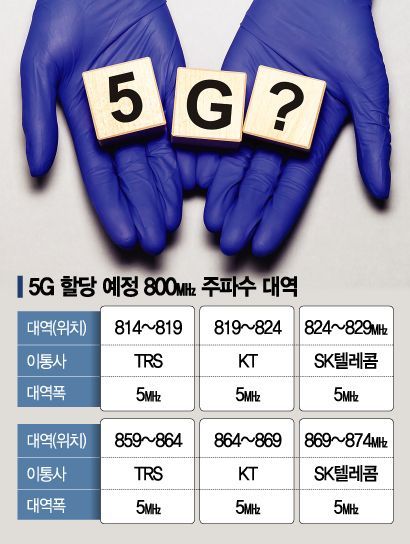
◆ 800 MHz left over from 2G termination allocated to 5G = According to the industry on the 16th, the Ministry of Science and ICT decided to use a total bandwidth of 30 MHz in the 800 MHz band for 5G. This includes 10 MHz of the 800 MHz band returned by SK Telecom due to the 2G termination, 10 MHz returned by KT due to investment non-fulfillment, and 10 MHz previously held by the Frequency Shared Communication (TRS) operator, totaling 30 MHz. A Ministry of Science and ICT official stated, "In order to improve 5G network quality, we plan to utilize the 800 MHz band from the 2G termination along with adjacent bands for 5G in the mid to long term by bundling them." Since the 800 MHz band will be used for 5G, it will be newly allocated, requiring carriers to participate in an auction for frequency allocation.
The reason the 800 MHz band is important for 5G is that it can complement the weaknesses of the existing high-frequency 3.5 GHz band allocation and improve communication quality. While 3.5 GHz has strong directivity, it has a high reflection rate and low diffraction rate when encountering obstacles. This means the radio wave reach is short and bypassing obstacles is difficult. When signals meet building materials such as glass, bricks, or cement, the signal weakens, reducing the strength of signals transmitted from outdoors to indoors. This is one reason why 5G has the stigma of 'not working well indoors.' The base station radius is also short, requiring about five times denser base station installation than 4G. This problem is similar for the 28 GHz band, which carriers are also pushing to introduce due to its higher efficiency than 3.5 GHz. On the other hand, the low-frequency 800 MHz band allows for a wider radio wave path with fewer base stations, reducing base station investment costs. An industry insider analyzed, "To maintain the fast speeds of high-frequency bands while compensating for weaknesses such as indoor signal weakening, an appropriate mix of low-frequency bands is necessary."
Currently, among the 5G frequency bands secured by the three carriers, SK Telecom and KT each have 100 MHz in the 3.5 GHz band, while LG Uplus holds 80 MHz. Additionally, all three carriers equally possess 800 MHz in the 28 GHz band. Another industry insider stated, "The 800 MHz band has high utility for services requiring ultra-low latency of 5G while transmitting small amounts of data such as low-power Internet of Things (IoT), and will serve as a backup for the existing 3.5 GHz network."
◆ The cost of reallocation is key... Increased burden on carriers = If the 800 MHz band goes to auction, the burden on carriers could increase further. The total frequency subject to reallocation next year is 320 MHz, which accounts for 78% of the total frequency cost that carriers must pay. Investment in the 3.5 GHz and 28 GHz bands allocated for 5G use is also slow due to capital expenditure (CAPEX) burdens. An industry official said, "If the reallocation cost for LTE and lower services is set too high, investment in frequency bands for 5G use will naturally become burdensome," adding, "The reallocation cost for existing frequency bands must be reasonably set so that the three carriers can pay more attention to newly allocated 5G bands."
Meanwhile, according to the Ministry of Science and ICT, as of the end of April, the number of 5G subscribers in Korea exceeded 6.33 million, surpassing 6 million within one year of commercialization. The three carriers expected 5G subscribers to reach 10 million this year after surpassing 5 million last year, but subscriber growth has been gradual due to slow coverage expansion and network quality issues.
© The Asia Business Daily(www.asiae.co.kr). All rights reserved.


















