Lee Tae-ho, 2nd Vice Minister, Summons Koji Domita, Japanese Ambassador to Korea
[Asia Economy Reporter Lim Cheol-young] The Ministry of Foreign Affairs strongly protested on the 15th against the historical distortion by the Japan Industrial Heritage Information Center, which was opened to the public, and the complete failure to implement the follow-up measures promised at the time of the registration of modern industrial facilities as World Cultural Heritage.
Kim In-cheol, spokesperson for the Ministry of Foreign Affairs, stated on the day, "Our government strongly protests that the follow-up measures recommended by the World Heritage Committee (WHC) and promised by Japan at the time of the registration of Japan’s modern industrial facilities as World Heritage in July 2015 have not been implemented at all in the exhibition content of the Japan Industrial Heritage Information Center located in Tokyo, which has been opened to the public." Earlier, Lee Tae-ho, the second vice foreign minister, summoned Koji Domita, the Japanese Ambassador to Korea, to the Ministry of Foreign Affairs building in Doryeom-dong, Seoul, in the afternoon.
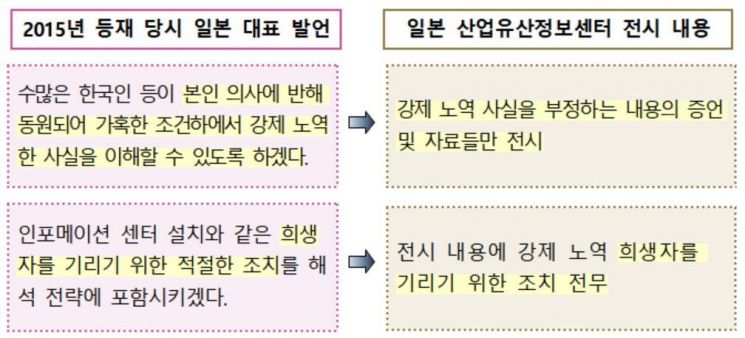
The Japanese government promised to make the forced labor facts understandable when registering the modern industrial facilities as World Cultural Heritage but did not fulfill this promise. Spokesperson Kim said, "The Japanese government stated that as a concrete follow-up measure to implement the World Heritage Committee’s recommendation, it would make it possible to understand the fact that numerous Koreans, among others, who were acknowledged by Japan itself, were mobilized against their will and forced to work under harsh conditions. However, the content of the center directly contradicts such promises and includes a complete distortion of historical facts, which is deeply regrettable."
He added, "In particular, the Japanese government promised to establish the information center as a measure to honor the victims of forced labor, but there is no effort to commemorate the victims anywhere in the exhibition content of the newly opened center, which causes concern and disappointment."
He urged compliance with the decision of the World Heritage Committee. Spokesperson Kim said, "The government once again solemnly urges Japan to faithfully implement the promises made to Korea and the international community at the time of the World Heritage registration and to thoroughly comply with the World Heritage Committee’s decision recommending an understanding of the full history of each facility."
In July 2015, the World Heritage Committee decided to register 23 sites of Japan’s Meiji Industrial Revolution as World Heritage (WHC Decision 30 COM 8B.14) and recommended establishing an interpretive strategy to enable an understanding of the full history of each site.
Among the 23 registered sites, forced labor victims including Koreans occurred at seven sites, including Hashima (Gunkanjima) Coal Mine, Miike Coal Mine, Takashima Coal Mine, Yahata Steelworks, and three facilities within the Mitsubishi Shipyard.
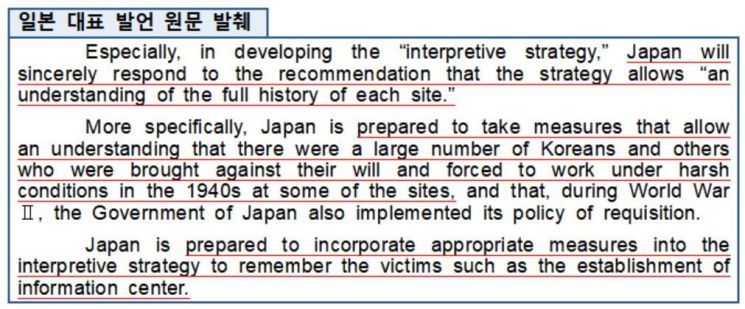
At that time, the Japanese representative stated that to faithfully implement the committee’s recommendations, they would take measures to make it possible to understand the fact that numerous Koreans, among others, were mobilized against their will and forced to work under harsh conditions at some facilities in the 1940s, and include appropriate measures to honor the victims, such as establishing an information center, in the interpretive strategy.
© The Asia Business Daily(www.asiae.co.kr). All rights reserved.
![Clutching a Stolen Dior Bag, Saying "I Hate Being Poor but Real"... The Grotesque Con of a "Human Knockoff" [Slate]](https://cwcontent.asiae.co.kr/asiaresize/183/2026021902243444107_1771435474.jpg)

















