5-Year Average Annual Growth of 21%
[Asia Economy Reporter Hwang Yoon-joo] As the global distribution market rapidly reorganizes around e-commerce due to the spread of the novel coronavirus infection (COVID-19), trends such as 'aging population increase,' 'product diversification,' 'online-offline convergence,' and 'introduction of innovative technologies' are emerging as key keywords.
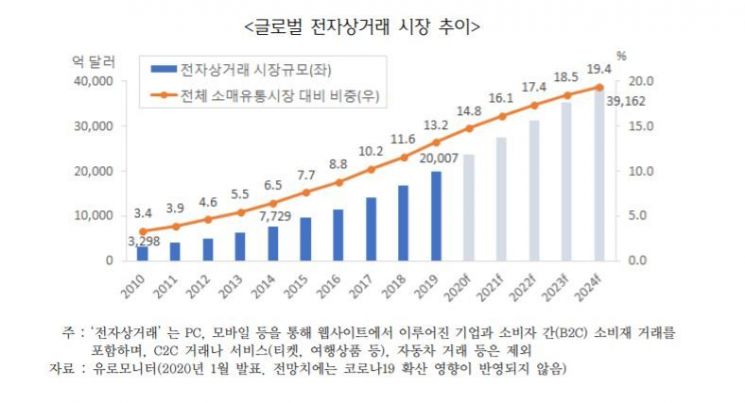
According to the "Global E-commerce Trends After COVID-19" report released on the 15th by the Korea International Trade Association's International Trade and Commerce Research Institute, e-commerce accounted for 13.2% of the global retail distribution market in 2019 and has grown at an average annual rate of 21% over the past five years. The e-commerce market, which grew even more during the pandemic, is expected to maintain a steep growth trend after the pandemic ends, establishing online retail as a daily norm.
The report emphasized, "Attention should be paid to the online transition of elderly consumers who previously preferred offline shopping," and forecasted, "The elderly, who have become accustomed to IT devices and internet use due to COVID-19, will further expand their use of e-commerce as they experience the convenience, diverse products, and excellent quality of grocery delivery, subscription-based online video services (OTT), and more."
The range of products purchased through e-commerce has also diversified. Not only personal hygiene products such as masks and sanitizers, IT devices related to telecommuting, and home fitness items under the home economy (home+economy) category, but also fresh foods and daily necessities, which were major offline consumer items, have shifted to online purchases. Companies are responding with cold chain technology and ultra-fast delivery services.
The boundary between online and offline is also rapidly disappearing. 'BOPIS' (Buy Online, Pick-Up in Store), where products purchased online are picked up at stores, and live streaming commerce, where shopping is done while watching live broadcasts on smartphones, are gaining popularity. With the introduction of innovative IT technologies such as augmented reality (AR) and the Internet of Things (IoT), consumers can test cosmetics and clothing or arrange furniture at home, and real-time logistics tracking and automatic ordering of electronic device consumables have also become possible.
© The Asia Business Daily(www.asiae.co.kr). All rights reserved.
!["The Woman Who Threw Herself into the Water Clutching a Stolen Dior Bag"...A Grotesque Success Story That Shakes the Korean Psyche [Slate]](https://cwcontent.asiae.co.kr/asiaresize/183/2026021902243444107_1771435474.jpg)
















