Franchise Association and Robot Industry Promotion Agency Begin Developing Robot Utilization Operation Model
Developing Models Usable at Coffee Bay and Go Pizza Franchise Stores
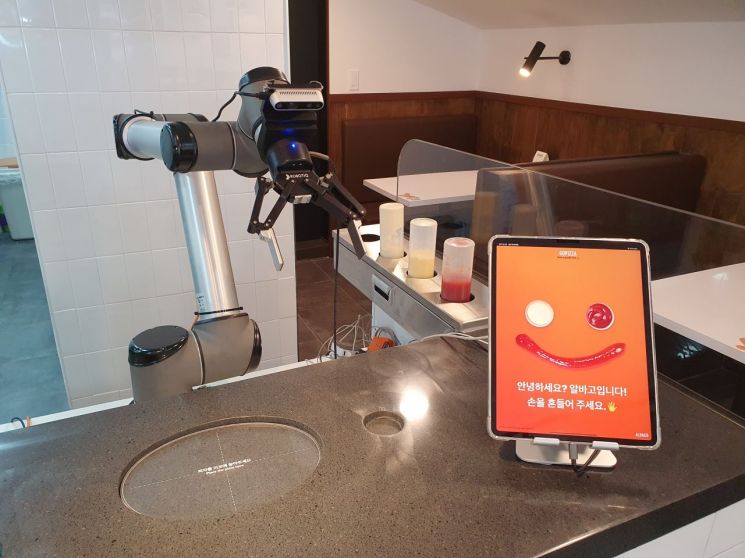
[Asia Economy Reporter Choi Saeng-hye] The dining franchise industry is recently accelerating the development of collaborative robots in response to the increased labor cost burden on small business owners and the spread of untact (contactless) consumption culture.
The Korea Franchise Industry Association announced on the 14th that it has recently completed an agreement with the Korea Institute for Robot Industry Advancement on the project "Industrial Activation for the Distribution of Collaborative Robots in Franchise Stores" under the "2020 Service Robot Utilization Demonstration Project," and will begin model development with Coffee Bay and GoPizza.
The "Service Robot Utilization Demonstration Project" is a business that introduces collaborative robots to franchise stores and other dining establishments to demonstrate their effectiveness for in-store customers as well as delivery and takeout order customers.
The project scale is approximately 380 million KRW in total, of which about 270 million KRW is government funding, and about 110 million KRW is the contribution from the robot adoption demand sources. The association, as the lead organization, will develop collaborative robots and utilization models that can be used at franchise store sites with Coffee Bay and GoPizza respectively.
Coffee Bay plans to develop a collaborative robot capable of performing simple and repetitive coffee-making tasks and unmanned sales during nighttime, aiming to verify a 24-hour operation system for improving product and service quality and store operation efficiency.
Additionally, GoPizza plans to automate the entire post-processing process?including cutting, moving, and sauce drizzling after oven pizza cooking?with collaborative robots, developing a "one-person kitchen" model that reduces the possibility of accidents during cooking while providing products of consistent quality.
Through this, the dining franchise industry is expected to achieve various outcomes such as ▲reducing labor costs required for product manufacturing and management ▲increasing untact consumption sales and revitalizing startups ▲improving product and service quality through process standardization ▲enhancing consumer convenience and advancing dining culture.
An association official stated, "When people think of robots, they usually imagine robots in manufacturing sites, but there are many areas where significant effects can be achieved in dining franchise stores as well," adding, "We will strive to enable small and medium franchise companies with limited resources to utilize these widely and contribute to the management stability of small business owners."
© The Asia Business Daily(www.asiae.co.kr). All rights reserved.

















