'K-Jangnyeo', a trending term combining Korea's 'K' and 'jangnyeo' meaning eldest daughter
Adding the burdens traditionally placed on the eldest and the roles imposed on women
Experts say "It also criticizes the contradictions of the patriarchy"
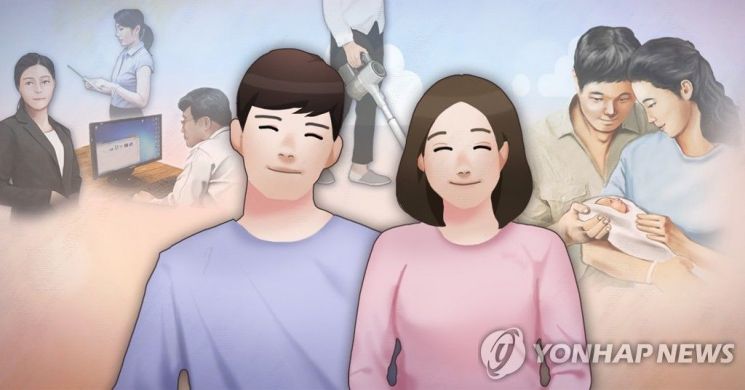
[Asia Economy Intern Reporter Kim Seul-gi] "The eldest daughter is the foundation of the household," "If our daughter doesn't understand her parents' hearts, who will?"
Recently, the term 'K-Jangnyeo' has become a hot topic on online communities and social networking services (SNS). 'K-Jangnyeo' is a trendy term combining the letter 'K' from Korea, as seen in 'K-pop' and 'K-quarantine,' with 'Jangnyeo,' meaning eldest daughter. It mainly refers to women who have lived sacrificing themselves or under emotional oppression in patriarchal families.
The characteristic of K-Jangnyeo is that, in addition to the burdens traditionally placed on the eldest son or child, it includes the roles forced upon women within the patriarchal system. They often bear the responsibility of supporting their parents while also fulfilling emotional expectations to treat their parents warmly and 'like a proper woman.'
Experts explain that the term 'K-Jangnyeo' serves as a critique of the contradictions inherent in the traditional patriarchal system present in Korean society.
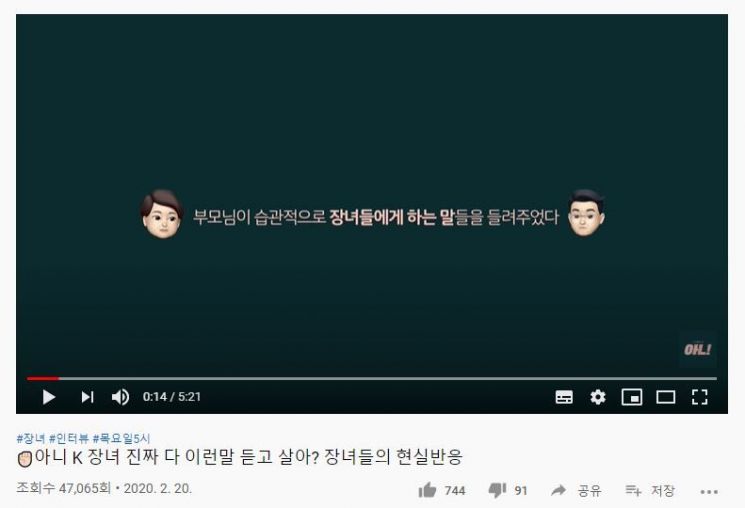 When searching for 'K-Jangnyeo' on the video platform YouTube, the top-ranked content titled 'No, do all K-Jangnyeo really hear these kinds of comments? The real reactions of eldest daughters' has about 46,000 views and approximately 200 supportive comments./Photo by YouTube channel 'Ani' screenshot
A 27-year-old office worker A, who refers to herself as a 'K-Jangnyeo,' said, "After seeing the term 'K-Jangnyeo' trending on SNS recently, I often use it when talking with friends," adding, "Office workers jokingly call themselves 'company slaves.' I think it's a similar context."
A said, "Honestly, if you haven't experienced it, you might not understand well, but if you're an eldest daughter with a younger brother, you might relate to some extent," and added, "Discrimination appears differently from my parents' generation. It's subtle, so unless you're the person involved or share the same experience, it's often hard to understand. Many friends didn't get it when I talked about it."
She continued, "When I said I wouldn't get married, they stopped calling me 'the foundation of the household,' but discrimination still shows up here and there," and said, "Being the firstborn daughter, they expect me to play all roles?from being the cute daughter to being responsible for the household finances?but I've given up now. My parents are always disappointed in me, but there's nothing I can do."
Another office worker B, 24, who also considers herself a 'K-Jangnyeo,' said, "My mother's phone saves my name as 'My Hope,' while my younger brother is saved as 'Beloved Son.' Seeing this made me think that my parents have higher expectations for me than for my brother," and added, "As a daughter, they demand more emotional connection than they do from my brother. Many parents want a sweet, affectionate daughter, but not many want an affectionate son or a son who always yields."
The term 'K-Jangnyeo,' carrying this meaning, is also gaining much sympathy on YouTube. When searching for 'K-Jangnyeo' on YouTube, the top-ranked content titled 'No, do all K-Jangnyeo really hear these things? Real reactions from eldest daughters' has about 46,000 views and around 200 empathetic comments.
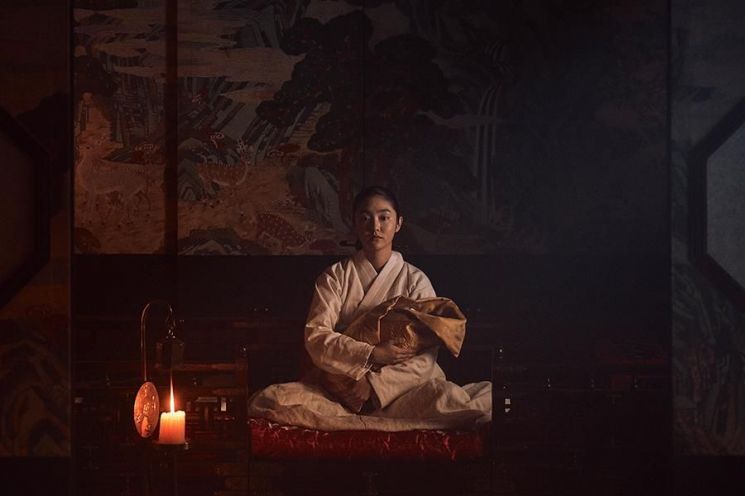 Last year, in the Netflix original series Kingdom, the character "Jungjeon," who is not recognized by her father simply because she is a daughter, gained support from female viewers. The photo shows Jungjeon from the Netflix original series Kingdom. Photo by Netflix
Earlier, in last year's Netflix original series 'Kingdom,' the character 'Queen,' who was not recognized by her father simply because she was a daughter, received support from female viewers.
Actress Kim Hye-jun, who played the role, said in an interview with Sports Chosun, "It was upsetting that many women related to this character. It was upsetting to realize 'I'm not the only one feeling this way.'"
The essence of K-Jangnyeo is that it differs from the previously existing 'Good Child Complex' and 'Eldest Child Complex.' It combines the responsibility expected of the eldest child with the traditional female role burdens imposed under a patriarchal society.
In fact, a research study confirmed that the responsibility expected of women in traditional patriarchal societies, such as supporting parents, is much higher than that expected of men.
According to last year's research conducted by the 'Center for International Migration and Inclusive Societies' (Director Eun Ki-soo) at the Graduate School of International Studies, Seoul National University, over 70% of primary caregivers were women, including daughters (35.0%) and daughters-in-law (36.7%).
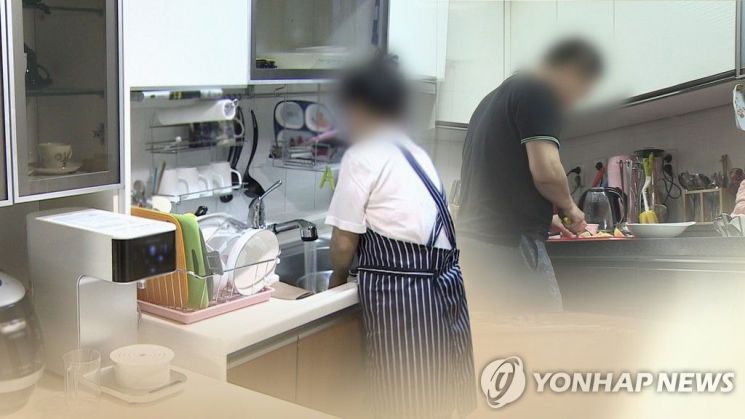
Experts explain that the term 'K-Jangnyeo' carries a critical perspective on the contradictions of the traditional patriarchal system in Korean society.
Professor Lee Soo-jung of the Department of Criminal Psychology at Kyonggi University explained in an interview with the tvN variety show 'Secret Garden' last year, "There is an old saying in our country, 'The eldest daughter is the foundation of the household.' In the past, eldest daughters were those who were not sent to school but went to factories to support their younger siblings. Even now, although no one is explicitly responsible for them, living under such perceptions and treatment, the eldest daughters tend to bear heavy responsibilities."
Professor Lee Dong-gwi of the Department of Psychology at Yonsei University also said, "It seems to contain a critical view of the responsibility, concession, and humility unilaterally imposed on women under patriarchy. It can also be seen as a skeptical view of the inheritance of responsibility, especially stereotypes about femininity and eldest daughters."
He added, "I think this concept does not fit well in an era where traditional families are breaking down, single-person households are rapidly increasing, the number of children is decreasing, and more women are choosing not to marry."
© The Asia Business Daily(www.asiae.co.kr). All rights reserved.
!["The Woman Who Threw Herself into the Water Clutching a Stolen Dior Bag"...A Grotesque Success Story That Shakes the Korean Psyche [Slate]](https://cwcontent.asiae.co.kr/asiaresize/183/2026021902243444107_1771435474.jpg)


















