Bank of Korea Monetary Policy and Credit Report Briefing
"It will be difficult to significantly deviate from the current low interest rate and low inflation trend"
"There is consideration on ways to enhance the effectiveness of monetary policy"
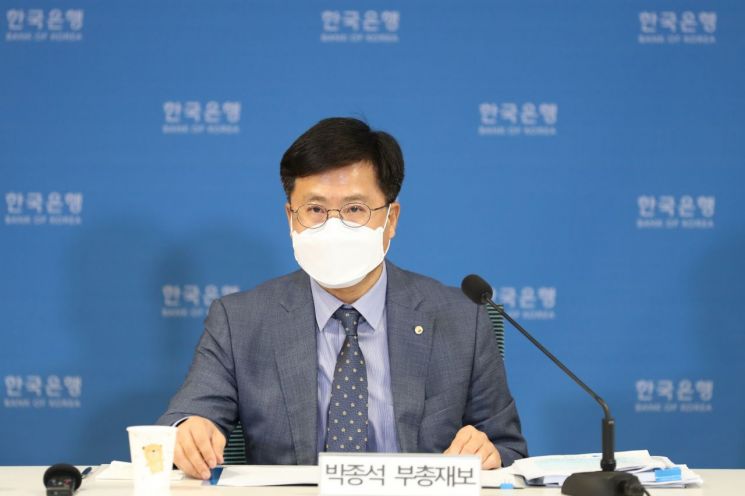 Park Jong-seok, Deputy Governor of the Bank of Korea, is speaking at the Monetary and Credit Policy Report (June 2020) briefing held at the Bank of Korea in Jung-gu, Seoul, on the morning of the 11th.
[Asia Economy Reporter Kim Eunbyeol] As the low interest rate and low inflation trend is expected to become the 'new normal' after the novel coronavirus infection (COVID-19), the Bank of Korea is also considering ways to replace the price stability target system.
On the 11th, Park Jongseok, Deputy Governor of the Bank of Korea, said at a press briefing on the Monetary and Credit Policy Report, "I think it will be difficult for the low interest rate and low inflation trend to deviate significantly even after COVID-19," and added, "We are thinking a lot about how to improve the current price stability target system to enhance the effectiveness of monetary policy."
The price stability target system is a policy in which the central bank sets a medium- to long-term inflation rate target (2%) in advance and operates monetary policy accordingly. However, as the inflation rate has recently declined, there is controversy over whether the price stability target system itself is an effective policy.
Deputy Governor Park cited price-level targeting and average-inflation targeting as examples of methods that could replace the price stability target system.
Price-level targeting is a method of setting a price index to be reached over a certain period. Under the current price stability target system, even if last year's inflation rate fell short of the target, this year's target is set based on the previous year. In contrast, price-level targeting sets a goal to be achieved over a specific period, so if the deadline approaches and the price target has not been reached, a more accommodative monetary policy is implemented.
Average-inflation targeting allows the inflation rate to exceed 2% during periods of economic growth, considering the low inflation trend during recessions. Deputy Governor Park explained, "(If improvement measures are introduced) there are discussions that the central bank's monetary policy would influence expected inflation, thereby raising actual inflation, and it would create room to make interest rate policy more flexible and adaptable."
However, he added, "Currently, discussions have slowed due to COVID-19, and since there is no consensus even within the U.S. Federal Reserve (Fed), we are continuously monitoring major countries and researching what kind of monetary policy framework suits our country's conditions."
Earlier, Lee Juyeol, Governor of the Bank of Korea, also appeared on a documentary program by Educational Broadcasting System (EBS) recently and said, "In a situation where deflation (price decline during economic downturn) is a concern, we are facing the issue of whether the price stability target system is truly suitable for reality and how it should be changed."
Meanwhile, Deputy Governor Park evaluated the Fed's announcement to maintain zero interest rates as "in line with market expectations." He continued, "If the U.S. maintains an accommodative monetary policy stance, I think there are positive aspects for emerging countries such as Korea," and added, "It will also have a helpful effect in operating our country's monetary policy." Currently, Korea's base interest rate has been lowered to 0.5%. Initially, the market viewed Korea's effective lower bound for the base rate to be around 0.5%, but as the Fed lowered its base rate to zero (0), Korea's effective lower bound is estimated to have fallen further.
© The Asia Business Daily(www.asiae.co.kr). All rights reserved.

















