[Asia Economy Reporter Seol Gina Jo] The Device Distribution Structure Improvement Act (Device Distribution Act), which has faced continuous calls for revision due to controversy over the 'communication blackout law' since its implementation, has emerged as a key issue in the telecommunications sector of the newly launched 21st National Assembly. Debates are expected over each issue, including the 'complete device self-supply system' proposed as a general election pledge by the United Future Party this year, the sales incentive reporting system, and the separate disclosure system. The government has also begun discussions to revise the Device Distribution Act for the first time in six years, paving the way for legislative competition in the second half of the year.
According to the National Assembly Legislative Research Office on the 10th, the report titled 'Major Legislative Policy Issues of the 21st National Assembly,' distributed to lawmakers' offices this week, included 'improvement of the Device Distribution Act' as one of the major telecommunications issues to be addressed in the 21st National Assembly. The Device Distribution Act, which has been in effect since October 2014, has been criticized for blocking competition among businesses contrary to the law's intent, infringing on market autonomy, and reducing consumer choice. The Legislative Research Office stated, "All stakeholders agree on the necessity to reorganize the Device Distribution Act to reflect the changed telecommunications market environment."
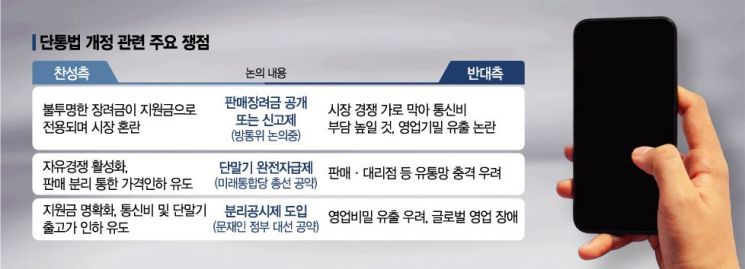
◆ Full-scale Legislative Competition... Examining the Issues= Major issues related to the revision of the Device Distribution Act include regulation of sales incentives, the complete device self-supply system, and the introduction of a separate disclosure system. These were proposed by lawmakers Byeon Jae-il, Park Beom-gye, Shim Jae-cheol, and Kim Seong-tae respectively in the 20th National Assembly. A total of 26 revision bills for the Device Distribution Act have been introduced over the past four years.
The complete device self-supply system aims to eliminate bundled sales of mobile communication services and devices to induce a reduction in device prices. In particular, the United Future Party clearly stated its intention to reignite discussions on this in the 21st National Assembly, having included it as an election pledge in April. The civic group Consumer Sovereignty Citizens' Meeting argued, "To fundamentally improve the current distribution structure where the fee system is complex and subsidies vary by mobile carrier even for the same device, the complete device self-supply system must ultimately be introduced."
Mobile carriers generally agree with the positive outlook that separating services and devices could lead to reduced communication costs for users. However, considering the impact on sales and agency distribution networks, they cannot simply support it unconditionally. Even within the same industry, subtle differences in positions appear depending on market share. Among carriers, SK Telecom is the most positive, while KT and LG Uplus take a more principled stance. Samsung Electronics, as a manufacturer, holds a cautious position, emphasizing the need to consider the impact on distribution networks first.
The separate disclosure system is also a hot topic. This system aims to induce device price reductions by transparently disclosing not only carriers' official subsidies but also manufacturers' subsidies. In the 20th National Assembly, lawmakers including Park proposed revision bills containing such provisions. However, concerns about the leakage of trade secrets persist, mainly among manufacturers. The Legislative Research Office reported, "While carriers and civic groups support the introduction of the separate disclosure system, manufacturers are passive."
◆ Consensus on Revising Incentives, Divergent Alternatives= Inside and outside the industry, there is a consensus that to eradicate illegal subsidies in the device distribution market, the opaque incentive system paid by carriers to sales and agencies must be revised. This is why the Ministry of Science and ICT, the competent authority, has been operating a consultative body since early this year to decide the direction of the Device Distribution Act revision and gather opinions.
However, opinions vary widely on alternatives such as disclosure and reporting systems for sales incentives. An official participating in the consultative body said, "Businesses express concerns about disclosing incentives, which are trade secrets, and the reporting system is not easy," adding, "There are significant differences in positions among businesses, distribution networks, and consumer groups." Within the distribution network, small businesses support the measures, while large-scale operators express dissatisfaction. A senior official at the Ministry of Science and ICT acknowledged that discussions on revising the Device Distribution Act are not easy but drew a line on the ongoing effectiveness controversy, saying, "It is not a side effect but a matter of expiration of effectiveness."
© The Asia Business Daily(www.asiae.co.kr). All rights reserved.

















