Formation of the 'Basic Income Deliberation Committee' Equivalent to the Minimum Wage Meeting
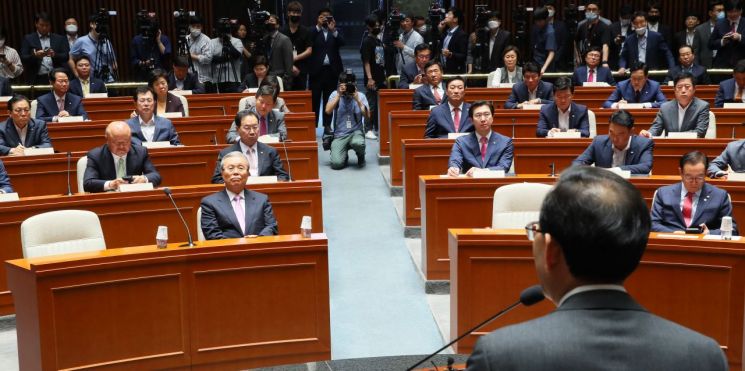
[Asia Economy Reporter Jang Sehee] Amid heated political debates surrounding the basic income system, Jo Hae-jin, a member of the Future United Party, plans to propose a basic income bill in June, marking the first such initiative from the opposition party. Since Kim Jong-in, the emergency committee chairman of the Future United Party, sparked discussions on the basic income system, attention is focused on the content of the opposition's first bill. Although even the opposition, which previously advocated selective welfare, now supports the concept of basic income, making the introduction of the basic income system a hot topic, securing funding remains a persistent challenge.
According to political circles, Representative Jo is preparing a basic income bill targeting the 'relatively poor lower-income class (50-70% of median income).' Regarding this, Jo stated on the 9th, "I plan to soon propose a basic income bill targeting economically vulnerable groups." The fact that the payment target is not the entire population signifies that the emphasis of the basic income is on addressing relative poverty, polarization, and welfare blind spots. It is known that Representative Jo had prior consultations with Chairman Kim about the bill's content.
Representative Jo is preparing the basic income bill not as an addition to existing welfare but as a concept that replaces and integrates current welfare systems. This is because basic income requires enormous resources. For example, providing a monthly basic income of 500,000 won per person to the entire population would require a budget of 310.68 trillion won annually.
Jo's bill is also expected to include provisions for the establishment of a Basic Income Committee, a deliberative body involving both public and private sectors. This committee would include relevant ministries such as the Ministry of Economy and Finance, the Ministry of the Interior and Safety, and the Ministry of Health and Welfare to formulate mid- to long-term plans and decide on the amount and recipients of basic income after thorough consultations before policy implementation. An annual evaluation will also be conducted on the bill's effects, including the replacement of existing welfare policies, elimination of welfare blind spots, and economic revitalization.
Additionally, the bill will include measures to adjust the scope of basic income recipients in urgent situations such as the COVID-19 pandemic. It is also reported that the bill will include provisions for local governments to secure funding and provide 'emergency special basic income.'
The Ministry of Economy and Finance, responsible for fiscal policy, holds the view that introducing basic income is premature. On the 1st, Hong Nam-ki, Deputy Prime Minister and Minister of Economy and Finance, stated, "Given our circumstances, the government's position is that the introduction of a basic income system is inappropriate." This is interpreted as meaning that once implemented, basic income is difficult to reverse and the enormous fiscal burden would be unsustainable. A ministry official also said, "We are not currently discussing specific funding measures," adding, "Since there is much overlap with existing welfare policies, sufficient discussion on this aspect is necessary." The official further noted, "If there are mentions from the Blue House, a comprehensive review within the administration will likely follow."
© The Asia Business Daily(www.asiae.co.kr). All rights reserved.
!["The Woman Who Threw Herself into the Water Clutching a Stolen Dior Bag"...A Grotesque Success Story That Shakes the Korean Psyche [Slate]](https://cwcontent.asiae.co.kr/asiaresize/183/2026021902243444107_1771435474.jpg)
















