On the 10th, Launch Ceremony of the 'Cement Nitrogen Oxides Reduction Council' Held
Seeking Solutions and Reduction Plans for Nitrogen Oxides, the Cause of 'Ultrafine Dust'
Applying Optimal Reduction Technology Expected to Decrease Emissions by up to 40,000 Tons
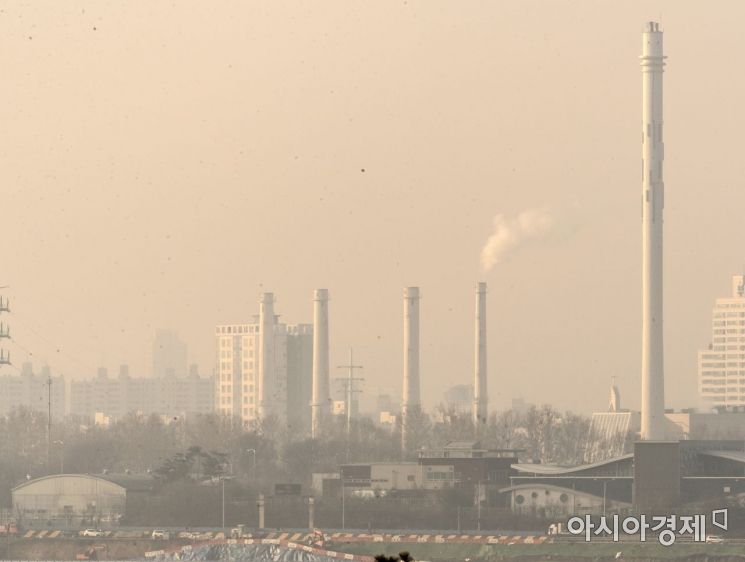
[Asia Economy Reporter Kim Bo-kyung] The government and the cement industry are joining forces to reduce fine dust. They plan to establish nitrogen oxide reduction targets and measures for the cement industry by the end of this year.
On the 10th, the Ministry of Environment will hold the launch ceremony of the "Cement Nitrogen Oxide Reduction Council" at Ssangyong Cement Donghae Plant located in Donghae City, Gangwon Province.
The council will include a total of 19 participants, including government officials, representatives from nine cement manufacturers, and air quality experts. The participating cement manufacturers are Ssangyong Cement, Sungshin Cement, Hanil Cement, Hanil Hyundai Cement, Sampyo Cement, Halla Cement, Asia Cement, Koryo Cement, and Union. They plan to establish nitrogen oxide reduction targets and measures for the cement industry by the end of this year.
The cement manufacturing industry emits large amounts of nitrogen oxides, a major contributor to ultrafine dust (PM2.5), requiring active efforts to reduce fine dust. Currently, the efficiency of nitrogen oxide pollution control facilities installed mainly at cement plants is mostly between 40-60%. Upgrading these to high-efficiency control facilities can achieve efficiency levels of up to 90%.
However, the cement industry has expressed difficulties in improving control facilities due to spatial limitations at sites, interference with other processes, and operational cost burdens.
The Ministry of Environment plans to form a council with industry and experts to reduce nitrogen oxides at cement plants and develop technical solutions through on-site investigations.
They will decide on reduction directions through various methods, including installing high-efficiency control facilities, improving manufacturing processes, and upgrading existing control facilities. Nitrogen oxide reduction targets will be set according to improvement plans, and detailed investment plans for each plant will be established to realize these targets.
In particular, to seek technical solutions, research and development (R&D) projects will be strengthened, and field demonstrations of various reduction technologies will be conducted. Support measures for costs invested in large-scale facility improvements are also under consideration.
The Ministry of Environment expects that if the optimal reduction technologies are applied on-site and the nitrogen oxide emission concentration of the cement industry falls below the emission charge standards, annual nitrogen oxide emissions will be reduced by approximately 40,000 tons or more.
Geum Han-seung, Director of Air Environment Policy at the Ministry of Environment, said, "If this council is successfully promoted, it could serve as a model applicable to other industries beyond cement," adding, "We will do our best to ensure that the measures prepared by the council lead to actual facility improvements."
© The Asia Business Daily(www.asiae.co.kr). All rights reserved.

















