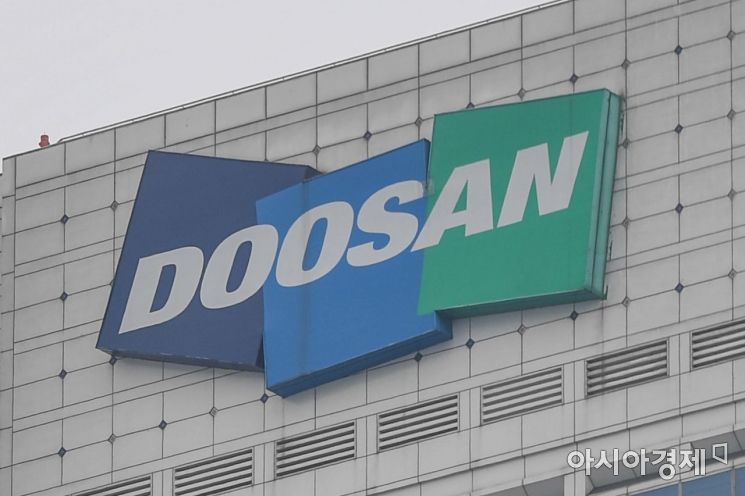
 On the 27th, the Doosan Tower building in Dongdaemun-gu, Seoul, is visible as the government decided to inject 1.6 trillion won into Doosan Heavy Industries, which is experiencing financial difficulties, through the Korea Development Bank and the Export-Import Bank of Korea. Photo by Kang Jin-hyung aymsdream@
[Asia Economy Reporter Ki-min Lee] Doosan Group is proceeding with the sale of affiliates, business units, and non-core assets to secure liquidity, but has yet to reach a conclusion.
According to the business community on the 7th, Doosan Group, which received a total of about 3.6 trillion won in support from creditors earlier this month, is currently undergoing the sale process of affiliates and business units to normalize management. Previously, Doosan Group submitted a management normalization plan (self-rescue plan) to the creditors last month, which included raising more than 3 trillion won in liquidity through capital increase, business structure reorganization, asset sales, and restructuring.
Doosan is actively working to implement the self-rescue plan, but the sale process is not smooth. The sale of Doosan Solus, initially classified as a prime asset, is also sluggish. Doosan values Solus, whose main business is copper foil (battery foil), at over 1.5 trillion won, considering its profitability and future value. However, the sale of Doosan Solus fell through due to disagreements with the private equity fund (PEF) Skylake, and major potential buyers such as Lotte Chemical and SKC did not participate in the preliminary bidding, causing difficulties. Recently, Solus's stock price surged, increasing its market capitalization by about 300 billion won compared to a month ago, reaching 1.2511 trillion won.
Doosan Group is negotiating the sale of Doosan Tower with the investment management firm Mastin Investment Management. The sale price is expected to be around the book value of Doosan Tower (681.1 billion won) at the time of Doosan's merger with Dutamall in 2018. After deducting secured loans and taxes, the amount Doosan Group can secure is projected to be around 200 billion won. In addition, Doosan has put Motrol BG, Doosan Tower, and golf courses operated by Doosan Heavy Industries on the market. In the case of Doosan Motrol BG, Doosan expects around 500 billion won, but potential buyers estimate about 400 billion won, making the sale difficult.
Because of this, speculation about the sale of Doosan Group's cash cow, Doosan Bobcat, is resurfacing in the industry. Bobcat recorded sales of 1.0642 trillion won and operating profit of 86.8 billion won in the first quarter of this year. Bobcat's performance declined due to the construction industry's downturn caused by the spread of COVID-19 this year. However, since it maintains the number one market share in the U.S., it is expected to benefit once the U.S. economic stimulus measures are fully implemented.
On the other hand, there is also a forecast that selling Bobcat will be difficult because Doosan Heavy Industries is likely to face a severe hardship period for several years. The creditors submitted to the government at the end of last month that Doosan Heavy Industries plans to restructure its business toward eco-friendly and renewable energy. Among the new businesses, wind power, considered eco-friendly energy, has low efficiency and a saturated market, making competition tough. The gas turbine, which Doosan Heavy Industries is pushing as its next core business, is still in the test operation phase and will take about three years to commercialize. An industry insider said, "Since Doosan Heavy Industries needs strength to endure until the restructured business gets on track, it will be difficult to sell the profitable subsidiary Bobcat."
© The Asia Business Daily(www.asiae.co.kr). All rights reserved.

















