[Asia Economy Reporter Suyeon Woo] Amid the worsening economic difficulties caused by the novel coronavirus infection (COVID-19), more than half of the population believes that the health insurance premium rate should not be increased next year.
On the 7th, the Korea Employers Federation (KEF) commissioned Korea Research to conduct the "Public Perception Survey on Health Insurance Burden," which found that 55.3% of all respondents answered that the premium rate should be frozen or lowered. While 35.9% said it should be frozen and 17.4% said it should be lowered, only 2.6% responded that it should be increased by 3% or more, which is the premise of the current health insurance coverage enhancement policy.
This survey was conducted from May 13 to 21 among 1,174 adult men and women nationwide. A KEF official interpreted, "Since the implementation of the current coverage enhancement policy, the burden of insurance premiums on the public has intensified over the past three years, resulting in a largely negative evaluation of any additional premium rate increases."
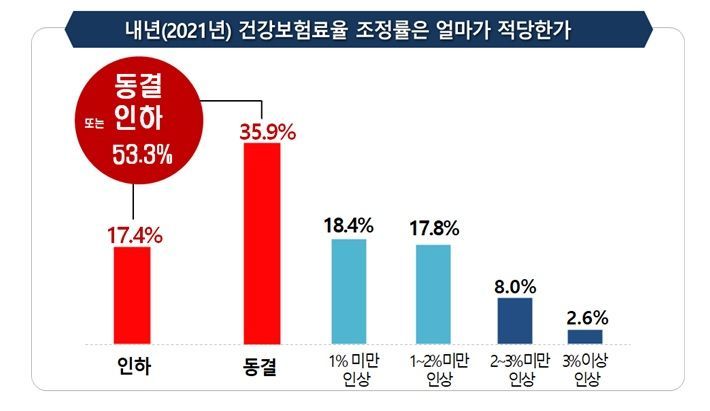
In the survey on the perception of the health insurance premium level, 62.9% of respondents said the current level is "burdensome," while only 7.1% said it is not burdensome. Regarding the premium rate increase over the past three years (2018-2020), 79% of respondents evaluated it as "high," whereas only 0.7% said it was "low."
Additionally, in this survey, 76.5% of respondents disagreed with the government's policy of expanding health insurance benefits (coverage enhancement) and the trend of increasing premium rates. Specifically, the largest group, 39.6%, said that while expanding health insurance benefits is necessary, they oppose premium rate increases, and 31.1% answered that both health insurance benefits and premium rates should be maintained at the current level. Opinions advocating both reducing benefits and lowering premium rates accounted for 5.8%.
More than half of respondents also held a negative perception regarding the sustainability of health insurance benefits. Only 17.4% viewed positively the possibility that the next generation will receive the same level of health insurance benefits, while 55.7% expressed a negative view. This is interpreted as the majority of the public being concerned about the sustainability of health insurance due to rapidly increasing fiscal expenditures caused by population aging and coverage expansion.
The KEF stated, "In the case of health insurance, since the spread of COVID-19 has reduced medical utilization, creating some financial leeway, the government should find ways to freeze the premium burden at the current level by expanding national treasury support and adjusting the coverage enhancement plan."
© The Asia Business Daily(www.asiae.co.kr). All rights reserved.
!["The Woman Who Threw Herself into the Water Clutching a Stolen Dior Bag"...A Grotesque Success Story That Shakes the Korean Psyche [Slate]](https://cwcontent.asiae.co.kr/asiaresize/183/2026021902243444107_1771435474.jpg)
















