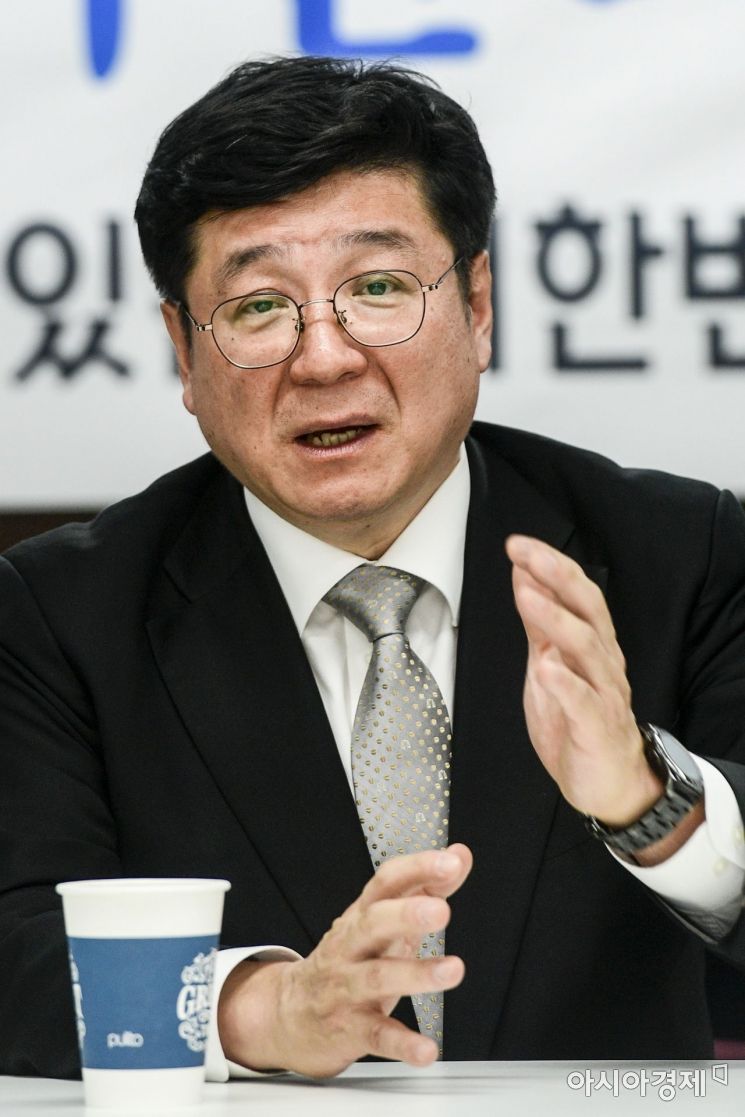
 Lee Chan-hee, who was elected as the 50th President of the Korean Bar Association, is being interviewed on the 25th at Sungin Law Firm in Seocho-gu, Seoul. Photo by Kang Jin-hyung aymsdream@
[Asia Economy Reporter Kim Hyung-min] With the launch of the High-ranking Officials' Crime Investigation Office (Gong-su-cheo) just over a month away, attention is focused on the appointment of the first head of the office.
The selection process for the Gong-su-cheo chief is expected to come to the surface following the Korean Bar Association's recommendation of candidates for the position.
According to the legal community on the 7th, the Korean Bar Association plans to select candidates for the Gong-su-cheo chief at its upcoming standing board meeting and submit them to the National Assembly's Gong-su-cheo Chief Candidate Recommendation Committee.
Considering that the Gong-su-cheo is set to launch on the 15th of next month and that the standing board meets once a week, it is highly likely that the recommended candidates will be finalized on the 8th.
The recommendation committee consists of seven members: the Minister of Justice, the Chief of the Court Administration Office, and the President of the Bar Association each serve as members, along with two members recommended by the ruling party and two by the opposition parties.
The committee requires the approval of at least six members to recommend a candidate for the chief to the President. After the President nominates one of the two candidates recommended by the committee, the appointment is finalized following a confirmation hearing.
The Gong-su-cheo chief must have at least 15 years of experience as a judge, prosecutor, or lawyer, and the mandatory retirement age is 65. Therefore, anyone over 65 cannot be appointed as chief. Additionally, anyone sentenced to imprisonment or higher is disqualified.
For prosecutors, a disqualification period of three years after retirement applies, and for public officials affiliated with the Presidential Secretariat, a two-year period applies. Naturally, active prosecutors or Presidential Secretariat officials cannot be candidates for the Gong-su-cheo chief. Even if they retire immediately, they will only become eligible after 2 to 3 years.
Among those who meet the criteria, Lee Kwang-beom (61, Judicial Research and Training Institute class 13), a lawyer at the law firm LKB & Partners, is strongly mentioned as a leading candidate for the first Gong-su-cheo chief.
Lee, a former judge, is a founding member of the Uri-beop Research Association, known as a progressive group within the judiciary, and has experience investigating former President Lee Myung-bak's alleged purchase of a residential site in Naegok-dong as a special prosecutor in 2012.
Recently, Lee stepped down from his position as the representative of LKB & Partners, which has been interpreted as preparing for the role of the first Gong-su-cheo chief.
However, Lee may face opposition from opposition parties who argue that his involvement with the Uri-beop Research Association and his special prosecutor investigation history make him unsuitable for the Gong-su-cheo chief position, which requires strong political neutrality.
Other candidates mentioned include Baek Seung-heon (57, class 15), a lawyer at the law firm Kyung and former member of the Lawyers for a Democratic Society (Minbyeon); Kim Jin-guk (57, class 19), an Audit and Inspection Committee member; and Kim Nam-jun (57, class 22), a lawyer at the law firm Simin. However, since Minbyeon is known as a progressive organization, there are concerns about political neutrality controversies.
Minbyeon is an organization that former Presidents Roh Moo-hyun and Moon Jae-in were also active in, though both left the group before and after their presidential elections.
Additionally, Lee Jung-mi (58, class 16), a professor at Korea University who served as the acting Chief Justice of the Constitutional Court during the impeachment trial of former President Park Geun-hye, was also considered a strong candidate but has publicly expressed her intention to decline through the media.
© The Asia Business Daily(www.asiae.co.kr). All rights reserved.

















