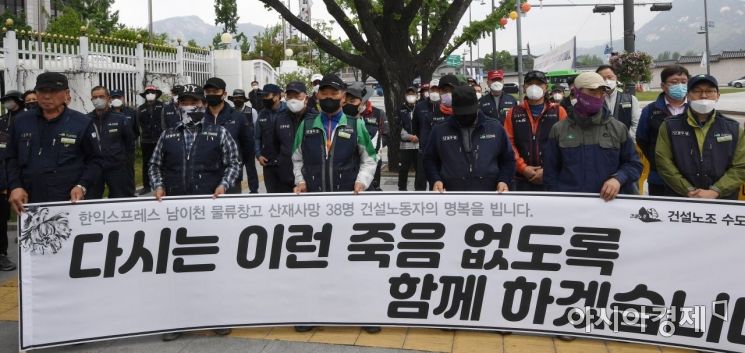
[Asia Economy Reporter Kim Bo-kyung] The government is pushing to increase the sentencing for business owners responsible for worker deaths in an effort to shed the stigma of being the "worst country for industrial accident fatalities." This move reflects calls for stricter punishment standards to prevent serious accidents amid a series of recent workplace fatalities.
According to the Ministry of Employment and Labor on the 6th, the number of industrial accident deaths from January to March this year was 562, a 3.7% (20 people) increase compared to the same period last year. Among them, accidental deaths rose by 5.0% (12 people) to 253, and disease-related deaths increased by 2.7% (8 people) to 309. Despite the implementation of the amended Industrial Safety and Health Act (ISHA) this year, which strengthens penalties for employers when workers die, the number of industrial accident deaths has rather increased.
Looking at accidental deaths by industry in the first quarter, they mainly occurred in construction (131 people) and manufacturing (52 people). By workplace size, small-scale workplaces with 5 to 49 employees (105 people) and fewer than 5 employees (93 people) accounted for many cases. By age group, workers aged 60 and above (110 people) were the majority, and the most common accident type was "falling" (110 people).
"Unless sentencing practices change, current punishment levels will be maintained"
As large-scale industrial accident deaths continue to occur, there is growing demand to raise employer sentences by adjusting sentencing guidelines to enhance safety awareness. The current sentencing guidelines for violations of the ISHA were established in 2016 and classify these offenses under negligent homicide and injury crimes. The amended ISHA provisions have not yet been reflected. It recommends sentencing employers responsible for worker deaths without other aggravating or mitigating factors to imprisonment ranging from 6 months to 1 year and 6 months.
An analysis of sentences for industrial accident injury and death cases from 2013 to 2017 shows that among 2,932 individual defendants, only 86 (2.93%) received imprisonment or detention, while most received suspended sentences (981 people, 33.46%) or fines (1,679 people, 57.26%). Among imprisonment and detention sentences, those between "6 months and less than 1 year" were most common, and the average fine amount was 4.2 million KRW for individuals and 4.48 million KRW for corporations.
Professor Lee Jin-guk of Ajou University Law School said, "When the benefit a perpetrator seeks through their crime exceeds the loss of being caught and punished, it gives the impression that 'committing the crime is worthwhile,' undermining the practical value of the state's crime prevention policies. Despite legal amendments, unless court sentencing practices change, the current level of punishment is expected to be maintained."
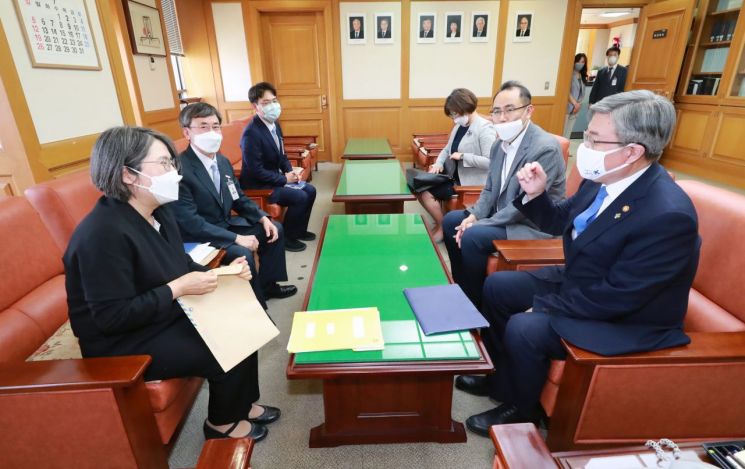
Minister Lee Jae-gap of the Ministry of Employment and Labor meets with Sentencing Commission Chair Kim Young-ran: "Adjustment of Sentencing Guidelines Needed"
The Ministry of Employment and Labor has rolled up its sleeves to raise the punishment level for business owners responsible for industrial accident deaths. On the 3rd, Minister Lee Jae-gap visited the Supreme Court Sentencing Commission and expressed to Chair Kim Young-ran the need to raise sentencing guidelines related to ISHA violations by companies causing worker deaths. The Sentencing Commission sets sentencing guidelines that serve as a "guideline" for judges to derive reasonable sentences.
Minister Lee emphasized the need to raise sentencing standards for ISHA violations, saying, "There is a strong social consensus that strict punishment is necessary for companies causing mass casualties as social values and demands for safety have become very serious."
He also requested, "Unlike criminal negligence causing death or injury due to individual negligence, deaths caused by ISHA violations have the nature of corporate crimes such as inadequate safety management systems. Please set ISHA violation cases as an independent crime category and discuss sentencing guidelines accordingly."
He added, "Fines are the only sanction available for companies violating the ISHA, so appropriate standards need to be established. Considering that the amended ISHA significantly raised corporate fines to 1 billion KRW, sentencing guidelines for fines are necessary."
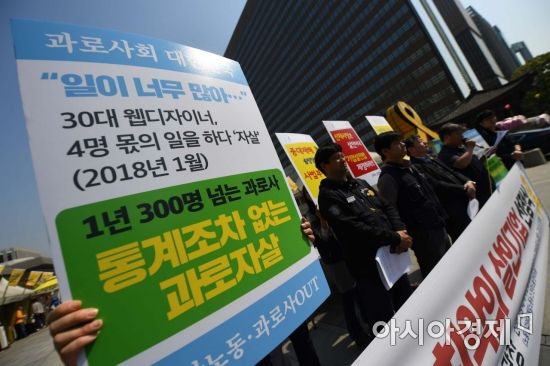 Asia Economy DB=Photo by Honam Moon munonam@
In response, Chair Kim said, "I will work with the Sentencing Commission members to actively discuss ISHA sentencing guidelines during the 7th Sentencing Commission term."
An official from the Ministry of Employment and Labor explained, "Since Chair Kim stated that they will try to discuss this matter within the current 7th Sentencing Commission term, there is a possibility of amendment before the term expires on April 26 next year. Otherwise, a draft will be prepared during this term and finalized at the start of the next term."
Meanwhile, South Korea carries the dishonor of being the worst country for industrial accident deaths among OECD member countries. According to Statistics Korea, as of 2015, the number of industrial accident deaths per 100,000 workers in South Korea was 5.3, ranking third highest among OECD countries after Mexico (8.2) and Turkey (6.9). The United States was next at 4.8, followed by France and Canada at 2.6 and 1.7, respectively.
© The Asia Business Daily(www.asiae.co.kr). All rights reserved.
![User Who Sold Erroneously Deposited Bitcoins to Repay Debt and Fund Entertainment... What Did the Supreme Court Decide in 2021? [Legal Issue Check]](https://cwcontent.asiae.co.kr/asiaresize/183/2026020910431234020_1770601391.png)