[Asia Economy Reporter Koh Hyung-kwang] Samsung Biologics (hereinafter Samsung Bio) and Celltrion, domestic bio rivals, are both continuing their upward trend by hitting 52-week highs. This is interpreted as a result of increased interest due to the COVID-19 pandemic and added expectations for future new drug development.
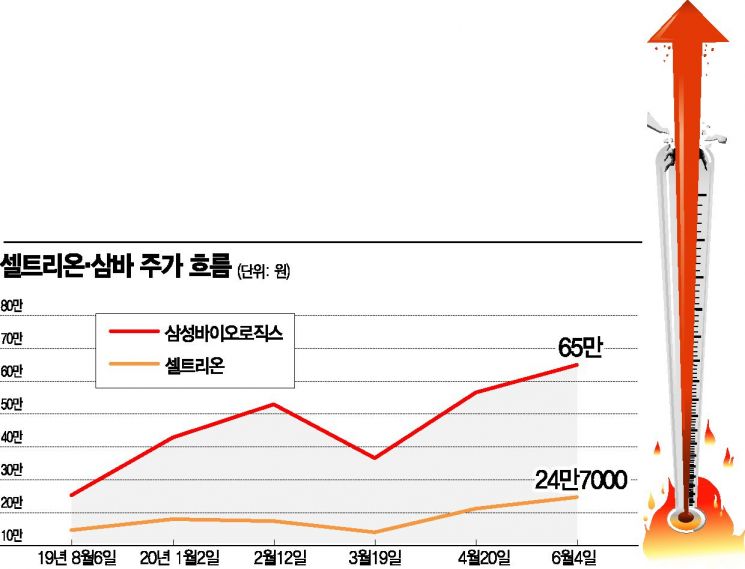
According to the Korea Exchange on the 5th, Celltrion closed at 247,000 KRW on the previous day in the KOSPI market, soaring 8.5% compared to the previous trading day. This is a 52-week high. Compared to the lowest stock price in the past year, 137,500 KRW (intraday) on August 6 last year, it has risen about 80% in 10 months. This year, due to the impact of COVID-19, the price dropped to 140,000 KRW on March 19, but even compared to that, the increase is 76.4%.
Samsung Bio’s rise is even steeper. Samsung Bio rose 3.8% the previous day, closing at 650,000 KRW. This is the highest price since its listing on November 10, 2016. Compared to this year’s low of 366,000 KRW (March 19) and the 52-week low of 241,500 KRW (August 6 last year), it surged 77.6% and 170%, respectively.
The significant rise in the stock prices of the bio 'two-tops,' Celltrion and Samsung Bio, is largely due to the bio industry gaining attention during the COVID-19 phase. Celltrion’s stock price has been gaining strength since it announced in March that it would develop a COVID-19 antibody treatment. Recently, news that Celltrion succeeded in the first stage of a test neutralizing the COVID-19 virus led to a sharp upward curve. In animal efficacy tests of the COVID-19 antibody treatment conducted on ferrets (a type of weasel), the virus was confirmed to decrease by up to 100 times, verifying the drug’s effect. Accordingly, its affiliates Celltrion Healthcare and Celltrion Pharm have also shown recent strength. Lee Dong-geon, a researcher at Shinhan Financial Investment Securities, explained, "Celltrion is developing a COVID-19 tailored new drug, not repositioning existing drugs," adding, "The fact that clinical trials are being pursued in Europe as well as domestically is also reflected in the stock price."
Samsung Bio’s stock price was pushed up by news of large-scale orders. On the 22nd of last month, Samsung Bio signed a pharmaceutical production contract worth 284 billion KRW with the global pharmaceutical company GlaxoSmithKline (GSK). The contract amount is 40.4% of Samsung Bio’s sales last year. The contract period is until the end of 2027, and Samsung Bio will supply large-scale biopharmaceutical production facilities to GSK. Samsung Bio also signed a letter of intent for a contract worth 184 billion KRW for biopharmaceutical contract manufacturing with a U.S.-based pharmaceutical company. This amount could increase to 273 billion KRW through negotiations.
Jin Hong-guk, a researcher at Korea Investment & Securities, evaluated, "Samsung Bio, leaving behind public skepticism due to a 200 billion KRW operating loss in 2016, is now looking at 1 trillion KRW in sales and a 30% operating profit margin," adding, "The orders to be received in the future can be said to be orders for the 4th plant, and the company is securing long-term growth engines."
With the stock price rising sharply, market capitalization also increased significantly. Based on the closing price the previous day, Samsung Bio’s market cap is 43.0072 trillion KRW, and Celltrion’s is 33.33 trillion KRW. They rank 3rd and 5th respectively in the KOSPI market. Their share in the stock market has also grown. Samsung Bio’s KOSPI market cap share was 2.0% at the beginning of the year, ranking 4th, but with the surge in expectations for bio stocks due to the COVID-19 situation, the market cap share rose to 2.98%, moving up to 3rd place overall. Celltrion also rose from 7th (1.6%) to 5th (2.31%).
The future stock price outlook is also bright. Heo Hye-min, a researcher at Kiwoom Securities, analyzed, "Celltrion is the world’s first company to successfully develop an antibody biosimilar and has over 10 years of R&D experience in infectious disease new drugs, possessing know-how," adding, "Based on cash generation from biosimilars, it succeeded in developing the biosimilar better Ramcima SC and is developing infectious disease new drugs, so its fundamentals are gradually evolving."
Hong Ga-hye, a researcher at Daishin Securities, forecasted, "Samsung Bio recently signed large-scale contract manufacturing agreements with global pharmaceutical companies, achieving this year’s order target early," adding, "With mid- to long-term performance improvements and new facility expansion events to follow, the projected average annual net profit growth rate for the next five years is expected to reach 33.8%, and the stock price is also expected to continue a positive trend."
© The Asia Business Daily(www.asiae.co.kr). All rights reserved.
![Clutching a Stolen Dior Bag, Saying "I Hate Being Poor but Real"... The Grotesque Con of a "Human Knockoff" [Slate]](https://cwcontent.asiae.co.kr/asiaresize/183/2026021902243444107_1771435474.jpg)
















