Economic Downturn and Minimum Wage Impact
Household and Nonprofit Revenues Saw Largest Decline in 8 Years Last Year
Fundamental Policies Needed Instead of Loans
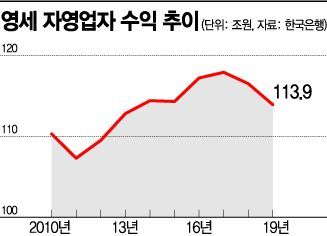
[Asia Economy Reporter Kim Eunbyeol] It has been revealed that the profits of self-employed individuals were already sharply declining even before the outbreak of the novel coronavirus infection (COVID-19). This is analyzed to be due to the economy showing a downward trend as well as the impact of government policies such as the minimum wage. It is expected that the damage to small business owners will increase further due to COVID-19, raising calls for fundamental solutions beyond just loans.
According to the Bank of Korea on the 5th, the operating surplus of 'households and non-profit organizations' recorded 113.9 trillion won last year. This is about 2.6 trillion won less compared to the previous year (116.5 trillion won). In terms of annual change, this is almost the same level as in 2011 (-2.9 trillion won), marking the largest decline in profits in eight years. The year when the profits of small self-employed businesses dropped the most so far was 2007 (-5.3 trillion won).
The operating surplus of 'households and non-profit organizations' mainly refers to the profits of small self-employed businesses. Since 'non-profit organizations' included in the name do not engage in profit-making activities, it practically means the operating surplus figures of 'households,' i.e., small self-employed individuals.
When looking at the operating surplus in terms of growth rate, last year recorded -2.2%, the largest decrease since 2011 (-2.6%). The profit growth rate of small self-employed businesses, which rose to around 2.6% in 2016, fell to 0.5% in 2017, -1.2% in 2018, and dropped further below -2% last year. A Bank of Korea official stated, "It appears that the profits earned by small self-employed individuals were affected by the economic conditions."
The crisis in self-employment can also be felt through service industry production indicators. The production index for the restaurant industry, a representative sector for ordinary people's startups (based on the current index), showed an annual growth rate of only 0.6% last year. After rising 2.7% in 2016, it has been fluctuating around the 0% range. In the case of the lodging industry, the production index turned negative, shifting from a 3.6% increase in 2018 to a 1.4% decrease.
The profits of small self-employed individuals in South Korea surged in the 1990s but collapsed following the International Monetary Fund (IMF) foreign exchange crisis. It fell from 10.8% in 1998 to just above 0% in the early 2000s.
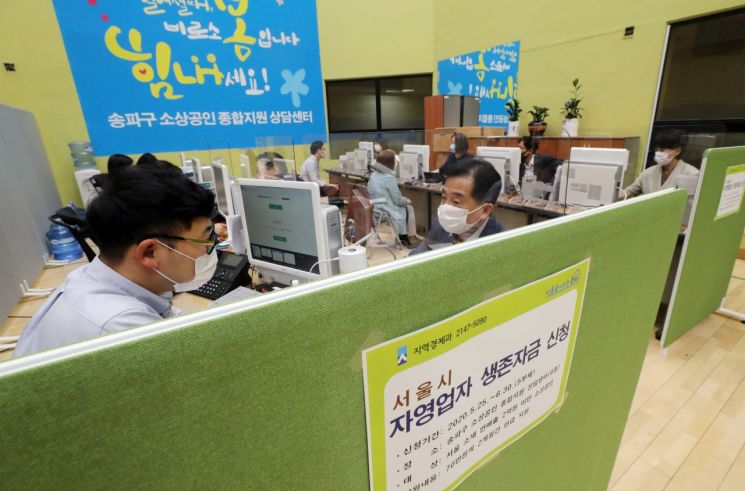
Meanwhile, the situation is more problematic because self-employed individuals are only holding on through debt. According to the Bank of Korea's 'Industrial Loans by Depository Institutions in Q1 2020' statistics, the loan balance in the service industry as of the end of March this year was 776 trillion won. This is an increase of 34 trillion won compared to the end of December last year, marking the largest increase since the statistics began in 2008. By sector, the loan increase was largest in wholesale and retail, lodging, and restaurant industries, totaling 12.2 trillion won.
Experts point out that the minimum wage hike in 2018 was a major factor that pulled down the profits of self-employed individuals. Professor Kim Kyungsoo of Sungkyunkwan University said, "Until now, the operating profits of self-employed individuals had been increasing along with the growth of the Gross Domestic Product (GDP), but the recent decline, especially starting from 2018, is evidence that the significant event of the minimum wage increase had an impact." He added, "We need to reconsider the side effects caused by the excessive increase in the minimum wage and also consider the adverse effects caused by people being pushed out of self-employment."
According to Statistics Korea, the total number of self-employed individuals in South Korea last year was 5.63 million, accounting for 25.1% of all employed persons. The total number of self-employed businesses that closed last year was as high as 586,209.
© The Asia Business Daily(www.asiae.co.kr). All rights reserved.


















