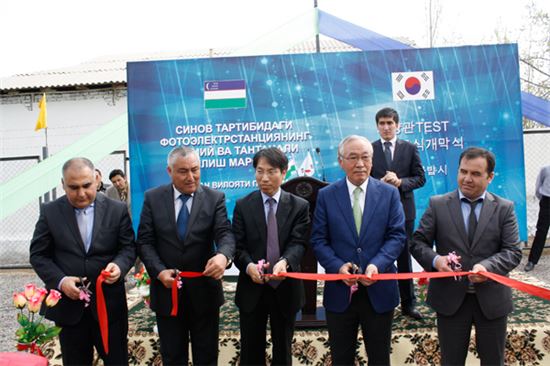
 In the center is Noh Geon-gi, Director of Free Trade Agreement (FTA) Policy at the Ministry of Trade, Industry and Energy, attending as the chief representative of Korea at the 7th Korea-European Free Trade Association (EFTA) Joint Committee. (Photo by Ministry of Trade, Industry and Energy)
[Asia Economy Reporter Moon Chaeseok] The Ministry of Trade, Industry and Energy held the 7th Joint Committee meeting with the European Free Trade Association (EFTA) via video conference on the 5th. They completed the task of updating the rules of origin to the latest product classification system.
This was to review the status of FTA implementation between the two countries on the 15th anniversary of the Free Trade Agreement (FTA) coming into effect.
EFTA is an economic union consisting of Switzerland, Norway, Iceland, and Liechtenstein, which are not members of the European Union (EU).
From Korea, No Geon-gi, FTA Policy Officer at the Ministry of Trade, Industry and Energy, and from EFTA, Markus Schlagenhof, Swiss Trade Agreement Ambassador, attended as chief representatives.
At this 7th Joint Committee, they reviewed the implementation status including changes in trade and investment between the two sides since the FTA came into effect. They also shared FTA policy trends of both countries and discussed major implementation issues in depth.
Both sides completed the work to update the Korea-EFTA FTA product-specific rules of origin, which were based on HS (Harmonized System) 2012, to the latest product classification system, HS 2017.
HS is a product classification system used worldwide according to the HS Convention established by the World Customs Organization (WCO) to unify customs clearance and statistics for international trade goods.
Considering that they conduct long-distance trade, they agreed to allow recognition of origin when exporters and importers store, split, and transship cargo in third countries.
No Geon-gi, FTA Policy Officer, stated, "We will regularly review the FTA implementation status between the two sides to ensure the agreement is implemented without any issues. We will strive to maximize the utilization of the FTA by our companies so that trade and investment between the two countries continue to expand in a mutually beneficial direction."
According to the FTA provisions of both sides, the Joint Committee is generally held every two years.
The FTA between the two is Korea's first FTA with European countries. As of December last year, the export utilization rate of this FTA was 83.2%, higher than the 74.9% of other FTAs Korea has signed.
Trade between the two sides exceeded 10 billion dollars in 2015. Last year, it increased by 135% compared to 2005, before the FTA came into effect.
According to the Ministry of Trade, Industry and Energy, exports led by tariff reductions after the FTA include ships, automobiles, and pharmaceuticals.
Since Norway plans to stop selling internal combustion engine vehicles in 2025, exports of electric vehicles have recently expanded significantly.
Last year, automobile (electric vehicle) exports to EFTA amounted to 458 million dollars, a 27.6% increase compared to 2005. Electric vehicle exports increased from 1 million dollars in 2013 to 324 million dollars last year.
Ship exports increased by 405% to 1.414 billion dollars, and pharmaceuticals increased by 2360% to 123 million dollars.
Imports also steadily increased, focusing on FTA preferential items such as watches, pharmaceuticals, and fish (including salmon).
Last year, watch imports increased by 936.7% to 819 million dollars compared to 2005, pharmaceuticals rose by 326% to 524 million dollars, and fish imports increased by 996.6% to 318 million dollars.
© The Asia Business Daily(www.asiae.co.kr). All rights reserved.
!["The Woman Who Threw Herself into the Water Clutching a Stolen Dior Bag"...A Grotesque Success Story That Shakes the Korean Psyche [Slate]](https://cwcontent.asiae.co.kr/asiaresize/183/2026021902243444107_1771435474.jpg)















