Increase in Employees Postponing or Giving Up Job Change Plans After COVID-19
"Just Holding My Position Is Tough" Workers' Anxiety Amid Employment Freeze
590,000 Decrease in Total Employees Over Two Months
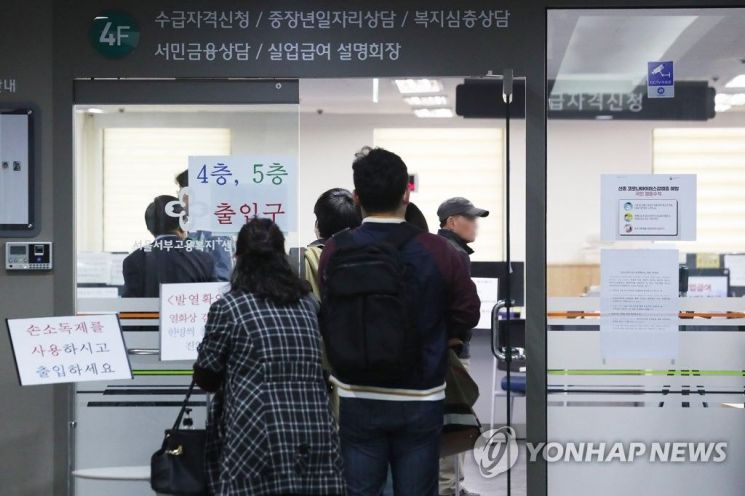 On April 14th, job seekers are waiting to have their temperatures checked at the entrance of the Seoul Western Employment Welfare Center in Mapo-gu, Seoul. / Photo by Yonhap News
[Asia Economy reporters Seunggon Han and intern reporter Juhyung Lim] "No sharp solutions are coming up. Even though it's tough, I have to keep going."
A (29), who has been working at an advertising company for two years this year, gave up plans to change jobs after March. Previously, A was in contact with headhunters to explore foreign companies offering higher salaries and various welfare benefits, but thoughts changed after the outbreak of the novel coronavirus infection (COVID-19).
A said, "In times like these, even holding onto my current position is tough," adding, "I plan to consider changing jobs gradually once the economy improves."
As COVID-19 reached a pandemic stage, causing rapid deterioration of domestic and international economic conditions, the number of workers giving up or postponing job changes increased.
With companies delaying new hires or even reducing employment scales, workers hesitate or give up on seeking jobs offering better working conditions.

On the 27th of last month, job site 'JobKorea' conducted a survey of 478 office workers about 'COVID-19 and job change plans.' Among respondents, 61.0% answered that "due to the COVID-19 situation, they postponed their original plans to change jobs." Additionally, 10.1% said they "gave up changing jobs altogether." More than 70% of workers postponed or gave up job changes after COVID-19.
The main reason workers postponed or gave up changing jobs was the recession in the labor market. "There were not many companies hiring (52.1%)" ranked first as the reason for delaying or giving up job changes, followed by "It seems difficult to change jobs under good conditions (44.7%)" in second place. Third was "It seems like a time to endure at the current company rather than changing jobs (35.6%)."
The actual domestic employment market situation is rapidly worsening. According to data from the Ministry of Employment and Labor, the total number of office workers decreased by 225,000 in March compared to the same month last year, and by 365,000 in April, resulting in a reduction of about 590,000 jobs over two months.
With the global economic contraction severely impacting exports in May, the employment chill is expected to continue. Deputy Prime Minister and Minister of Economy and Finance Hong Nam-ki said at an expanded meeting of the Ministry of Economy and Finance held at the Government Sejong Complex on the 18th of last month, "The shock of COVID-19 will intensify from the second quarter (April to June) and is likely to continue for some time."
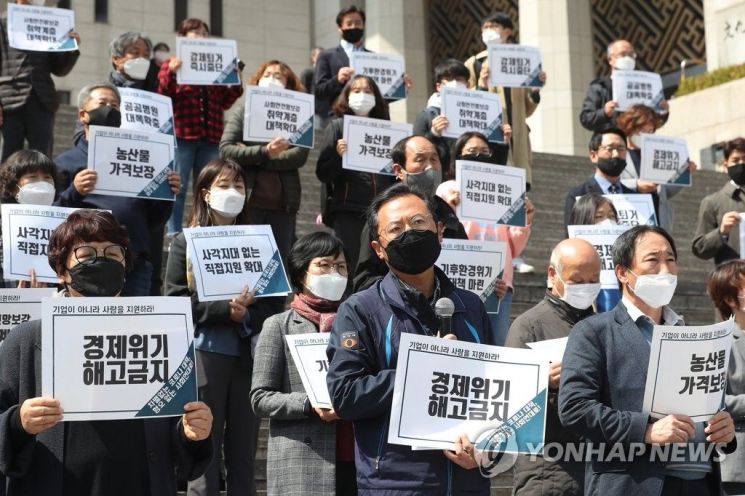 On the afternoon of March 31, at the stairs of Sejong Center for the Performing Arts in Jongno-gu, Seoul, Kim Myung-hwan, chairman of the Korean Confederation of Trade Unions, is speaking at the "Emergency Press Conference on the Position of Religious and Civil Society Organizations Regarding the COVID-19 Economic and Social Crisis Response." / Photo by Yonhap News
Given this situation, office workers have no choice but to lower their expectations even if they intend to change jobs for the time being.
Office worker B (31) said, "Because the work intensity is high and there are many overtime hours, I have always hoped to change jobs," adding, "But now, there are no places hiring additionally, and even if there are, the conditions probably won't be better than where I currently work. Even though it's tough, I have no choice but to keep working."
Another office worker C (28) said, "In the past, I was confident I could take a break from work and return successfully, but honestly, I don't know after COVID-19," adding, "The work I'm doing now could be cut off anytime, so I'm anxious and don't have the luxury to worry about changing jobs."
Meanwhile, the government plans to make every effort to create public and private jobs to prevent the employment chill.
The Ministry of Employment and Labor previously approved the 'Public and Youth Job Creation Plan' at the '4th Emergency Economic Central Countermeasures Headquarters' meeting held at the Government Seoul Office on the morning of the 20th of last month.
This plan involves investing a budget of 3.5 trillion won to supply a total of 550,000 jobs, combining 400,000 public sector jobs and 150,000 private sector jobs.
Regarding this, Deputy Prime Minister Hong said at the '2020 Second Half Economic Policy Direction and 3rd Supplementary Budget Party-Government Meeting' held at the National Assembly Members' Office Building on the 1st, "We will make every effort to ensure swift execution after confirming the economic policy direction for the second half and the supplementary budget," adding, "Especially, we will strive to have 75% of the total budget executed within three months after the supplementary budget passes the National Assembly."
© The Asia Business Daily(www.asiae.co.kr). All rights reserved.



















