Introduction of Smart City Technology Utilization at 'CAC Global Summit 2020'
Participation from Singapore, Taipei, Rome, and Others
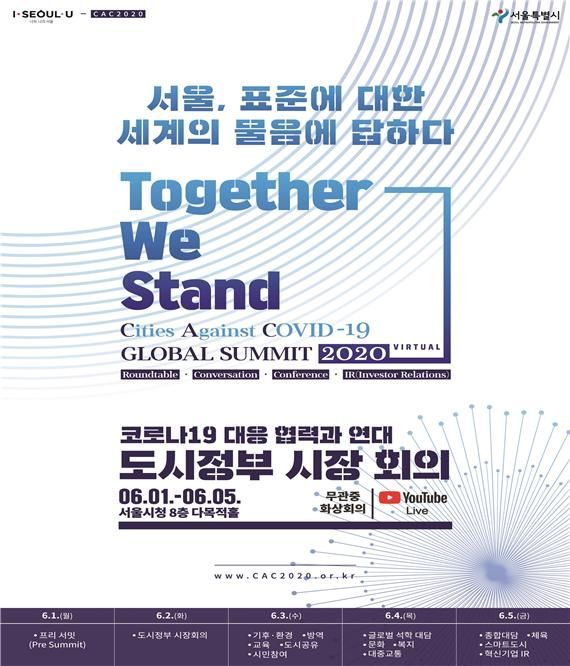
[Asia Economy Reporter Jo In-kyung] On the last day of the 'CAC Global Summit 2020' on the 5th, Seoul City will share cases worldwide of responding to the novel coronavirus infection (COVID-19) using technologies such as smart work, artificial intelligence (AI), and big data.
In this session, moderated by spatial information data expert Professor Heo Jun of Yonsei University, chief information officers (CIOs) and chief data officers (CDOs) from Singapore, Rome, and Taipei?cities actively promoting smart city projects?will also attend to introduce ICT technology-based COVID-19 response cases from their respective countries and cities. Participants will also discuss the development direction of smart cities in the post-COVID era.
Seoul City’s Lee Won-mok, Smart City Policy Officer overseeing smart city policies, will present on "ICT-based Seoul City COVID-19 Response Strategy."
He will introduce smart work cases such as COVID-19 patient and contact screening based on big data, AI monitoring call systems, disclosure of COVID-19 status through the Digital Citizen Market Office, and telecommuting. He will also present the vision of an "inclusive smart city," focusing on guaranteeing basic communication rights for information-vulnerable groups, and explain the six core infrastructures of the Smart Seoul Platform to implement this vision.
From Singapore, Bruce Liang, CEO of the Health Information Systems, a technology agency under the Ministry of Health, will introduce ICT-based strategies that enabled successful COVID-19 responses and share experiences and know-how in adopting various advanced technologies ranging from blocking local infection transmission to providing COVID-19-related medical services.
Hsin-Ke Lu, Director of Taipei’s Department of Information and Communication Technology, will present Taipei City’s COVID-19 response cases based on public-private cooperation and smart city new technologies. Representative examples include contactless mask vending machines, the COVID digital dashboard, and experiences in operating video conferences.
Raffaele Gareri, Chief Data Officer of Rome’s Economic Development Department, will share cases of socio-economic impact analysis of COVID-19 based on floating population and traffic data analysis. He will also introduce Rome’s data-driven smart city promotion direction in preparation for the post-COVID era, along with Rome City’s social media campaigns to prevent COVID-19 spread and support measures for vulnerable groups.
Byun Hyung-kyun, Executive Director of KT AI/Big Data Business Division, will present on "KT’s Infectious Disease Spread Prevention Platform (GEPP)." Based on KT’s experience of first establishing an infectious disease spread prevention platform in 2016, KT plans to conduct research projects over three years, including developing infectious disease spread route models using communication data, funded by the Bill & Melinda Gates Foundation.
Participants in these sessions will then discuss the role, prospects, and measures of ICT for realizing smart cities in the post-COVID era.
Lee Won-mok, Seoul City Smart City Policy Officer, emphasized, "We are entering an era of great transformation where digitalization accelerates due to COVID-19, and non-face-to-face and contactless lifestyles become the new normal. This smart city session will be an opportunity for cities worldwide to share ICT-based COVID-19 response strategies and strengthen global cooperation and solidarity to prepare for the post-COVID era."
© The Asia Business Daily(www.asiae.co.kr). All rights reserved.

















