Ministry of Land, Infrastructure and Transport Defines 'Women of Childbearing Age' as Criteria for Newlyweds
Outdated Perception Viewing Women as Childbearing Tools Persists
Experts Say "Focus Only on Raising Birth Rate... Policies Need to Consider Women's Perspectives"
 The Ministry of Land, Infrastructure and Transport (MOLIT) faced controversy after applying the criterion of "female spouse aged 49 or younger" for newlyweds in the housing survey results announced on the 1st./Photo by Yonhap News
[Asia Economy Reporter Han Seung-gon, Intern Reporter Kang Joo-hee] The Ministry of Land, Infrastructure and Transport (MOLIT) is facing criticism for "sexist standards" after recently setting the criteria for newlyweds based on "women of childbearing age" in the housing status survey results it announced.
The controversy arises from specifying the age of women in the newlywed couple criteria, suggesting that only women capable of childbirth meet this standard. As the backlash spread, MOLIT announced plans to abolish the age restriction criteria.
Experts pointed out that policies considering women's perspectives are necessary to fundamentally resolve the issue of gender discrimination.
On the 1st, MOLIT released the "2019 Housing Status Survey Results," conducted on 60,000 households nationwide, categorizing the housing status of specific groups such as youth, newlyweds, and elderly households separately. In this process, newlywed households were defined as "households married for 7 years or less, with the female spouse aged 49 or younger," sparking controversy.
Women criticized the standard as sexist because it imposed an age limit only on women, not men. The criticism is that the newlywed couple criteria were set based on the assumption that women under 50 are capable of pregnancy and childbirth.
The MOLIT bulletin board is flooded with comments condemning this. Netizens are voicing strong criticism, saying, "Is the ability to have children the criterion for newlyweds?", "Why impose an age limit only on women?", "What kind of perception of women allows such a standard?", and "It's absurd that the newlywed criteria depend on the woman's age."
There are also concerns that the responsibility for low birth rates and non-childbearing is being unfairly placed solely on women.
A in his 40s, an office worker, said, "It's ridiculous to set an age limit when defining newlyweds, but it's even more outrageous to impose it only on women," adding, "Pregnancy and childbirth are not done by women alone, so placing the age limit only on women seems like shifting the responsibility for childbirth solely onto them."
A expressed, "The outdated perception of women as mere tools for childbirth still persists in society; who would want to have children under such circumstances?"
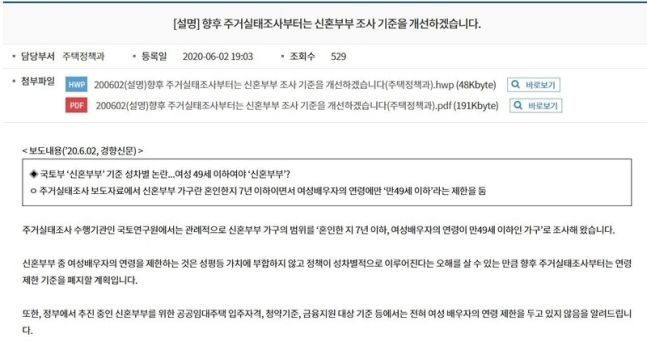 When the criteria for newlyweds in the '2019 Housing Survey' became controversial, the Ministry of Land, Infrastructure and Transport released an explanatory statement on the 2nd / Photo by Ministry of Land, Infrastructure and Transport website capture
This is not the first time that government policies have revealed sexist perceptions toward women.
In 2016, the Ministry of the Interior and Safety (formerly the Ministry of Public Administration and Security) created a so-called "Map of Women of Childbearing Age," showing the number of women aged 20-44 by city, county, and district, which drew heavy public criticism.
At the time, the ministry claimed it was providing local information to residents to raise public consensus on overcoming low birth rates, but faced severe backlash for classifying women based on "childbearing potential," leading to the map's removal within a day.
Despite such past controversies, critics say the perspective on women has not changed. Some argue that these government policies reflect a lack of gender sensitivity.
As the controversy grew, MOLIT issued an official statement on the 2nd, announcing plans to abolish the age restriction criteria.
MOLIT explained, "The Korea Research Institute for Human Settlements, which conducts the housing status survey, has conventionally defined newlywed households as 'married for 7 years or less, with the female spouse aged 49 or younger.'"
It added, "Restricting the age of the female spouse among newlyweds does not align with the value of gender equality and may cause misunderstandings that the policy is discriminatory. Therefore, from the next housing status survey onward, we plan to abolish the age restriction criteria."
Experts emphasized that policies considering women's perspectives are essential to fundamentally resolve gender discrimination issues.
Park Eun-joo, an activist with the Korean Women's Associations United, criticized, "Using women of childbearing age as the standard to define newlyweds shows that policies still regard women as tools for childbirth," adding, "The government is focusing solely on increasing birth rates to solve the low birth rate problem rather than addressing fundamental gender discrimination. This completely ignores women's perspectives."
She continued, "To solve the low birth rate issue, institutional aspects such as the entire childbirth process and childcare systems must be established. The gender equality index is also an important factor. However, societal perceptions and systems regarding women remain trapped within patriarchal frameworks."
Park stressed, "Times have changed, and family structures have also evolved. The perception that marriage is essential has decreased, and not only heterosexual families but also single individuals can have and raise children," adding, "However, all government policies remain confined to the framework of what is commonly called the 'normal family,' the heterosexual family. It is now time to break away from these outdated views and change policies."
© The Asia Business Daily(www.asiae.co.kr). All rights reserved.


















