1-Hour Drive Reduced to 20 Minutes
Estimated Initial Fare: 110,000 KRW for 40km
Market Growth and Autonomous Driving Adoption Expected to Lower Prices
Hyundai Motor's Commitment to Market Development...Active Support
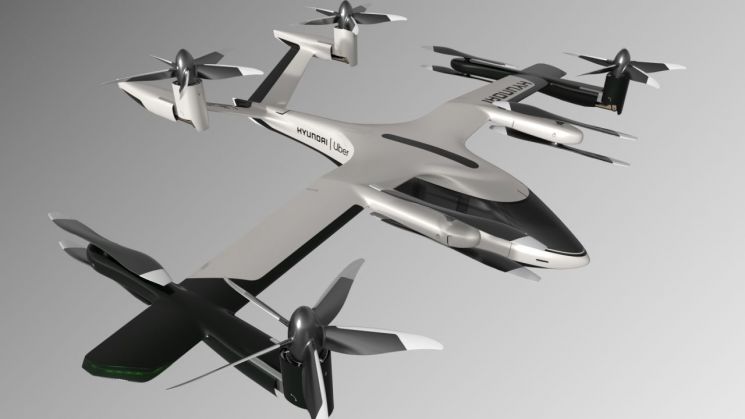
[Asia Economy reporters Moon Jiwon and Kim Jihee] 'Flying taxis' are expected to appear in Seoul within five years. This next-generation transportation mode can cover distances that previously took about an hour by car in just around 20 minutes. Although fares will initially be expensive at around 110,000 KRW for 40 km during the early commercialization phase, it is anticipated that as the market expands and technology advances, fares will become cheaper than regular taxis.
On the 4th, the government finalized and announced the 'Korean Urban Air Mobility Roadmap' at the 2nd Innovation Growth Strategy Meeting held at the Government Seoul Office. This plan represents the government's first roadmap for the Urban Air Mobility (UAM) sector.
According to the government plan, legal and institutional arrangements related to urban air mobility will be completed by 2024, and commercial services on some routes will begin in 2025. The goal is to expand flight routes and establish a system where operators can turn a profit by 2035. Notably, the government aims to enable autonomous flight starting from 2035.
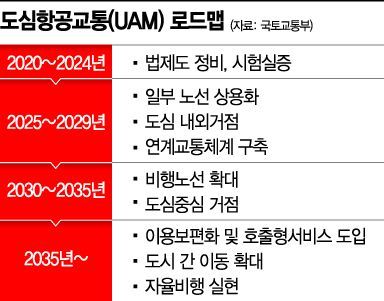
The government has set the initial flight target distance at 30 to 50 km within urban areas. The demonstration routes in the metropolitan area include a route along the Han River from Gimpo Airport to Gangnam COEX and another from Incheon Airport to COEX and Cheongnyangni. While these distances currently take about an hour by car, flying will reduce travel time to just 20 minutes, making it a revolutionary transportation mode.
The Ministry of Land, Infrastructure and Transport stated, "We expect to reduce social costs by up to 70% based on the heavily congested metropolitan area." Integrated transportation services allowing transfers with buses and trains will also be provided. The government plans to link urban air mobility with the construction and promotion plans of complex transfer centers to include it in metropolitan wide-area transportation and will cooperate with relevant local governments.
Fares during the early commercialization phase will be around 110,000 KRW for 40 km (Incheon Airport to Yeouido), which is more expensive than premium taxis. This is due to significant costs involved in aircraft purchase and infrastructure development. However, the government expects that as the market expands and autonomous flight is realized, fares will drop to about 20,000 KRW, making it cheaper than regular taxis.
The government has emphasized safety and convenience to ensure flying cars become part of everyday life. Security screening for passengers will be simplified compared to existing aviation security checks, focusing only on identity verification and hazardous items. UAM terminals (Vertiports) will be built with private capital, and accessibility will be enhanced by utilizing existing helipads on building rooftops. Aircraft will be made safer than current helicopters and equipped with advanced weather and navigation systems to withstand wind, rain, and lightning. Noise levels aim to be around 63 dB, equivalent to normal conversation.
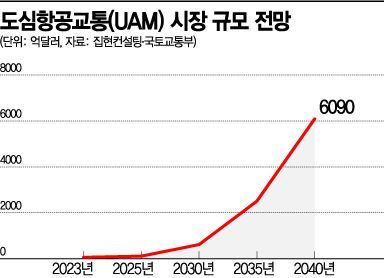
Urban air mobility is expected to operate with autonomous flight using artificial intelligence (AI) from 2035 after technological development and safety certification by aviation authorities. If a comprehensive industrial ecosystem is formed, the domestic urban air mobility market size is projected to reach 13 trillion KRW by 2040 (with the global market size exceeding 730 trillion KRW).
Among domestic companies, Hyundai Motor Group is actively aligning with the government's UAM policy. Earlier this year, Hyundai Motor Group Vice Chairman Chung Euisun presented the vision for the UAM business on the stage of CES 2020, the world's largest electronics and IT exhibition. Hyundai Motor Group has identified three pillars for realizing a human-centered future city: Purpose Built Vehicles (PBV), mobility transfer hubs, and UAM. To this end, they plan to invest 1.8 trillion KRW in UAM-related R&D by 2025 and start full-scale business from 2028.
To secure leadership in the UAM market, Hyundai Motor Group has been actively recruiting talent since the end of last year. After establishing a dedicated team and expanding personnel, in September last year, they hired Dr. Shin Jaewon, a veteran engineer with 30 years of experience in unmanned aviation research at NASA, and expanded the organization into a UAM business division. Earlier this year, they also recruited Pamela Cone, founder of the US aviation consulting firm Ascension Global, and Scott Drennan from US helicopter manufacturer Bell Textron as executive directors in charge of global strategy & operations and development, respectively.
© The Asia Business Daily(www.asiae.co.kr). All rights reserved.



















