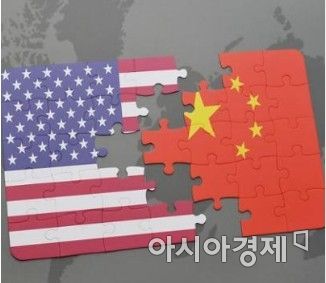
[Asia Economy Beijing=Special Correspondent Park Sun-mi] The United States, which is clashing with China on multiple fronts, is imposing sanctions on 33 Chinese companies starting from the 5th, following a retaliatory ban on Chinese aircraft operations. It is also considering restrictions on Chinese media activities within the U.S. This move comes as tensions escalate around the 31st anniversary of the Tiananmen Square incident, further pressuring China.
On the 3rd (local time), the U.S. Department of Transportation announced that starting from the 16th, passenger flights operated by Chinese airlines will be banned from flying to the U.S. The affected airlines include Air China, China Eastern Airlines, China Southern Airlines, and Hainan Airlines. The Department of Transportation emphasized that, following President Donald Trump's decision, the ban could take effect even before the 16th, increasing pressure on China. The department highlighted that this measure is a reciprocal response to China’s earlier ban on U.S. airlines and stressed that it is not a 'preemptive strike.'
On the same day, the U.S. Department of Commerce also stepped up pressure on China. Last month, citing reasons such as weapons of mass destruction (WMD) and human rights abuses in the Xinjiang Uygur Autonomous Region, the Commerce Department designated 33 Chinese companies and institutions as a 'blacklist.' It announced the sanctions would be enforced starting from the 5th. At the time of designation last month, no specific enforcement date was mentioned. The sanctioned entities include cybersecurity firm Qihoo 360, robot company CloudMinds invested in by SoftBank, and major artificial intelligence companies like NetPosa, among others developing advanced technologies such as AI and facial recognition.
From the 5th, these companies will be unable to access U.S. technology within the United States without government approval. Even products manufactured outside the U.S. cannot be sold to blacklisted companies if they incorporate U.S. technology or content.
The U.S. also plans to expand sanctions on Chinese media. Major foreign media outlets reported, citing sources, that the U.S. intends to designate more than four Chinese state media outlets, including China Central Television (CCTV) and China News Service, as foreign missions requiring asset registration. Once designated as foreign missions, these media outlets must register their assets in the U.S. and obtain prior approval for acquiring new assets. They must also submit lists of all employees, including U.S. citizens. In February, the U.S. designated five media outlets, including Xinhua News Agency, CGTN, China Radio International, and China Daily, as foreign missions.
The series of U.S. sanctions has become more prominent as China pushed forward with the Hong Kong National Security Law and the 31st anniversary of the Tiananmen Square incident coincided on the 4th. On that day, the U.S. State Department publicly revealed that Secretary of State Mike Pompeo met with key figures from the Tiananmen protests. State Department spokesperson Morgan Ortagus, in a statement regarding the Tiananmen democracy protests, said, "We honor the brave Chinese people who peacefully demanded democracy, human rights, and a corruption-free society, only to meet a violent end at the hands of the People's Liberation Army armed with guns and tanks on June 4, 1989. The United States continues to applaud their aspirations." She added, "We mourn the victims and stand with the Chinese people who continue to hope for a government that protects basic human dignity, fundamental freedoms, and human rights."
In China, efforts are focused on blocking any discussion of the Tiananmen incident. On Chinese social media platform Weibo, searches for '6.4,' referring to the Tiananmen democracy movement, have been blocked, and media outlets are refraining from reporting on the incident. Tiananmen Square is under tight security. Police presence and security checks have been increased at nearby subway stations, and foreign journalists have been barred from entry. When asked, "Do you know what day June 4th is?" many Chinese responded, "I don't know what day that is," reflecting how the Tiananmen incident is fading from public memory in China.
The Hong Kong government also banned the annual June 4th memorial rally for Tiananmen victims for the first time in 30 years, citing the prevention of COVID-19 spread. However, the dominant interpretation is that the government fears the rally, combined with protests against the Hong Kong National Security Law, could escalate into a larger anti-government movement. The Hong Kong government declared the rally 'illegal' and deployed over 3,000 police officers and water cannons across the city.
© The Asia Business Daily(www.asiae.co.kr). All rights reserved.
!["The Woman Who Threw Herself into the Water Clutching a Stolen Dior Bag"...A Grotesque Success Story That Shakes the Korean Psyche [Slate]](https://cwcontent.asiae.co.kr/asiaresize/183/2026021902243444107_1771435474.jpg)















