Busan Special Judicial Police Refer 10 Companies to Prosecution
14 Tons of Red Beans, Seoritae, and Soybeans Seized and Destroyed... Smuggling Using Carry-on Limits
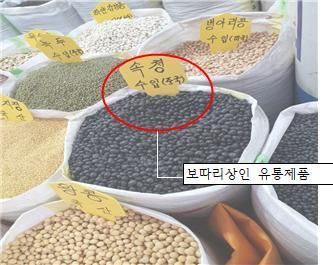
[Asia Economy Yeongnam Reporting Headquarters Reporter Kim Yong-woo] Companies selling Chinese agricultural products illegally brought in by 'bottari merchants' were heavily cracked down on in Busan.
The Busan Special Judicial Police announced on the 4th that they conducted a special investigation into illegal distribution of Chinese agricultural products targeting 58 sales companies, including grain wholesale and retail businesses, and referred 10 companies that violated the 'Food Sanitation Act' to the prosecution.
The special judicial police conducted a special investigation from February to May, viewing that so-called 'bottari merchants' illegally imported and distributed Chinese agricultural products, disrupting the prices in the domestic agricultural market, threatening not only the livelihood of legitimate agricultural product distributors but also the food safety of citizens.
The city plans to investigate illegal bottari merchants and distributors who imported and distributed agricultural products of unclear nationality without undergoing quarantine procedures such as residual pesticide inspections, improve unfair and illegal practices, and enhance trust in food safety.
As a result of this investigation, a total of 10 companies were caught: three distribution and sales companies in Busan and Gimhae that regularly purchased Chinese agricultural products from bottari merchants, five companies that supplied and sold illegally imported agricultural products from distributors, and two companies that distributed and sold imported agricultural products without Korean labeling.
Among them, three distribution and sales companies are suspected of purchasing about 42 tons of Chinese agricultural products from bottari merchants traveling between China and Korea since 2014, storing them in secret warehouses in Gimhae and Busan, and distributing and selling uninspected Chinese products worth about 200 million KRW to traditional markets and rice cake processing companies.
They were found to have regularly purchased Chinese agricultural products from bottari merchants by exploiting the allowable import quantity (40 kg per person) through international passenger ships operating between Incheon, Pyeongtaek, and Chinese cities such as Weihai, Dandong, Yantai, and Qingdao.
On-site inspections revealed that 10 tons of illegal Chinese agricultural products (market value 60 million KRW) were stored in warehouses, and some agricultural products were found to be unsanitarily managed with foreign substances presumed to be rodent excrement.
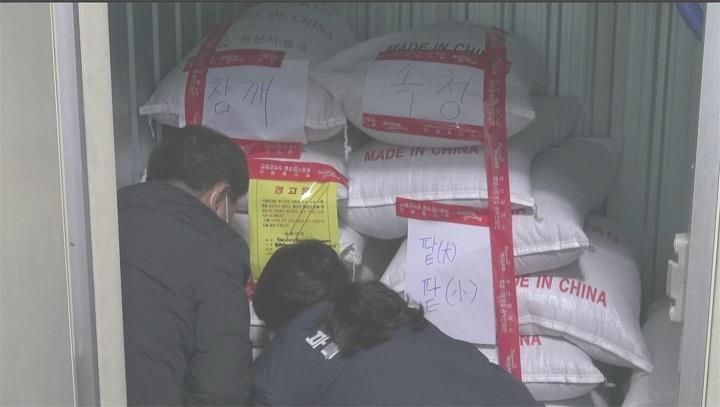
Additionally, five companies were found to have purchased about 44 tons of illegal Chinese agricultural products from three previously caught agricultural product distribution companies since 2013 and sold about 180 million KRW worth to rice cake processing companies and consumers. The city immediately seized about 4 tons of illegal Chinese agricultural products stored for sale on-site.
Two agricultural product distribution companies were caught storing 212 tons of Chinese black beans and buckwheat without Korean labeling in warehouses for sale. In particular, one business is suspected of 'repackaging' Chinese agricultural products and selling them to large agricultural product wholesalers in Seoul, Chungju, and Busan since 2013 without any Korean labeling.
A representative of the city’s special judicial police stated, “We plan to propose institutional improvements to related agencies to block the distribution of agricultural products by bottari merchants who exploit travelers’ baggage allowance,” and added, “We will continue to crack down on illegal imported agricultural product distribution networks for the safety of citizens.”
© The Asia Business Daily(www.asiae.co.kr). All rights reserved.
![User Who Sold Erroneously Deposited Bitcoins to Repay Debt and Fund Entertainment... What Did the Supreme Court Decide in 2021? [Legal Issue Check]](https://cwcontent.asiae.co.kr/asiaresize/183/2026020910431234020_1770601391.png)

















