Announcement of 'Foreign Exchange Service Innovation Plan' at the Innovation Growth Strategy Meeting
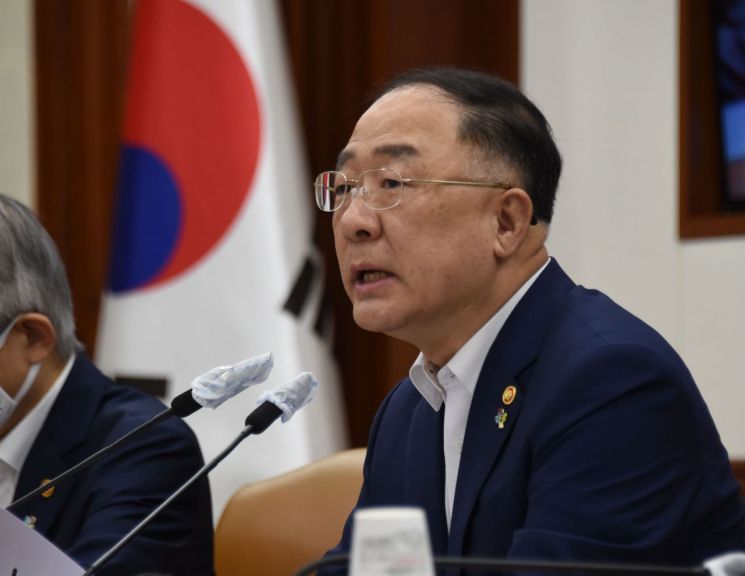 Hong Nam-ki, Deputy Prime Minister and Minister of Economy and Finance, is delivering opening remarks while presiding over the '2nd Innovation Growth Strategy Meeting' held on the 4th at the Government Seoul Office in Gwanghwamun, Seoul.
[Sejong=Asia Economy Reporter Joo Sang-don] From now on, it will be possible to receive foreign exchange payments via delivery without having to visit banks directly. It will also be possible to receive foreign exchange payments while seated in a vehicle at the airport duty-free parking lot through a 'drive-thru' or at the airline counter along with flight tickets.
On the 4th, the government held an Innovation Growth Strategy Meeting chaired by Deputy Prime Minister and Minister of Economy and Finance Hong Nam-ki at the Government Seoul Office and announced the
'Foreign Exchange Service Innovation Plan through Convergence, Non-face-to-face Expansion, and Competition Promotion.'
Deputy Prime Minister Hong explained, "Innovative attempts are focused on convergence and non-face-to-face foreign exchange and remittance services, but entry and business regulations and prohibition of consignment are restricting the spread of qualitative innovation. Therefore, the focus is on expanding competition among foreign exchange service providers and promptly resolving regulatory uncertainties regarding new services to firmly support companies' innovative experiments at the government level."
Until now, the government has restricted foreign exchange and remittance services to banks, foreign exchange operators, and small remittance operators for capital outflow and inflow monitoring and did not allow consignment. Because of this, various innovative foreign exchange services by fintech companies have been limited. Accordingly, the government revised related foreign exchange transaction regulations to allow consignment of foreign exchange tasks within the scope that does not hinder compliance with anti-money laundering laws and financial real-name laws. As a result, customers will be able to apply for foreign exchange and receive payments through various channels such as financial companies other than banks and foreign exchange operators, airlines, duty-free shops, and delivery services. After applying for foreign exchange via a smartphone app, customers can receive foreign exchange payments at home via delivery, or receive payments simultaneously with check-in at the airport airline counter. Also, it will be possible to receive foreign exchange payments through a non-face-to-face drive-thru at the duty-free shop parking lot.
The scope of consignment for overseas remittance tasks will also be expanded. Until now, small remittance services of Company A could only be used by applying through Company A’s app and depositing into Company A’s account. This will be allowed so that customers can apply for remittance and receive payments through various platforms such as nearby financial companies or ATMs. Additionally, sharing of remittance networks among small remittance operators will be permitted, enabling small remittance operators without partners in specific countries to provide services using the overseas cooperation networks of other domestic small remittance operators.
Furthermore, small overseas remittance operators and online foreign exchange operators will be allowed to collect and deliver remittance payments to customers through various channels such as ATMs and counters, similar to banks. Business methods that involve concluding contracts online and collecting and delivering foreign exchange payments offline will also be recognized.
However, such consignment of foreign exchange and remittance is limited within the scope where the use of foreign exchange certificates (up to $2,000) and bank verification and documentation related to remittance (up to $5,000 per transaction) obligations are exempted. In addition to the reporting of transaction details by the consigning institution to the Bank of Korea and the Korea Customs Service, the entrusted institution must also report processing details to the Financial Supervisory Service and the Korea Customs Service through the consigning institution.
A rapid confirmation and exemption system for regulations on fintech companies’ new businesses will also be introduced. The government plans to confirm whether regulations apply and the possibility of future regulations within 30 days in principle, and if necessary, the Minister of Economy and Finance will implement regulatory exemptions through a 'notification' that can enforce separate regulations different from foreign exchange transaction regulations within the scope of laws and enforcement decrees, applying them industry-wide.
To promote competition among foreign exchange service providers, the government has expanded foreign exchange and remittance operations of securities and card companies and eased entry requirements for fintech companies in foreign exchange services. Currently, foreign investors who want to invest in domestic securities mainly exchange foreign currency to Korean won at banks where their accounts are opened. Although foreign exchange transaction regulations allow foreign exchange through securities companies as well as banks, this has not been activated due to lack of awareness among foreign investors and securities companies. Therefore, the government clarified the interpretation of the current regulation that allows foreign investors to remit foreign currency to a securities company’s investment-only foreign currency account opened at a bank, and the securities company exchanges it into Korean won for domestic securities investment, supporting the activation of 'third-party foreign exchange' where foreign investors exchange currency through securities companies instead of banks.
In addition, securities companies will be allowed to provide payment gateway (PG) services and foreign exchange payment services together when performing electronic payment agency operations, and securities and card companies will be improved to handle settlement fund remittance requests from small overseas remittance operators.
Along with this, to maintain business continuity of foreign exchange business institutions including fintech companies and prevent damage to foreign exchange customers, a 'preliminary review of foreign exchange business registration requirements' procedure will be established to review the foreign exchange business registration requirements of newly established (or planned) corporations prior to financial business approval (Financial Services Commission) in cases of fintech company splits or mergers.
Foreign exchange transaction procedures will also be simplified. When prior notification has been made for the first foreign exchange transaction, simple changes such as the notifier’s business name, name, and address will be converted from prior (change) notification to post-reporting. Also, the exemption criteria for submission of supporting documents for export companies will be lowered from $50 million to $30 million in export-import performance in the previous year, and when overseas Koreans remit 'wages for domestic employment,' submission of acquisition reason documents such as pay slips will be allowed instead of source of funds confirmation certificates.
The government plans to immediately implement related authoritative interpretations and complete amendments to the Foreign Exchange Transactions Act Enforcement Decree and related regulations by September.
© The Asia Business Daily(www.asiae.co.kr). All rights reserved.

















