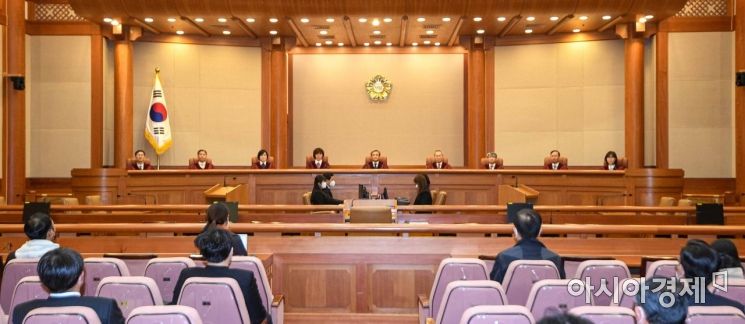
 Chief Justice Yoo Nam-seok of the Constitutional Court is delivering a ruling on the constitutional complaint filed by the family of the late farmer Baek Nam-gi in December 2015, claiming that the police's direct water cannon action violated the Constitution, at the Constitutional Court in Jongno-gu, Seoul, on the 23rd. Photo by Kang Jin-hyung aymsdream@
[Asia Economy Reporter Kim Hyung-min] The Constitutional Court has ruled that the provision of the Land Compensation Act, which punishes with imprisonment or fines those who fail to timely hand over buildings or land designated for redevelopment to the project implementer, does not violate the Constitution.
On the 4th, the Constitutional Court announced that it made a constitutional ruling with a 5 (constitutional) to 4 (unconstitutional) decision in a constitutional review case requested by the Uijeongbu District Court, which asked for a judgment on the constitutionality of Article 95-2 of the "Act on Acquisition and Compensation of Land, etc. for Public Works" (Land Compensation Act).
The relevant provision in the Land Compensation Act stipulates that "if a building or land subject to delivery obligation is not delivered or transferred, the offender shall be punished by imprisonment for not more than one year or a fine not exceeding 10 million won."
The Constitutional Court stated regarding this provision, "For the efficient execution of public projects, land and objects must be secured within an appropriate time," and "if the delivery timing is delayed until the court's final judgment and the appeal process is concluded, there is a risk that the project may be delayed or canceled."
Furthermore, the Court judged that civil lawsuits or fines cannot replace this provision.
The Court emphasized, "Although the obligation to deliver land and objects under this provision is enforced through criminal punishment, rights are procedurally protected and means of appeal are provided," and "it cannot be considered a violation of property rights or freedom of residence and relocation in violation of the principle of proportionality."
In addition to this case, the Constitutional Court also unanimously ruled constitutional on a constitutional complaint case filed regarding Article 43 of the Land Compensation Act, which stipulates the obligation to deliver expropriated land, etc.
Mr. B, who rented a building in Seoul to operate an academy, and Mr. C, who ran a restaurant, were prosecuted for failing to deliver buildings expropriated for public projects to the project implementer by the start date of expropriation and were sentenced to fines in the first trial.
During the trial, Mr. B and others filed a request for constitutional review, arguing that the part of Article 43 of the Land Compensation Act concerning "delivery of expropriated land or objects by landowners and related persons" violated the Constitution, but when the court dismissed it, they filed a constitutional complaint in 2017.
© The Asia Business Daily(www.asiae.co.kr). All rights reserved.
![User Who Sold Erroneously Deposited Bitcoins to Repay Debt and Fund Entertainment... What Did the Supreme Court Decide in 2021? [Legal Issue Check]](https://cwcontent.asiae.co.kr/asiaresize/183/2026020910431234020_1770601391.png)
















